Lab Exam Study - Eukaryotic Microbiology
 Call Kai
 Learn
 Practice Test
 Spaced Repetition
 Match
 Flashcards
 Knowt Play
1/48

There's no tags or description
Looks like no tags are added yet.
49 Terms
Phylum Metamonada (amitochondriate flagellates)
flagellated symbiotic protozoa
no mitochondria

1
Giardia lamblia
Fixed trophozoites in human stool sample
two large nuclei, median bodies and flagella (8)
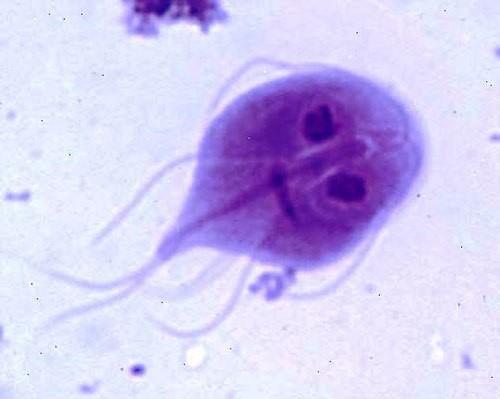
Giardia lamblia
Phylum Metamonada (amitochondriate flagellates)
Intestine of humans and other mammals
Transmitted in water (ingested by humans)
Resistant dormant cysts form when trophozoites enter the colon

2
Chilomastix mesnili
Fixed trophozoites in human stool sample
Teardrop-shaped
nucleus anterior portion (blunt end) cytoplasm
4 flagella projected anteriorly
Chilomastix mesnili
Phylum Metamonada (amitochondriate flagellates)
Found in the human intestine
commensal does not cause disease

3
Trichomonas vaginalis
Fixed trophozotes in human vaginal fluid sample
Spider like
Undulating membrane and 4 anterior flagella
Median rod = axostyle
Trichomonas vaginalis
Phylum Metamonada (amitochondriate flagellates)
found in human vagina, sexual contact transmission (trophozoite)

4
Trichonympha species
Termite gut flagellates (fixed trophozoites from termite gut)
Numerous flagella! NOT CILIA
Trichonympha species
Phylum Metamonada (amitochondriate flagellates)
Essential to allow termites to derive nutrients from wood
Anaerobic environment inside termite digestive system
Die if exposed to oxygen
Phylum Heterolobosa (amoeboflagellates)
Amoeba found in moist soil
Internalize smaller protists and bacteria phagocytosis
heavy rain → ideal → convert to flagellated form to colonize new habitats
Ex. Naegleria fowleri (brain eating amoeba)
Phylum Euglenozoa (euglenozoan flagellates)
Phototrophs (distinct chloroplast remnants of symbiotic green algae)
Osmotrophs (parasites in blood and tissues vertebrates, invert vectors)
Phagotrophs
One flagella arises from cell pocket and one within
flagellates one mitochondria (kinetoplast) LARGE

7
Euglena species
Fixed trophozoites
Two flagella one small and non projectile
One light sensitive eyespot (dark red) near base of flagella
Euglena species
Phylum Euglenozoa (euglenozoan flagellates)
Freshwater protists with chloroplasts
Lack a cell wall BUT rigid pellicle below cell membrane
Movement swim with flagella, slow worm-like euglenoid movement
Phacus
Phylum Euglenozoa (euglenozoan flagellates)
Freshwater

9
Phacus
leaf-like stiff shape

11
Trypanosoma brucei
Fixed stages in smear of human blood
twisted elongated parasites
large in size
Trypanosoma brucei
Phylum Euglenozoa (euglenozoan flagellates)
Sleeping sickness in Africa
transmitted to human by bite of tsetse fly

12
Trypanosoma cruzi
Fixed stages in smear of human blood
C-shaped
smaller than brucei
Trypanosoma cruzi
Phylum Euglenozoa (euglenozoan flagellates)
Chagas disease
South and Central America
transmitted to humans by kissing (reduviid) bug

13
Trypanosoma cruzi
Fixed stages in section of rat heart
replicative stages of parasite in various muscles
abundance of parasites inside of pseudocyst

14
Leishmania donovani
Fixed promastigotes from culture
Leishmania donovani
Phylum Euglenozoa (euglenozoan flagellates)
Human blood and tissue
Causes visceral leishmaniasis (spleen and liver swelling)
Transmitted to humans by bite sand fly
Phylum Dinoflagellata (dinoflagellates)
freshwater and marine protists
phototrophic or phagotrophic
surrounded by a shell of cellulose plates
two flagella protruding from centre of joined plates

16
Peridinium species
Fixed trophozoties
double shell of two cellulose plates
two flagella (one lying in groove of cell) the other projecting
Peridinium species
Phylum Dinoflagellata (dinoflagellates)
freshwater
photosynthetic (none visible chloroplast)
Phylum Ciliophora
cilia
two nucluei
large macronucleus (non reproductive)
micronucleus (reproductive conjugation)
cytostome and oral groove (phagocytosis)
cirri (enlarged cilia)
Paramecium species
Phylum Ciliophora
freshwater
movement of cilia when microbe confronts obstacle (contractile)
1 (live) 2 (fixed)
Paramecium species (fixed)
3
Paramecium in fission (fixed)
4
Paramecium in conjugation (fixed)
Stentor species
trumpet shaped
distinct cilia (ring of oral cilia around cytostome)
attach to substrate by holdfast
hunts paramecium
5 (live) 6 (fixed)
Stentor species (fixed)
Spirostomum species
elongated cilitate
can withstand polluted freshwater and low oxygen
pearl link micronucleus
7 (living) 8 (fixed)
Spirostomum species (fixed)
Didinium species
barrel shaped
cytostome that can enlarge enormously to gobble up Paramecium
two bands of cilia used for locomotion
retracted harpoons near cytostome
9 (live) 10 (fixed)
Didinium species (fixed)
Euplotes species
Cirri arrangement that form which locomotory structures
Walk with precise coordination on substrates
11 (living) 12 (fixed)
Euplotes species (fixed)
Ephelota species
Suctorian ciliate (sucks cellular components of other protists) using tentacles
13
Ephelota species (fixed)
Tetrahymena species
tear dropped shaped
important for studies in molecular biology
14 (living)
Tetrahymena species (living)
Vorticella species
tulip shaped bacteria eater
attaches to substrate via long stalk
retract and coil on its stalk hen startled
16
Vorticella species (fixed)
Phylum Apicomplexa (apicomplexans)
distinct complex - apical organelles used too invade host cells
extracellular stages move by gliding
often two or more hosts, complex lifecycles
Plasmodium falciparum
Phylum Apicomplexa (apicomplexans)
most pathogenic of 5 plasmodium species that cause human malaria
sporozoites injected by Anopheles mosquitoes travel to liver, asexually divide, release 1000s of merozoites into blood
merozoites invade erythrocytes, transform into trophozoites, asexually divide erythrocytic schizont
mrozoites burst and invade new erythrocytes and continue asexually
merozoites become gametocytes that can be ingested by mosquitoes
1
Plasmodium falciparum (fixed in smear of human blood)
ring shaped trophozoites in peripheral blood (dark nucleus and lighter cytoplasm)
gametocytes (sausage shaped) and note the nucleus, cytoplasm and pigment granules
2
Plasmodium vivax (fixed in smear of human blood)
Plasmodium vivax
Phylum Apicomplexa (apicomplexans)