Biology (photosynthesis)
 Call Kai
 Learn
Learn Practice Test
 Spaced Repetition
 Match
Match Flashcards
 Knowt Play
1/18

Earn XP
Description and Tags
exam questions
Name | Mastery | Learn | Test | Matching | Spaced | Call with Kai | Chat |
|---|
No analytics yet
Send a link to your students to track their progress
19 Terms
Explain the role of chloroplast pigments in the light-dependent reactions of photosynthesis (2 marks)
→ absorbs light in chlorophyll so that the electrons are excited
→ for photophosphorylation to take place
describe how GALP, produced in chloroplasts, is converted to protein. (3 marks)
→ GALP is converted to glucose
→ amino acids made from glucose and nitrates
→ amino acids joined by condensation reaction
In a glucose molecule, where in the chloroplasts are these bonds formed? (1 mark)
stroma (why? because the calvin cycle occurs in the stroma, where carbon is fixed and is used to produce GALP, which is used to make glucose)
Explain why amin acids cannot be produced by glucose? (2 marks)
→ glucose doesn’t have nitrogen atoms
→ some R groups in amino acids contain sulfur

E - electron carriers
F - ADP
G - inorganic phosphate
H - ATP
D - light-absorbing pigments/chlorophyll
Explain why light energy is converted into energy stored in ATP. (2 marks)
→ the energy is needed for Calvin’s cycle
→ because ATP is the source of energy for all living organisms
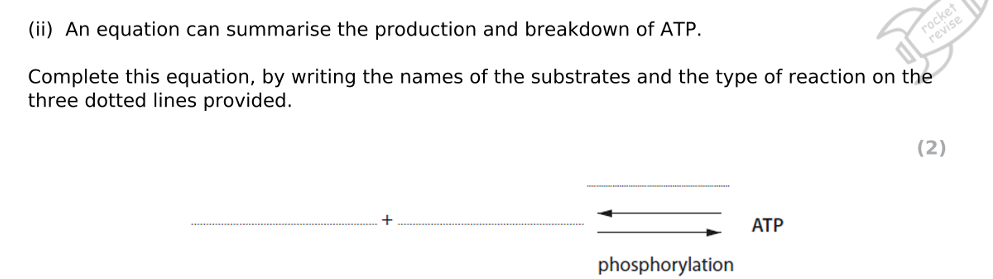
→ inorganic phosphate
→ ADP
→ hydrolysis (bcuz if u split ADP it goes back to those two substrates)
Explain the role of light energy in the light-dependent reactions.
→ to excite electrons in the chlorophyll
→ so electrons can be used in photophosphorylation
→ photolysis to replace electrons that were lost in the chlorophyll for the formation of reduced NADP.

where is GP formed?
answer: Q

What is the correct order of size?
answer: PRS

answer is carbon dioxide for C and O. water for H
remember, they’re asking for inorganic MOLECULES
Why does the species composition of a community change as succession progresses?
→ Species composition changes because the organisms already present modify the environment, making it more suitable for some new species and less suitable for others.
In the evolutionary arms race, how does Mycobacterium tuberculosis evade the host's immune system after being engulfed by a phagocyte?
→ it produces substances
→ this prevents fusion with phagocytic vacuole
What term describes the changes in the surface antigens of pathogens, making previous vaccinations less effective?
Antigenic variation (the ability of pathogens to alter their surface proteins, evading the host's immune response effectively.)
Why is a serial dilution performed before plating a bacterial culture on agar?
Serial dilution reduces bacterial concentration, preventing overcrowding on agar plates for distinct colony isolation.
in turbidimetry, what do you use a calibration curve for?
→ to estimate the cell count of unknown samples by measuring their turbidity

→ (state overall highest/lowest) teenage boys have a higher percentage of firmicutes.
→ (state a similarity between the groups) middle-aged and elderly men have very similar proportions of bacteria
→ (state a general overview) majority of skin flora is made up of the 3 groups.

→ (validity is to ensure a fair test)
→ ensure none of the men are taking antibiotics which can kill skin flora
→ ensure all men live in the same environment