PSY311: Sex/Gender Role Development
 Call Kai
 Learn
 Practice Test
 Spaced Repetition
 Match
 Flashcards
 Knowt Play
1/25

There's no tags or description
Looks like no tags are added yet.
26 Terms
Sex/Gender Role Development
One most important aspects of perceiving the self and others if gender role development
Gender role, sex role terms used interchangeably
One aspect of understanding self and others
I’m a man, what do I see myself as, what does it mean to be a man strong & assertive, or equalitarian or no difference between women, part of understanding of self and the other
Self perception & perception of others: whats my role, what is your role, how do I see myself, how do I see you given how our biological sex is assigned at birth
Gender roles, the process of a child seeing themselves as more feminine or masculine, and identifying with a biological sex that born with, very early developing category
Developmental Timeline (4)
(1) Infancy-Distinguish faces by sex
Evidence in infancy that babies distinguish face by sex
The amount of time a child spends looking at face, tells us their level of interest
If show 2 faces, similar to each other, child might not be interested in second one because similar one and wont look as long but if show novel face look at that more
Show male and female face to child, male face does not have facial hair and both male and female have the same length hair and glasses or not glasses, the child will look longer at 2nd face when second face opposite sex of first dace
In-born ability to tell difference between different human faces by sex
(2) 2 years- Childs able to label by sex
“Im a boy, dads a boy, moms a girl”
Doesn't understand what means but able to see world within categories they are taught
If tell difference between boys and girls by looking at them and certainly once more features used to recognize (facial hair, length of hair way dress) easier for child
(3) 3 years - sex-stereotyping in toy preference
See that even in highly equalitarian
Granddaughter exposed to blocks, trucks, princess dresses, tea parties, no particular agenda, shes a little princess,, maybe because of external things she sees, many girls play with trucks that supposedly masculine none of boys dress like princesses or play tea parties
Even in equalitarian families
Families in 20 years, raise kid genderless, no one know gender of child, yet these kids same as we see over here. Even tho no one knows, notion that its all socially constructed doesn't carry a lot of weight, kids behave in manner consistent with biological sex
4 years: Some rigid stereotypes about occupations
Boys bus drivers, girls are nurses
These things change, not rigid, change over generations
If kid growing up and going on buses and see female bus drivers, more likely to not include bus drivers in rigid stereotype
Very different, in different populations, depending entirely upon what kids see
Conservative societies more stereotyping than in liberal societies
Even in more Liberal societies still get that, workplace is still gender
5 years - association of personality traits with sex
Boys are strong, girls are nice
What is Sex?
Sex - biological dimension of being male or females
More dichotomic than gender, not 100% binary of dichotomist
What is Gender?
Gender - Sociocultural dimension of being male or female.
How people around you feel about it, less precise
More sociocultural, psychological, how feel about it, relayed more to how people around you feel about it
Less precise
What is gender role/sex role?
Gender role/sex roles - set of expectations that prescribe how females and males should think, act, and feel.
Given where you live, your culture, how do people that belong to your particular sex think, act and feel?
What role depends on depends on culture live in, time you live in and what people around you think
What it means to be a male in China, North America and different than male in Saudi aradia in other parts of the world different socioculturally, religiously etc
What is gender role stereotype?
Gender Role Stereotypes - broad categories that reflect our impressions and beliefs about females and males - image of what typical male and female would be like.
Stereotypes think of these as negative, basis for racism, if belong to this particular religious or cultural or racial minority, all people from that group the same. Leads to racism, meet one bad apple, deduct from that all people from that group like the bad able
Stereotypes from broader perspective simply cognitive shortcuts, world complex place, our brain power is limited, so we make many quick judgements in life
Use shortcuts, heuristics, use heuristics a stereotype is one of these. Prone to error because when use shortcuts more likely to make mistakes. Use heuristics to make some quick judgments about things like whether someone a male or a female
For eg. walking on beach, see two adults, same both, both dressed in jeans, belt, white tshirt, holding hands. One has short hair and one has long hair from the back. That’s the only information you have in order to make that judgment as to who is a girl and who is a boy. You are more likely going to use a heuristic, a cognitive shortcut and use that stereotype that in general girls more likely to have long hair, boys more likely to have short hair and you’re going to make that type of assessment
Thats what gender role stereotype is
Role in the home, who provides income, whos greater authority figure in the family, not just physical apparatus. Not basis for racism, manner in which we simplify the world, but prone to error, overgeneralize not everyone fit in that same type of category
How do children display gender roles? (4)
Toy preferences - by age 3 a clear pattern of choices emerges, although boys develop this pattern quicker than girls.
Tends to be that pattern established by age 3
Tends to be more clear for boys than it is for girls
Boys more likely at age 3 to play only with boy toys, girls play with both
Granddaughter play with trucks but also be a princess
Why is that pattern more stronger and weaker for girls not establish such pattern and play with both boy & girl stereotypical type of toys?
Theres more criticism of a boy playing with princess than girl playing truck
Girls do both, boys do only one
Girls encouraged to do whatever they want, live life. Boys not brought up in that same way. “Go girl, go play hockey, go to uni”.
A lot of this is culturally driven, culturally determine, that if women were punished for scolded for playing more games maybe they wouldn't. And if men were not scolded from playing girl games then maybe they would play girl games more
Dads more than moms involved in this sort of thing. Mom will tolerate and will encourage her daughter playing with truck. Dad wont tolerate son putting on a dress.
Dads have more of an agenda
Mom want children to be happy, wear clothing, boy, girl, they’re a kid. Want treat their kids as kids. Men more likely to have special focus on boys
Different dependinging on culture, societies, different families, how male dominated it is. So the more male dominated more see dad having that type of differential thing, no tolerance whatsoever for their son being brought up with anything feminine
Socialization and learning
Personality characteristics - from 2-3 years of age boys are consistently more aggressive.
Boys more aggressive compared with girls, more active with encouragement or without encouragement
Biological differences
Points to biological reasons compared to socialization like in the 1st point
Choice of playmates - between 1-6 years of age there is a steep increase in choice of same sex playmates.
Less today compared to how used to be
If boys are becoming more aggressive, girls wont wanna play with them
Boys want to play rough and tumble, girls don’t
In daycare boys told wrong to play rough and tumble and to behave more like the girls.
Depends on time period, here versus another country, depend upon the type of daycare, whether or not push a particular agenda of sameness between the 2 sexes or let each sex drive the way that they were presumably designed to upon nature
Psychological and behavioural differences between boys and girls become greater during early adolescence
Great differentiation as boys become more aggressive, once go through adolescence, bodies change, rise in testosterone, evolutionary paradigm unfold with true key purpose of what were all about bring babies in the world, then going to have greater differentiation between the two
Think about from lifespan perspective, when babies low differentiation between boys and girls, similar to one another.
People really old, you at their body shape and styles look more similar to one another.
Look at older couples, they look more and more like one another
Differentiation most important during reproductive ages, he needs to be sexually attractive, she needs to be, start in adolescence and peak late adolescent 20s, diminish as window closes of women when they go through menopause.
Gender Role Orientation
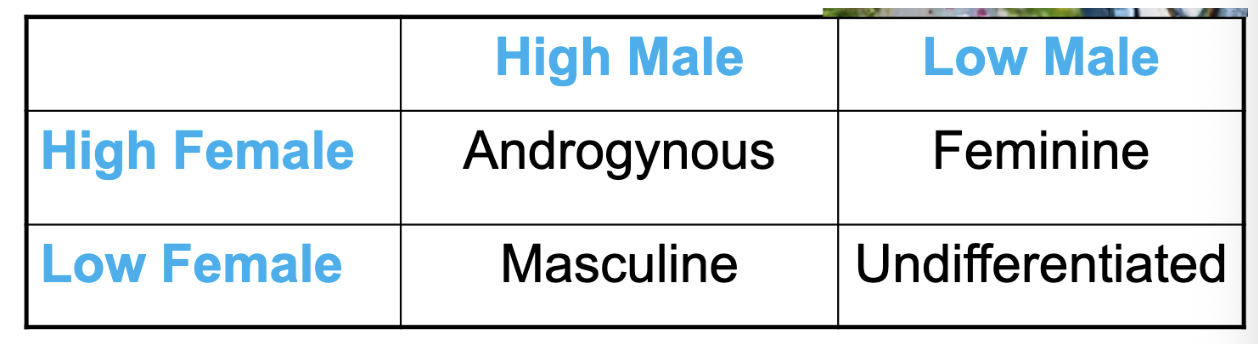
Regardless of what your sex is you may have stereotypical feminine, masculine, androgynous, or undifferentiated traits (Bem 1974, 1981)
Ben 1974, 1981, talked about gender role orientation and came up with interesting terms
Key point is separation of your biological sex and your gender role orientation
NOT identity: gender identity how see yourself as male or female, here are you feminine or masculine?
Regardless of biological sex, may have stereotypical feminine, masculine, androgynous (both), undifferentiated (neither)
If more typical male, biological male, most likely statistically to have masculine gender role orientation
Lots of male characteristics
Tough, strong, assertive, few feminine characteristics, not as kind, not as caring, not as emotional, etc
If biological female more likely to be feminine, few male characteristics, lots of feminine characteristics
Can be both, tough and assertive, strong, confident but also caring, nurturing, emotional: androgynous
OR undifferentiated: very young age, very old age, don’t have a lot of either, differentiated as feminine and masculine during the years during which most highest reproductive
Individual androgynous, regardless biologically male or female are the most adjusted
Having both feminine and masculine traits
Perspective taking, if you have both feminine & masclunine characteristics, understand both perspectives of males and females surrounded, rather than just understanding half world, understand whole world, more well adjusted, better in relationships
Get along easier with everyone: play ball as a women, watch emotional movie as a guy, easier time fitting in with broader variety of different groups
If have broader range of skills, you’re less likely to be outcasted
Both sets of skills might be advantageous in different situations
In workplace strong, confident and powerful and assertive might be good skills so people don't walk all over you
Emotional, caring, nutrition very important at home, when raising children
If your a male and power oriented what relationships with women in your life going to be like? Dont wanna be with guy with no vulnerabilities, emotional or nurturing skills. Guys don't want to be with women walked all over either.
So having the two different sets of skills of both being on the nurturing side, but also conscientious and so on, more typical to individuals that are androgynous.
Some research shows at the end of the day, primarily individuals who have masculine characteristics that tend to be more successful in life.
Paper on being one or the other.
Not atypical, not abnormal for male to be feminine or female to be masculine
Gender Role: Theoretical Explanations
5 key reasons that explain how males develop to be masculine and females develop to be feminine
Don't want to pick one, all make sense, all in part correct
1. Evolution/Sociobiology
Genes
2. Social reasons (Learning and Social Learning)
Environment
3. Psychoanalytic theory
Freud
4. Cognitive Development
5. Gender Schema Theory
Modern version of cognitive developmental theory that incorporates it into social reasons too
1) Evolution/Sociobiology
Males and females have different purposes in life and behave accordingly.
Their genetic endowment is responsible for their different behaviours just as it is responsible for their different physical characteristics
Males purpose in life is to get female pregnant, females purpose in life is to get pregnant and breastfeed their children
Male role is to protect the young family from physical harm for species to survive and next kin to survive.
Equal in terms of right but difference between saying male and females are the same
2) Social Reasons
3 things we can talk about
Learning theories, reinforcement principle
Social learning theory (imitation)
Reinforcement, punishment
Didactic teaching: you’re my own and I give you lessons.
From an early age different parental expectations and treatment (David & Brannon, 1976):
Put these 3 together
Argue theres huge differentiation in how boys and girls are brought up
Boys punished to greater extent from transgression, from not behaving like a boy compared to girls
That's what they focused on, in what way are boys brought up in manner different from the way girls are brought up
1. NO SISSY STUFF
Encourages boys to be as different from girls as possible
Dont be a baby, dont be a sissy, dont be a girl
Negative
Boys strong, boys don’t behave like that
Girls not brought up with no masculine stuff. “Go girl, go do whatever”
2. BE A BIG WHEEL
Encourages boys to be superior to others, to compete rather than cooperate
When look at how reinforce boys, through sport, competition not through cooperation
Girl hockey more cooperative
3. BE A STURDY OAK
This rule encourages male independence and self-reliance
Stoop boys from asking for help when they need it and from feeling comfortable with their emotions
Message boys get from fathers, “boys don’t cry”, many boys have a hard time dealing with their emotions
4. GIVE ‘EM HELL
This will encourage boys to be power oriented, aggressive, ruthless and even violent
Negative, on everybody, on these guys because it encourages these masculine characteristics, makes characteristics like human relationships, sensitivity to others peoples feelings as uniquely feminine, that are completely inappropriate for males to think and feel
Yet we are all human beings, we are emotions
Doesn’t enable them to deal with their feelings, even in their work, make mistake hide it, won’t ask for help, poor way to treating women
What are the sister supposed to feel?
How do these messages work?
Learning theory (reinforcement principles)
Goes back to Skinner and Watson, operant conditioning
Little boy puts on dress, take off that dress or else
Clear reinforcement and punishment for behaviours depending upon whether they are desirable or not
Learning theory: behaviour that's followed by something thats desirable is more likely to increase the behaviour than followed by something less desirable is less likely to increase
Social learning theory (imitation)
Bandura
Observational learning, based upon identification
Learn through observation from people that we identify with. I look up to you, your my role model, I identify from you, role models, mentors very important for that
When comes to gender roles very important boy has father and girl has a mother so that they can learn about themselves in terms of how they will want to behave
Also learning about other gender
Need fathers around, if good father modelling to their daughters what kind of guy their daughter should be looking for
If hes caring, loving, fair, gentle, hardworking thats what girl look for in romantic partners
When dad around to model that, theres a greater chance the girl is going to follow that
Research supports the importance of social learning theory, both same sex and opposite
Didactic
Simple explanations, this is how the world works, theres boys, theres girls, girl do this, boys do that, extreme
Equalitarian would emphasis flexibility and individual decision making in these areas too
So these didactic explanations that parents, teachers provides kid in manner best for kids
Probably not that simply because of:
1. Biological/physiological differences
Doesn't give biology or physiology credit
Scarr all behaviour has some hereditary basis, no credit given here for this
2. Unlikely to be based on simple learning mechanism
Because of the behaviourists were not successful in terms of changing behaviour
Why do we have crime? Were not able to change their behaviour through reinforcement and punishment
Things like habits smoke, drugs, obesity: personal behaviours, hard to change
Behaviour change through learning mechanisms doesn’t necessarily work
3. Little evidence that children select same sex role model for vicarious learning
E.g., someone close to mom, not so much to dad, so then how do I learn to develop male generals, do I need a specific guide I look up to?
It's not that strong evidence that males pick males and females pick females so maybe thats not that important. Maybe enough males out there to see how males behave and whether identify with them or not
Not clear evidence of that same sex role of model, where I identify with someone and now I learned from them
4. Begins extremely early with little reinforcement
Toy preferences start very early, provides evidence for biological reasons and weaker evidence for social reasons
E.g., parents who raise children genderless and still develop roles that are consistent with their biological sex
5. cause and effect?
No cause & effect resources
Cannot identify kids to different conditions, unethical
Cannot assign identical twins to different upbringing conditions, one raise like girl, one raise like a boy, unethical, cannot do that
Establishing empirically very difficult
3) What is Psychoanalytic Theory?
According to Freud Sex-role development plays out as a function of the biological sex of the child, rather than based upon socialization.
Freud’s work consistent with evolutionary theory, a function of child's biological sex (male or female)
Directly related to reproductive processes
Therefore gender, the sociocultural dimension of how boys and girls behave and sexual behaviour itself are essentially unlearned and instinctual
Argued consistent with evolutionary theory, given different roles men and women have, part of that process. Gender way see ourselves, how we see others but also sexual behaviour is unlearned & instinctual.
Young individuals don't have opportunity to learn about sexual behaviour but somehow they managed to figure it out
As evidence of original biological role in all of this
Biological theory, given different roles reproductive processes, gender way see as male and female, but also sexual behaviour unlearned and instinctual
An individual’s sex organs influence their own behaviour and therefore anatomy is destiny.
Freud and Erikson
Males anatomy is their destiny, determines their behaviour and same with female
Relates directly to sexual behaviour of males being dominant, control, males being on top
Where girls are recipient of sex
Relates directly to her more passive behaviour, and his more dominant assertive aggressive behaviour. Shape of organs way people behave during sexual acts that are instinctual and unlearned related to personality, disposition and behaviours of individual
Very consistent with evolutionary theory and sociobiology: we inherit behaviours that will ensure our survival, just like we inherit physical apparatus that ensures our survival
So how does this happen?
Its based upon biological sex of the child, rather than socialization
But the mechanism is very much through socialization
Purpose biological, Mechanism through socialization
According to Freud two types of identification with parents occur:
1. Anaclitic - similar to attachment - usually to mother based upon satisfaction of basic needs.
Similar to what Bowlby later on termed attachment, strong analytical principles
Girls and boys become attached to mom, she was pregnant with them, carried the baby, baby born, attached to mom because of that, breastfeed, more involved in child care
Boy, girl doesn’t matter, its a baby
First type of attachment/identification is similar to Bowlby's attachment, between mom and child
Mom looks at kids like a baby
Between mother to child, given function or role mom assumes in child's life from moment of conception, it doesn’t make difference whether its a girl or boy
Whats different from Bowlby Not talking about proximity seeking like Bowlby but here talking about satisfaction of basic needs (feed, diapered)
Both girl, boy identify with mom
2. Identification with same sex parent as a result of the Oedipal/Electra complex
During phallic period (around 4 years old), child tends to have active sexual desires towards opposite sex parent
Active sexual desires: sexual beings from minute we are born, might be boys seeking more affection from mom, girl from dad
Not actual act of having sex
Context of what child can and is able to think, act and feel given their age of 4 years of age
More in terms of affection
Identifies with a same sex parent, when he or she comes to realize the same sex parent is more powerful.
Ancient greek mythology, pedium and Electra, desire cannot be fulfilled
Boy seeks affection, sexual desire towards mom, dad is more powerful than the boy and will not allow this to happen and vice versa, mom do the same. Punish it, so parent identifies with same sex parent.
Healthy process, at age 4 more towards the opposite sex and the same sex parents will stop that
Both children (boy, girl) identify with mom (anaclytic) but beyond that girl identify with dad, and boy might identify with mom. But stopped during phallic period and result in same sex parent
That Internalization of same sex powerful figure (boy with dad, girl with mom) leads to the internalization of attitudes, behaviours, moral standards of the same sex parent
When boy identify with dad, dad more powerful figure than the boy, internalization of dads attitudes, behaviours, moral standards, same when girls identify with mom
Even al of this is driven by biology, the mechanism is through vicarious learning, girl identifies with mom and internalizes moms values
Mechanism is very social, social learning, Bandura even though the purpose based upon evolution and biology
Why is identification stronger for males?
Saw this in toy preferences, and in games we play
Girls are both princesses and play with trucks, whereas boys only play with trucks
Freud saw that and identification is stronger for males
1. They experience fear of castration
Boys experience this, girls don’t
Threat of castration strong for boys, weak for girls therefore boys better behave in line
If boy and don’t behave like a boy might be castrated
Girls cannot, so nothing to be afraid of, if behave like boy cannot be castrated
Not very convincing argument.
Castration physical way or we can talk about in psychological castration where boy feels emasculated, constantly told off, put down, not strong, not manly, not a leader, taking away ability to see themselves as strong males, form of castration
When look at this perspective, makes more sense
If boy afraid dad will kill him for wearing a dress, but girl not afraid mom is going to kill her for playing with trucks, then male afraid of castration girl not
2. They shift their anaclitic identification with mother to identification with father (the boys)
Girls’ on the other hand anaclitic identification with mother is strengthened due to fear of loss of mother’s love
More confident in their senses about their identity as women, less fragile compared to men
Freud: argued many sex differences stem from differences in the result of the identification process.
In general if the result of Oedipal and Electra Complex are incorrect, so that Oedipal happens and Electra happen, boy remains identified with mom, and girl remains with dad: girl internalize all of dads values & behaviours and boy will with mom
This is a dysfunctional family (according to Freud), a pathogenic family, girl will identify with masculine characteristics & will acquire them and boy will acquire feminine ones
Feminine boy abnormal, masculine girl abnormal all results from inappropriate, lack of resolution of the Oedipal and Electra. Very controversial conclusion.
Freud argued thats a very important process during phallic period, and outcome depends on how resolution
Erikson: Psychological differences between males and females stem from their anatomical differences: Males are more intrusive and aggressive, whereas females are more inclusive and passive.
Anatomy is destiny
Intrusive psychologically too whereas females more inclusive and passive
What are some critiques of Freud’s theory?
1. Experience is not given enough credit.
Child is brought up with different experiences and people, different relationships with females, males, grandparents, that the type experiences may determine who identify with
If dad in military, who is the boy going to identify with? Someone with another family? Male daycare teacher? Is that kid doomed? Evidence doesn’t support notion that boys that grow up in single mom families are feminine, no evidence.
Boy in dual mom family does he grow up more feminine? No evidence showing that, points stronger to biology, consistent with what Freud said.
2. People are more free to choose their gender.
And choose who they identify with
In both femininity and masculinity in our culture & degree to which one is punished
If live in culture punished for being feminine or masculine, if thats inconsistent with biological sex, then might need to be in the closet.
If live in society today, kids somewhat encouraged to think about am I gay? Straight? Female
3. The notion that sexual drives underlie behaviour received little empirical support.
Freud over reliance on sexual drives, drive reduction theory. Maybe post-puberty.
But at age 4 little there’s little evidence to support that at all
Maybe other drives like Bowlby states but not strong evidence these sexual drives play an important role
Cognitive Development
Changes in children’s cognitive capacities underlie the development of sex-typed behaviour
Kohlberg: children cannot be expected to show sex-typed behaviour until they have formed the constant mental representation to understand gender.
Once children grasp this concept they acquire behaviours only if they are consistent with their gender identity.
Biological theory: notion that anatomy is destiny, have different roles in evolution, different functions, body parts, behaviours, all directly related to reproduction
Social reasons: most part boys developing to be boys, socially created & socially determined in many different ways (reinforcement & punishment, observational learning imitation of other, didactic teaching dad teaches son this is how men behave), lessons taught & learned
Freduain theory combination between biological theory & social reasons, agreed with notion anatomy destiny, different purposes in life, happens through identification with same sex parent, when do this aquiring behaviours, feeling from same sex parent, if identify with opposite sex in trouble, boys develop like mom and vice vera
4) What is Cognitive Development?
Dealing with key question: in typical development how do little boys figure out they are boys, see themselves as males, how do young girls grow up to see themselves as girls
Cognitive development sees this as aspect of knowing, of understanding
Two key components of Development of self and others cognitive development (knowing understanding) and social comparisons, learn from others, look at others through social comparison
Focuses on the knowing part, for a boy to behave like boy first needs to understand what its like to be a boy, same for girls, what it entails
Strong emphasis/focus on knowledge
Changes in children's cognitive capacities underlie the development of sex-types behaviours
Need to know before we can act
We make this distinction between understanding, cognitive capacities, whats its like and behaviour thats observable
Boy rough and tough, can observe that so called masculine behaviour, what he thinks about being a male we don’t know, the knowledge part isn’t that observable, behavioural part is
Have to first know before we act
Kohlberg: children cannot be expected to show sex-typed behaviour until they have formed the constant mental representation to understand gender.
If we go back to Piaget develop schema, gradually filled with information through process of assimilation & accommodation, when we’re not able to assimilate that schema, we accommodate, expand to develop new schema. We gradually change way thing of something as new information comes in
Little boy cannot behave aggressively before has that schema, mental representation for what a boy really is like
Until has understanding of what gender like ( girls are this, bots are this, cannot behave in manner consistent with agena)
Once children grasp this concept they acquire behaviours only if they are consistent with their gender identity.
E.g., Little boy, little girl has schema, “boys are such and such”, im a boy seeing different behaviours but only internalize behaviours consistent with what I am
According to Kohlberg knowledge has to come first, so child born with, acquire schema for boy and that schema for a girl
Identify with one of them, then only then, can they acquire behaviours consistent with gender they identify with
Child needs to develop that type of knowledge before they can start behaving in that manner
Cognitive Development
Gender constructs emerge spontaneously and do not need to be taught
Early developing social category useful for classification of behaviour
Children born with this type of understanding/knowledge
Language acquisition certain matters so important, evolutionary focus, human race wont survive without males being males & females being females
Children born with this type of understanding of gender
E.g., granddaughter, parents egalitarian, she’s a princess, not brought up like that, parents don’t push any gender on her. Where does that come from?
Gender constructs there, born with them, they emerge.
Born with constructs
Once this category is filled with relevant information children begin imitating same sex role models.
Gender schema for girl, gender schema for boy kids imitate same sex role models
Consistent with Freud work, boy imitate dad, girl imitates mom
Understanding must happen first
Children may in fact be born with gender constructs but Kohlberg’s time line is incorrect.
Why? Children achieve gender constancy at age 6: gender constancy: gender constant thing, boy today, boy tomorrow, boy in a year, boy forever
Their Gender their psychological concept of gender, how see themselves as boy or girl, is consistent with biological sex at birth
If Kohlberg was right, this would mean wouldn’t show any sex type behaviour before age 6 (gender constancy)
But that is not the case
E.g., Toy preferences, other behaviours that occur much much earlier
More of matter of combination between social experiences & cognitive development
5) What is Gender Schema Theory?
Combination of social learning and cognitive developmental theories.
Child development complex
Cognitive development; how kids gradually change in ability to think, Solman’s perspective taking
But not without social experiences
Had to be combination between the two
Have to acquire that type of information, cognitive ability if not surrounded by people won’t learn
Attaining a clear gender construct is not necessary for sex typed behavior.
Kids start behaving in certain ways without understanding what it's all about
Strong emphasis on information processing aspects of gender schema.
Discussion of how gender schemas change, how they develop
Gender schemas (which are naive theories about males and females) develop early on through social experience.
Gender schemas develop through social experience
Little boy and little boy grow up with mom and dad (e.g., non egalitarian family)
Dad has specific role models, truck driver, goes to work, dressed in jeans, high work poots, lumber shirt
Mom stays home, does dishes, laundry, in a dress
Boy and girl raised in family see what mom does and is like, same with dad. Based on what they see development of gender
Watched Frozen, princess weak, dependant, prince, that saves her, dressed in her dresses, about her being pretty. These messages portrayed in terms of what the kids are watching, very much like that. Learn from friends.
Even in egalitarian Western societies
See these things and develop understanding of word
Have that capacity but not going to understand how the world works without seeing it & developing this understanding
Sex-typed behaviour (act) and attitudes develop along with differentiation of gender schemas (know).
Act behaviour of
Know: understanding of
Develop at the same time
See things, know things, feel things then gradually knowledge comes along with it
Some things we see are inconsistent with schemas
50s old fashion, division of labour now little kid invited to house that egalitarian, see role reversal, new information for them , dad going dishes while mom goes to work
Try to assimilate that information into existing schema, like Piaget said
May not work, if schema rigid of family that does opposite, has to broaden, have exceptions, new schema develop
E.g., Some women are like such and such
Diversity of roles apart of schema
Women have long hair, some do this and this.
Understanding changes with experiences, expereines also change with kids understanding
E.g., niche picking: if girl coordinated and athletic, keep telling parents want to play sports, surround self with more and more role models fo women of doing doing mae things
Seek out, ur going to surround yourself with information, experiences and behaviours that support what you think
Full separation of (act) and (know) is a later development
Lifelong process
When adult male and say to yourself “im a male, im a man, i feel like a man, gender identity is that of a man, I know most men like sports, drinking beer, im not like most males; im different because i dont like to do those things, i like to sew, knit. That would be a complete separation between act and know. Understand how things are like, my behaviour (my act) is different from what typical males are like. Doesnt change about what i think what males do, i understand that im different. Thats the separation of act and know
Argue: Only possible in egalitarian societies were people are able to explore these roles and when being the other not seen as been abnormal
If guy sewing seen as abnormal and beaten up for that, hard to have seperation
Fully developed gender schemas are complex structures that include many components
Include behaviour, physical characteristics, occupations traits associated with a sex
Under this whole thing, the issue of individuals transgender fits in this.
Do gender lessons have to be taught year after year?
Beal (1994): the answer is no. Instead children tend to learn quickly and at certain points in their development, especially when new abilities emerge
It will just happen
If kid exposed to world, even if parents push a certain agenda will see other things
Have these circles like Broffenbrenner, see other kids, go to school, so we learn and understand different perspectives
Two windows of opportunity for new abilities merge, transitionary times of boys learning to be boys, girls to be girls
Considerable learning takes place during the toddler years (1.5-3) when children first make bids for autonomy and begin to talk
Pronoun
Most languages are gendered, have to pick which pronoun going to use
European languages last name for boy and girl different within families
Languages are gendered
Early adolescence is another transitional point - young teens have to cope with change as a result of puberty and expanding cognitive abilities.
Huge hormonal changes, which control behaviour
When child small boy and girl the same
Differentiated when have highest likelihood of procreating
Process of separation: in terms of bodies, thinking, attract member of opposite sex, maturation program makes boys and girls different from one another
Hormonal, physical changes that result from puberty
What theory does this support?
Biological theories: pre-wired, just going to happen
Support needs to be exposed to this.
But need to be exposed to it, like language
Does support the social side:
Not need to teach things but need to be exposed
Biology take over as long as in environment where they have opportunity to learn all these things
Good enough parent as Scarr said
Parenting and Gender Deviancy
Gender deviancy according to Freudian model, feminine boy, masculine girl
Greater emphasis on feminine boy
Masculine girl not as bad
Biological male feminine or vice vera
Early studies of boys who showed extremely feminine behaviours assumed the Freudian model
Biological male feminine
According to Freud this happens pathogenic family, dysfunctional family because a boy rather than identifies with dad, identifies with mom, Oedipus or electra complex not resolved
Deviant child is the result
Assumption was that a boy must learn to denigrate the female, and to downplay the competence of the mother
Notion in order to raise proper boy or be a real boy had to be raised by dad to put down his mother and put down his sister
“Dont be a sissy”
Dad Strong patriarch that runs family and you need to be this too
According to other approaches this is much more explicit.
Modern research shows no consistent differences in parental treatment between such children and control groups.
Gender deviancy appears to be process thats interrelated to many things including…
Child's temperament: genetically determined
Child skinny, sickly, temperament such and such
Might be appearance: child skinny, looks feminine, whose voice doesn’t change when goes through puberty, little facial and body hair
Parental treatment: rather than some specific parental practice
No consistent differences in parental treatment between such and control groups
Gender deviance and nondeviance, feminine boys vs. masculine boys: look at two groups then look at parent, we don’t see no particular pattern, dont see feminine boys raised any differently than masculine boys
See more complicated, related to temperament, child's appearance, to their physical health, parental treatment rather than specific parental practices
E.e., Guy big strong, low voice, huge muscles less likely he’s going to be feminine
Compared to young man late through puberty, short: more likely to be feminine
Maybe some biological underlying in terms of temperament, a lot of things point back to biology
E.g., situation where only child, mom took off, raised solely by dad, People assume knowing and learning affection comes from dad not mom and became gay, but no evidence of this.
Are there differences in moms’ and dads’ contributions to the development of gender roles?
The traditional view of family is that moms provide nurturing and caregiving and dads provide discipline.
Traditional view, not a view all that universal now
Moms’ roles in the home haven’t changed much but dads’ roles have.
Even in our generation not complete 50/50 division of labour, women end up doing more
May have careers, more likely mom taking care of mom attending than that
Although women increasingly pursue education and careers, they often continue to perform a larger share of childcare and domestic responsibilities.
Fathers have become more involved in household tasks and caregiving.
However, many families still do not have a completely equal division of labour
Block (1976) suggested that dads would be more important to the sex-role development of children than moms
This notion is based upon Johnson’s reciprocal role theory (1963, 1975).
Fathers were believed to differentiate more strongly between sons and daughters.
Mothers were thought to focus primarily on caregiving regardless of the child's sex.
Mom is a mom, brought child, nurture that child
Fathers were therefore expected to play a greater role in reinforcing gender-specific behaviours and expectations.
Dad doesnt have same connection
More involved in education, discipline
Greater change dad provide that differentiated, more so with boys than girls
Whats some evidence that suggests that dads would be more important to the sex-role development of children than moms?
Dads’, but not moms’ sex-stereotyping is evident from the newborn period, even when no behavioural differences are apparent (Barry, 1980, Lynn, 1979)
Mom dress boy in pink pajamas
Dad comes home and upset
Differentiation, bother dad than mom
Less today than 1980s, depends on how egalitarian family is , culture
Dads’ are more likely to show sex-specific differences than mothers, however, the direction is contradictory among a large number of studies
Dads more likely to treat boys and girls differently than moms, moms more likely to treat boyd and girl sthe same
Studies contradictory
All show moms treat boys and girls similarities
some studies show dad give more attention to boys whereas others show more given to girls
Moms more consistent
Some studies find that fathers give more attention to sons.
Other studies find that fathers give more attention to daughters.
Mothers generally demonstrate more consistent treatment of sons and daughters.
Both parents are more involved and attached to same sex than to opposite sex children, an effect that’s especially pronounced with fathers (Dickie, 1987 and others).
Mothers may show greater involvement/attachment with daughters.
Fathers may show greater involvement/attachment with sons.
The tendency is particularly strong among fathers.
Parents are more permissive with opposite sex than with same sex children.
Fathers tend to be more permissive with daughters.
Mothers tend to be more permissive with sons
If girl asks dad to go out, dad more likely to say yes, less likely to say yes to her brother
Parents are more restrictive and cognitively challenging with same sex children.
They may establish stricter rules and expectations.
They may be more likely to enforce responsibilities.
They may engage children in discussions and reasoning about appropriate behaviour.
A father may insist that his son complete homework before going outside.
He may discuss why completing homework is important and challenge the child's reasoning.
He may be more permissive when responding to the same request from his daughter
Parents sing to same sex infants using a more playful style and use more baby talk.
When dad sings to son greater effort, than daughter
Same thing with women
Recorded parents singing to their childe, infant directed or non infant direction, holding baby or not holding
In general, when sang to baby when holding sang with more playful type of style, more baby talk, intonate, greater expression
Parents singing to same sex infants used more playful style and baby talk
When dad sings to son greater effort than to daughter
Moms less pronounced
What are some Conclusions?
General tendency for parents to be more involved with same sex children and thus provide a greater opportunity for them to learn appropriate sex roles.
General tendency for moms to spend more time and be more involved in their children’s lives than are dads.
Moms’ treatment of their children is less affected by child sex than dads given their primary focus on caregiving and nurturing.
Recent articles: Minimal support for the uniqueness of the dad’s role in the development of appropriate gender roles.