eco test 1
 Call Kai
 Learn
Learn Practice Test
 Spaced Repetition
 Match
Match Flashcards
 Knowt Play
1/63

There's no tags or description
Looks like no tags are added yet.
Name | Mastery | Learn | Test | Matching | Spaced | Call with Kai | Chat |
|---|
No analytics yet
Send a link to your students to track their progress
64 Terms
Aristotle
Scala natura hierarchy (ancient greece 384-322bce)
robert hooke
microscope, bacteria & protists (enlightenment)
anton lee
bacteria and protists (enlightenment)
Jean Baptiste Lamarck
transformism (1774-1829)
george cuvier
paleontology, comparative anatomy
thomas malthus
economist, human population growth
alfred wallace
conducted field studies in south east asia, developed ideas on evolution very similar to Darwin
epigenetics
study of dna modifications that alter expressions
uniformitarianism
Hutton-the idea that geological processes have been occurring at roughly the same rates throughout time
james hutton
founder of modern geology
eugenics
The science of improving a human population by controlled breeding to increase the occurrence of desirable heritable characteristics.
adaptive radiation
The diversification of organisms that occurs when many niches are vacant
theory of evolution
All living things that exist today are descended from a common ancestor and adapt to their environments over time through the process of natural selection
theory of evolution explains…
homology, vestigial structures
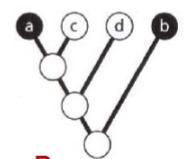
homology
taxa inherit the same trait from a common ancestor

analogy
taxa independently evolve the same trait
microevolution
a change in allele frequency within a population over generations
macroevolution
describes evolutionary changes and patterns at or above the species level, especially things such as speciation and extinction
biological species concept
Species are determined by whether or not they can mate and produce fertile, viable offspring
horizontal gene transfer
involves the transmission of DNA between different organisms pr species as opposed to between parent and offspring
transduction
the horizontal transfer of DNA via viral vectors

conjugation
The transfer of genetic material between bacterial cells by direct cell-to-cell contact or by a bridge-like connection
transformation
Picks up DNA from the environment. No virus is involved
gene flow
The movement of alleles between populations. occurs via immigration or emigration and dispersal of gametes or seeds
genetic drift
chance reduction in population size, which results in changes in allele frequencies within a population
bottleneck effect
A reduction in population size caused by the survival of a random subset of the population following an environmental event
the founder effect
a small population that occurs as a result of the migration of a subset of a few individuals into a new geographic location
disruptive selection
When possessing either of the extremes of a trait is more adaptive than possessing the average trait
natural selection
can cause some phenotypes to be favored over others, causing changes in survivorship or fecundity
stabilizing selection
When extreme variants are less fit than intermediate types
directional selection
when variants at one end of an extreme are favored over variants on the other end of the extreme
sexual selection
can cause some phenotypes to be favored as mates over other phenotypes
Hamilton rule
A gene for altruism will spread only if the loss of direct fitness or the altruist is offset by the indirect fitness gains
eusociality
social strategy characterized by cooperative brood care
systematics
the branch of biology that focuses on
the identification and classification of species, and
their phylogenetic (evolutionary) relationships.
Taxonomy
a sub-branch of systematics that
focuses on classifying species and curating
taxonomic nomenclature
Cladistics
a sub-branch of
systematics that focuses on resolving evolutionary
relationships
carl linnaeus
Created our modern system of
taxonomy, including binomial
nomenclature
rules of taxonomic nomenclature
scientific name, genus name, species name, ranks above species
Sister groups
taxonomic pairs that share a common
ancestor

Polytomy
an un-resolved branch-point in a tree that
indicates we are unsure about which of 3 or more taxa
diverged first

Plesiomorphy
The original, ancestral
state of the characteristic
Apomorphy
The changed, or derived
character state
Synapomorphies
apomorphies shared by multiple taxa due to
common ancestry

Homoplasies
apomorphies shared by multiple taxa due to
convergent evolution
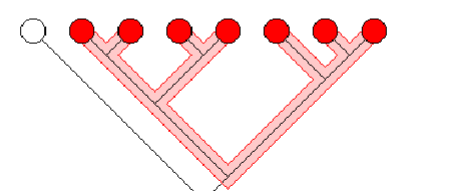
monophyletic group
a taxon that includes the ancestor and all of its
descendants
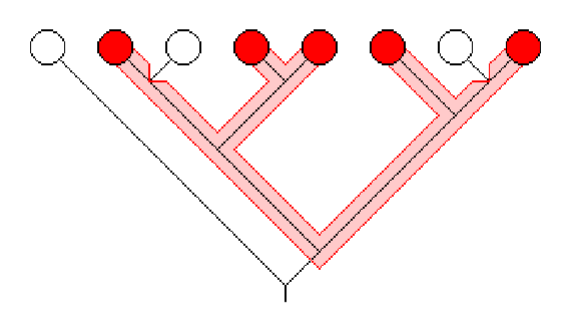
Paraphyletic taxon
a taxon that includes the ancestor and some but not
all of its descendants
Allopatric speciation
•occurs when reproductive isolation occurs due to geographic isolation. When the barrier is removed, individuals can no longer interbreed.
Sympatric speciation
•occurs when reproductive occurs while populations are geographically overlapping
Prezygotic barriers
block fertilization from occurring
Postzygotic barriers
prevent the hybrid zygote from developing into a viable, fertile adult
Habitat isolation
Two populations occupy different habitats, and so encounter each other rarely or never.
Temporal isolation
Populations that breed at different times of the day, different seasons, or different years cannot mix their gametes
Behavioral isolation
Courtship rituals and other behaviors unique to a population are effective barriers
Mechanical isolation
Morphological differences can prevent successful mating
Autopolyploidy
occurs when an organism exhibits multiple (>2) copies of its genome
Gametic isolation
Sperm of one species may not be able to fertilize eggs of another species
Reduced hybrid fertility
Even if hybrids are vigorous, they may be sterile
Hybrid breakdown
When first-generation hybrids are viable and fertile, but their F2 offspring are sterile or inviable
Proximate causation
The physical or molecular mechanisms underlying traits and behaviors (the
“how”; “zooming in”)
Ultimate causation
The ecological or evolutionary context that explains traits and
behaviors (the “why”; “zooming out”)
Abiotic Environment (non-living)
Physical factors: temperature, light, relative humidity,
precipitation etc.
– Chemical factors: pH, oxygen, nitrogen, phosphorus
Biotic Environment (living)
Other organisms (conspecifics and heterospecifics)