Art History Unit 3
 Call Kai
 Learn
 Practice Test
 Spaced Repetition
 Match
 Flashcards
 Knowt Play
1/98

There's no tags or description
Looks like no tags are added yet.
99 Terms
Minoan Culture
Bronze Age
1700-1400 BCE
Minoan Culture: Crete
main island of this area
Sir Arthur Evans around 1900 gets disks with unknown writing and rediscovers the culture here
Goes to excavate and finds entire palace
The Minoans
Development of monumental administrative centers
“Palaces”
ceremonial, religious structures
Part of trade network with Egypt, Cyprus, Levant, Anatolia, and Mesopotamia
Luxury items among elite: eggshell thin pottery, lively painted rooms, flushing toilets, drainage
3 Types of Writing on Crete
Linear A
Mosty incised on clay - very linear
1st form of writing on island
We can’t translate it
Likely for economic purposes
Linear B (Mycenaean)
Similar to linear A but dated later
Developed from linear A
Used to write early forms of Greek
Hieroglyphic script
Cannot read this either
“Palaces” Minoan Culture
administrative centers
1700-1400 BCE
Knossos is first to be excavated
6 throughout the island of Crete
Hierarchical?

Name, Date, Location, Period
Reconstruction of the palace complex - Knossos Palace
1700-1400 BCE
Knossos, Crete
The Minoan Culture
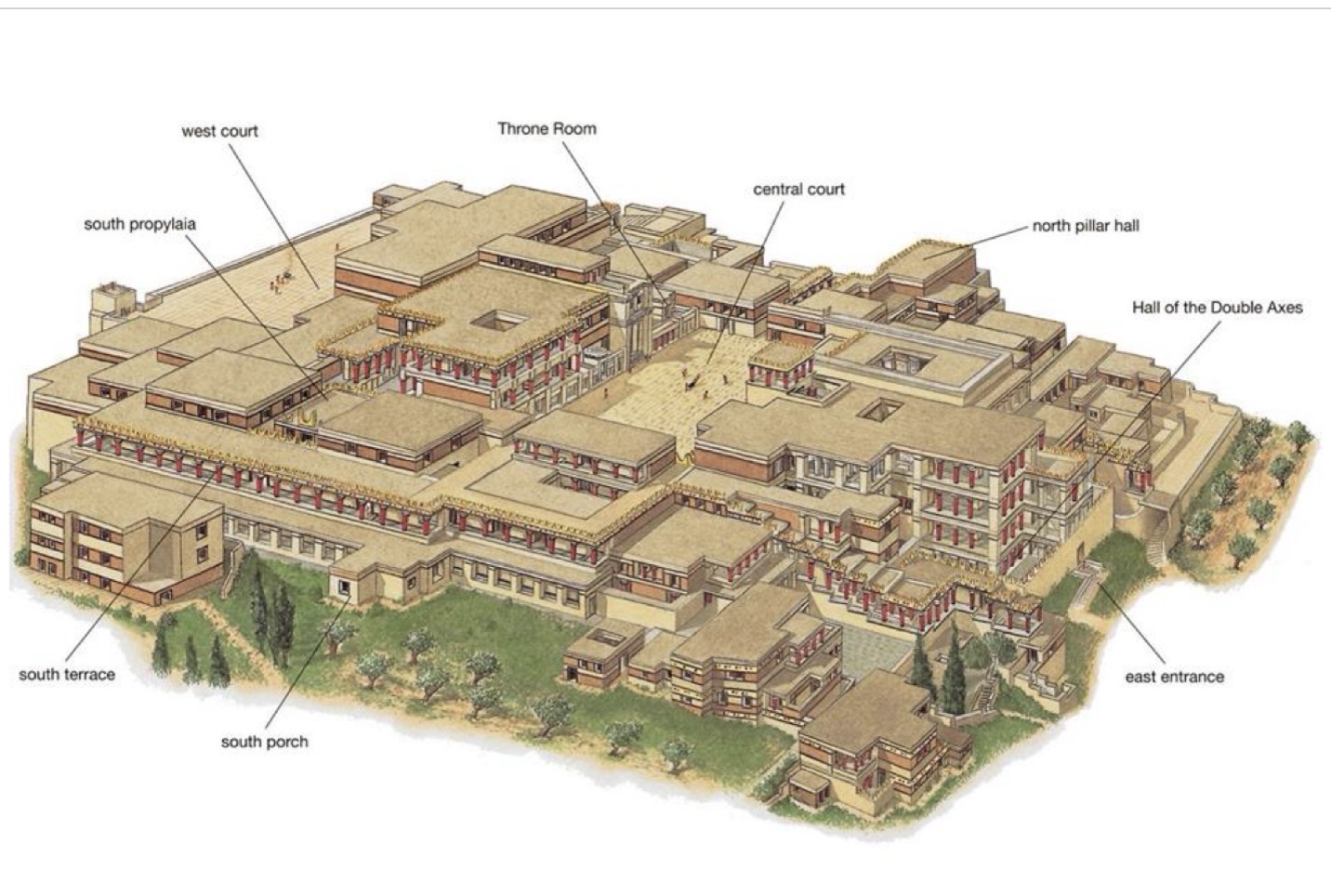
Notes on this image
no walls - on low lying hill - defensive
surrounded by fertile land
family of ruler of Knossos lived here along with high up officials
2-3 stories tall
columns painted brightly everywhere
central court in center
no main entrance - defensive

Name, Date, Location, Period
Bull-leaping Fresco
1450-1400 BCE
Palace at Knossos, Crete
The Minoan Culture

Notes on this image
painted while fresco is wet - wall painting
2 standing white skin, 1 leaping reddish skin - what does it mean? - gender? - all in same male dresses and hairstyles
Pastels and earth colors- very abstract border - rocks?
Humans are stylized and elongated
VERY tiny waist and big belts
Composite view
In North Entrance to court
Did the bull leaping happen in the community court?
Knossos Palace Throne Room
1st room found and excavated
Griffins flanking throne for protection?
Small room
Bathtub - ‘lustral basin’
Shows that ruler also has religious power
Likely used for religious reasons
Columns taper toward bottom

Name, Date, Location, Period
Snake Goddess
1600 BC
Palace at Knossos, Crete
The Minoan Culture

Notes on this Image
Buried religious objects under floor of shrine
Many statues of women- also lots of cups
Brandishing snakes - shows divinity
Snake goddess?
Very fancy dress with wasp waist
Breast exposed - normal for all Minoan elite women
Votive gift? cult statue?
Goddess or priestess?
Mode of Faience - perfected by Egyptians and maybe learned from them
Knossos Palace Magazines
storage area
inventory
collecting and distributing goods
Knossos Palace - Residential Quarters
Like apartments
Light goes down to bottom because of rotating stairways around a light well
Features of Minoan Palaces:
Architecture
Central courtyard
Throne room
Lustral basin
Magazine
Residential quarters
Bathrooms, flushable toilets, drainage system
Shrines
Urbane, sophisticated culture
fashion, music, peaceful themes, lots of nature, jewelry and gold work, stone vases, trade
Covered with frescoes and decorative architecture
Knossos Palace and others - Functions
Administrative
Seat of Ruler
Economic: redistributive centers
magazines and storage vessels for manufacture and storage
Linear A tablets
Seals
Ceremonial/Religious
Shrines
Sacred votives and objects
Lustral basins
Iconography

Name, Date, Period
Harvester Vase
1500 BC
The Minoan Culture

Notes on this image
Rhyton
Used to pour out religious libations - religious use
Carved reliefs into stone - likely learned from Egyptians - very difficult
Depicting harvest festival
Carrying wheat
Smiling and laughing and singing
Holding sistrum - Egyptian instrument
The Mycenaeans
Late Bronze Age
1600-1200 BC
worship some gods/goddesses
Mycenaens were bureaucrats
Very war like with each other and others
Sir Heinrich Schliemann
Mycenaean culture was forgotten then rediscovered
Finds world of Troy
Goes to Mycenae and finds it
Linear B and Michael Ventris
Michael Ventris solves Linear B translation
Proved that Linear B was used to form Greek
How are they related to Minoans and Greeks?
Writing accounts/inventories
no poems, Homer, etc.
Mycenae
one of largest citadel- each is independent
citadels usually on hill + surrounded by fertile plane
fortified with wall
monumental gate
Mycenae “Rich in Gold”: the shaft graves
2 grave circles - 1 later incorporated into wall

Name, Date, Period
Mycenae
1400 BC
Mycenaen Period

Name, Date, Age, Location
Grave Circle A with shaft graves
Mycenae
1600-1500 BCE
Mycenaen Period

Notes on this Image
1st evidence of Menaens
Very wealthy - lots of power
Come from Europe region (Transylvania)
Powerful families buried here likely royal
Had gravestones but no writing
each shaft held multiple people: men, women, and children

Name, Date, Age, Location
Grave Circle A with Shaft Graves
Mycenae
1600-1500 BCE
Mycenaen Period

Name, Date, Age, Location
Grave Circle A with Shaft Graves
Mycenae
1600-1500 BCE
Mycenaen Period
Grave Circle A: bronze weapons
Mycenae
FILLED with weapons
most ceremonial
Showing military might
Grave Circle A: Gold
GOLD
Sheets wrapped around bodies

Name, Date, Age, Location
Gold funerary mask
Grave Circle A, Mycenae
1600 BC
Mycenaen period

Notes on this image
only men
“mask of Agamemnon”
not actually
hammer gold over wooden mask of face
very stylized/idealized
hair and beard is unusual for area
Mycenaen: other gold masks and body coverings
not as regal
One shaft had 2 children with whole body in gold
meant to rule next/princes?
elaborate funeral

Name, Date, Age, Location
Inlaid dagger blade with lion hunt
Grave Circle A, Mycenae
1600-1500 BCE
Mycenaen Period

Notes on this image
embellished, bronze, not actually used as weapon
4 men, huge spears and hsields
matches with Homer (Ajax)
Men hunting lions - important symbols - linked to kings
No lions in Greece - trading, seeing animals in their art
Subjects very un-Minoan but Minoan style

Name, date, age, location and Notes on this image
Citadel Mycenae
1400-1200 BCE, Mycenae, Greece
Mycenaen
Architecture of intimidation
Huge gateway and entrance
Use Natural landscape
Cyclopean walls
Mycenae
Walls by putting in huge boulders and filling with small stones

Name, Date, Age, Location
Lion Gate and Bastion
Mycenae
1250 BC
Mycenaen Age
Ashlar
Mycenaean
Closer to gate charging HUGE stones into rectangles
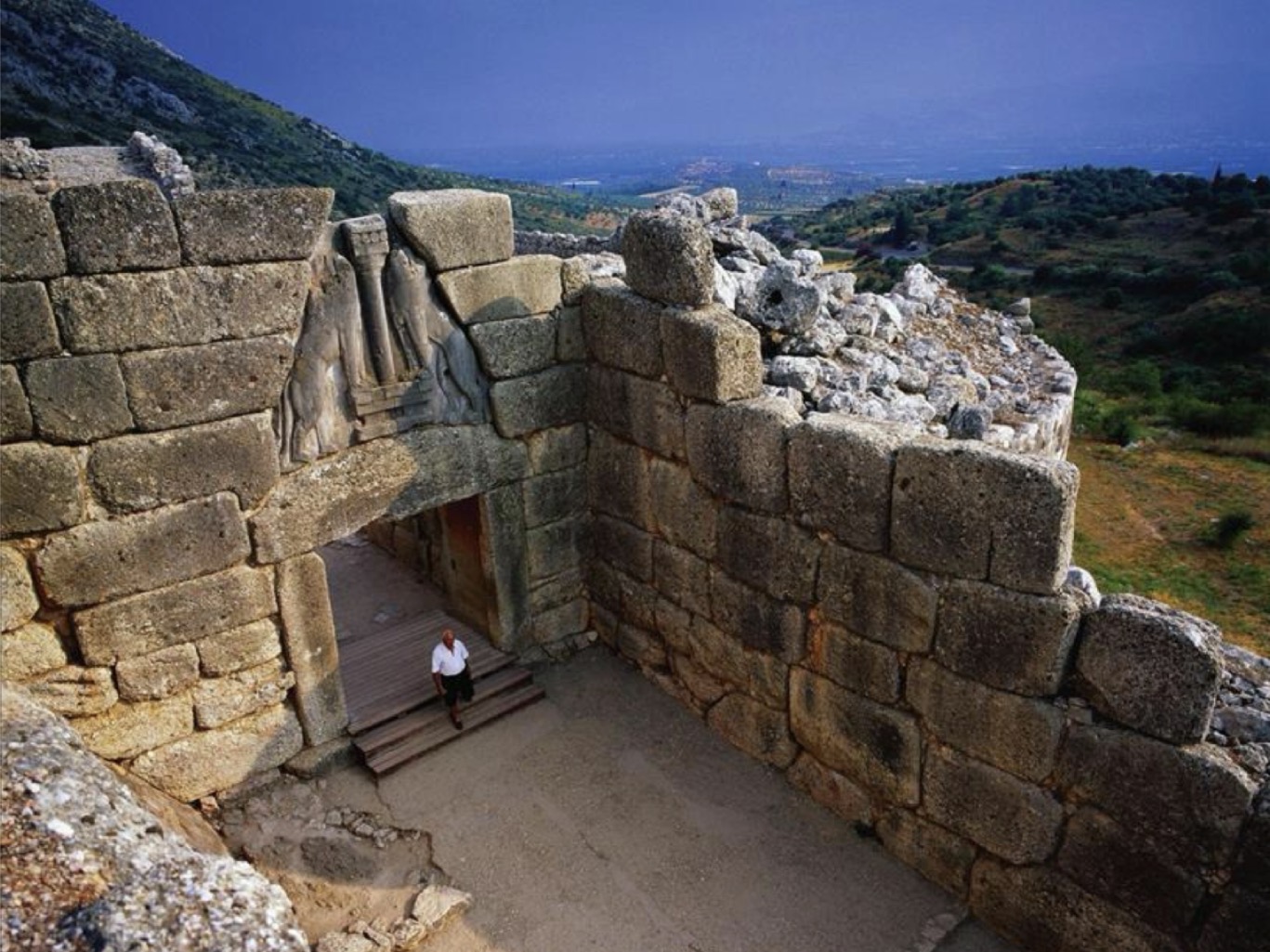
Notes on this image
2 lions flanking Minoan column
tapers at base
on top of Minoan style altar
goddesses Minoan often represented
Did they worship same goddess?
For religious protection over gate?
Clear Minoan influence
Heads were bronze and gold - pointed at
Three methods of spanning a passageway:
post and lintel
corbeled arch
arch

Great ramp
visitor ramp up to citadel
Megaron
building
open on one end
front porch and throne room
where king holds audience
Minoan style columns
brightly painted - Minoan style
covered in hunting, warlike scenes
Defensive measures: postern gate and sally port
Mycenae
constantly maintaining fortification
Back gate - much less elaborate than main defensive - secret way out for escape or send out small troops
Defensive measures: secret cistern
Mycenae
tunnel outside underground to get underwater source to avoid enemy from seeing
withstand siege for longer and avoid water getting poisoned
Mycenaen Citadels Overview
constructed 1400 BC monumentalized and strengthened until 1200 BC
Dominated surrounding landscape, concerned with defense and intimidation
Built with ashlar and cyclopean masonry
Features: gates, bastions, shrines associated with walls, megafauna, secret cisterns, postern gates, sally ports, production and storage
Storage area like Minoans inventory / economic
Mycenae: Tholoi Tombs
impressed / intimidated visitors
Reused over generations
Tholos Tomb Nots
Monumental doorway to massive burial chamber
Dead laid out surrounded with weapons, gold, etc. (looted)
seal it, cover with earth
Reexcavate for next burial
Side chamber to put older bones
Corbal dome distributes weight
Smoothed
Drill holes: bronze rosettes?
Largest enclosed space without supports until Pantheon
Mycenaen Tholos Tombs Overview
Reused over generations for inhumation burials (likely for families)
Commonly found along major roads
Associated with citadels or centers
The elaborate architecture and wealth of the burials suggests these were used as elite or even royal family burial grounds
The Greek World Dates
700-300 BC
What happened to the Mycenaeans?
don’t really know
12th century collapse
Art shows different headdresses from different areas
idea that collapse was bad and refugees go to Egypt but rejected
craziness of moving and refugees
The “Dark Age” / Geometric period
citadels all destroyed
political economy and administrative system collapses
Linear B and writing disappears
limited to bureaucratic system which goes away so writing goes away too
Trade and International connections drastically reduced
Massive depopulation and settlement abandonment/destruction
When they return, few similarities but culture mostly vastly different
Small villages, simple huts, trading reduced
No figural art - mostly geometric art
The Archaic Period
looking up from geometric dark age
The Greek World
New influence from Egypt: still pharaohs but not as powerful, Egyptian Pharaoh Psamtik: rein not secure, civil war
Greeks as mercenaries: paid army showing weakness, also use other people besides Greeks
Greek mercenaries allowed to settle for trade
Egyptian art is basically same as before
Age of Tyrants
Great patrons of art
Wealth
Aritstocrats but stabilized and bring political rest
Some make position hereditary and comes to be negative term
New role of artists: becoming known and name - can rise in status

Name, Date, Age
New York Kouros
600 BCE
Archaic Period

Notes on this image
Kouros: ancient word for young man
1x, 2x, 3x life size - learning directly form Egyptian sculptors
Egyptian ‘inspiration’:
Naturalistic
Ka statue - webbing
Clothed simple kilts - can still show off body but no clothes = negative
Greek
Single males
Similar pose - no emotion
Egyptian style wig
Completely no clothes - see MALE no clothes as positive
idealized version of greek man
Aristocrat/elite
Gravemarker
Very stylized

Name, Date, Age, Location
Kroisos Kouros
Anavysos, Greece
530 BCE
Archaic Period

Notes on this image
Inscription on Base: stay and mourn at the monument for dead Kroisos, whom violent Ares destroyed, fighting in the front rank
He died in battle heroically and honorably - as if statue is talking to you
More naturalistic
Same wig- was bright wig

Name, Date, Age, Location
Peplos Kore
Acropolis, Athens, Greece
530 BCE
Archaic Period

Notes on this Image
clothed - female no clothes in still bad
peplos - conservative dress
aristocratic ideal woman
Kore = young girl

Name, Date, Age, Artist
Achilles and Ajax Playing Dice, Attic Black Figure Amphora
530 BCE
Archaic Period
by Exekias

Notes on this image
Athens is pottery innovator
Black figure: local red clay and use clip to paint background and figures, incise lines for details and kiln makes slip black
Heroes from Trojan War: Achilles left Ajax right
Gambling with dice
Eyes drawn to table, Achilles won
game of chance - Achilles is more luck / has better fate than Ajax
True also for their stories - Ajax has bad fate in life murdering his family ; Achilles dies young but at height of career