Unit III (Civil Liberties & Rights) MCQ
 Multiple Choice & FRQ
 Call Kai
1/66

Earn XP
Name | Mastery | Learn | Test | Matching | Spaced | Call with Kai | Chat |
|---|
No analytics yet
Send a link to your students to track their progress
67 Terms
The Supreme Court addressed the admissions policy of the University of Michigan Law School in Grutter v. Bollinger (2003). Justice Sandra Day O’Connor wrote for the court, “in the context of its individualized inquiry into the possible diversity contributions of all applicants, the Law School's race-conscious admissions program does not unduly harm nonminority applicants.” The primary issue in the Grutter v. Bollinger decision involves
affirmative action
Which of the following would most likely be protected by the First Amendment?
A student wears a black armband at school to protest government involvement in a war.
The clause of the United States Constitution that was used in the Supreme Court’s ruling in Brown v. Board of Education of Topeka (1954) was
The equal protection clause
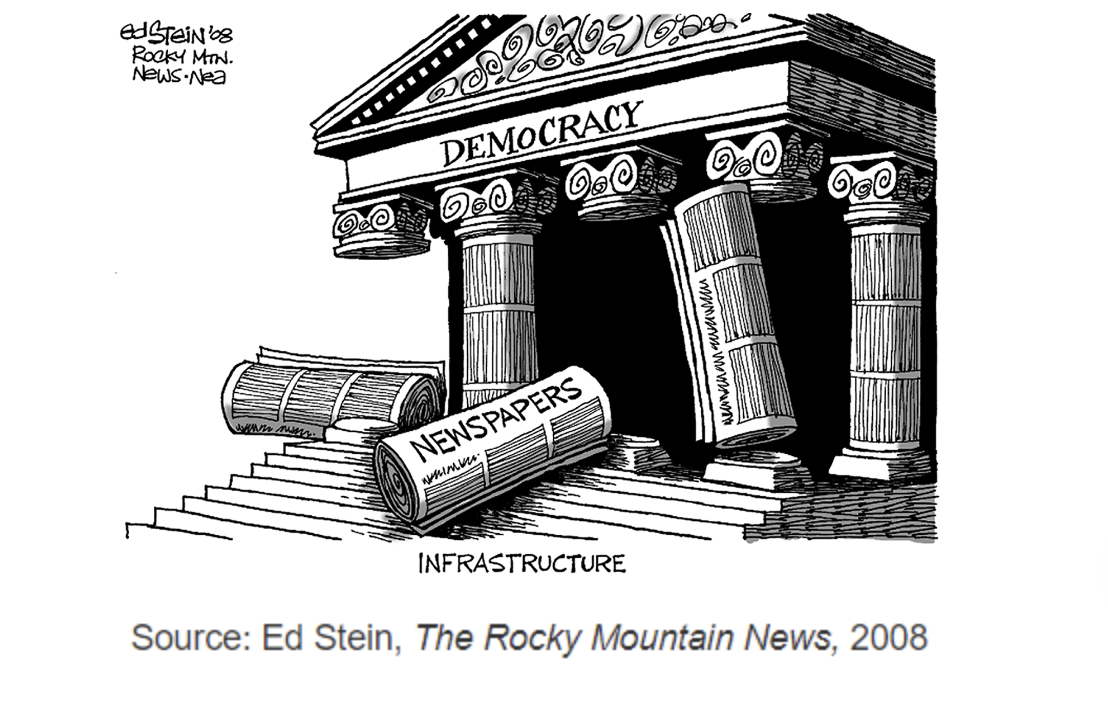
The facts of which of the following cases are most related to the political cartoon?
New York Times Co. v. United States (1971)
Establishment Clause | Free Exercise Clause | |
|---|---|---|
A | Used by founders to establish Christianity as the national religion | Reflects a basic belief in the protection of religious freedom |
B | Prohibits the federal government from promoting religion or creating a national religion | Protects an individual’s religious beliefs and reasonable religious practices |
C | Provides a wall of separation of between church and state | Not a civil liberty incorporated to states |
D | Ensures that all students must attend public school regardless of religious views. | Protects again school-led prayer ceremonies |
B
Protected by the First Amendment | Not Protected by the First Amendment | |
|---|---|---|
A | Libel/slander | Fighting words |
B | Freedom of religion | Freedom of assembly |
C | The right to burn a flag | Obscenity |
D | Online newspapers | The right of a student to pray in school |
C
Which of the following scenarios best explains how the equal protection clause of the Fourteenth Amendment has influenced political behavior?
Civil Rights leaders such as Martin Luther King, Jr., cited constitutional arguments as a basis for opposing segregation and inequality.
The Fourteenth Amendment’s equal protection clause declares that “No State shall . . . deny to any person within its jurisdiction the equal protection of the laws.” In which of the following scenarios is this clause most likely to be used by the Supreme Court in its decision?
A local school district mandates racially segregated schools.
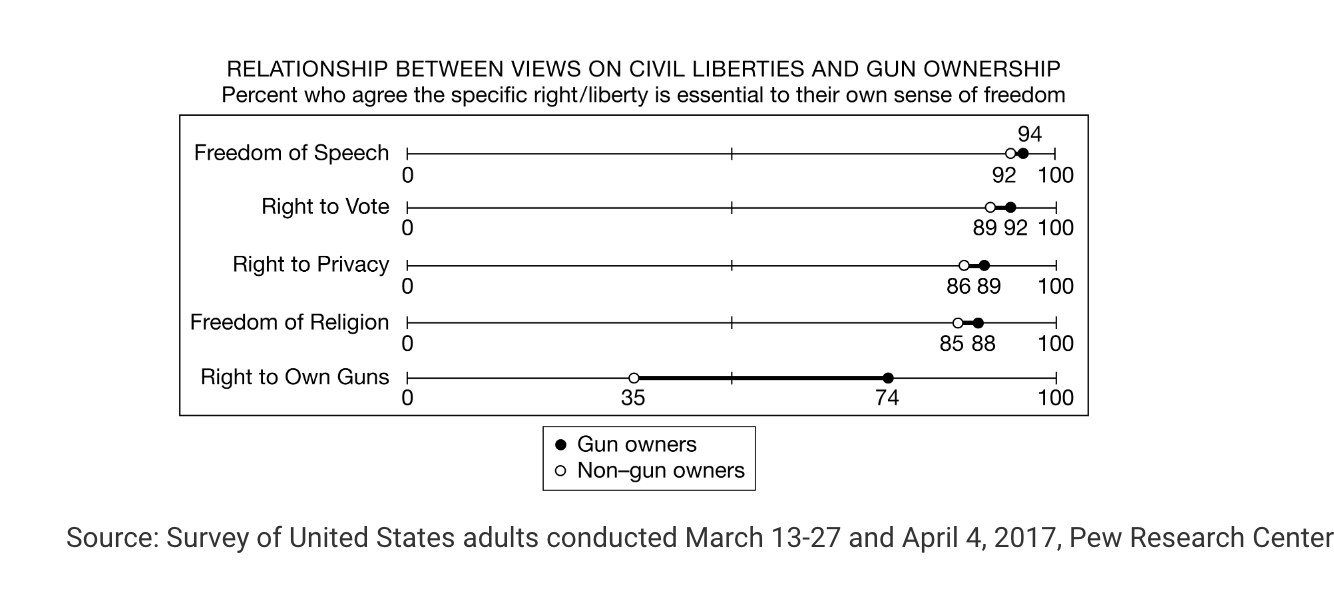
Which of the following best explains how poll respondents regard the relationship between the right to own guns and personal freedom?
The poll shows there is an ongoing debate over whether gun control laws promote or interfere with individual rights.
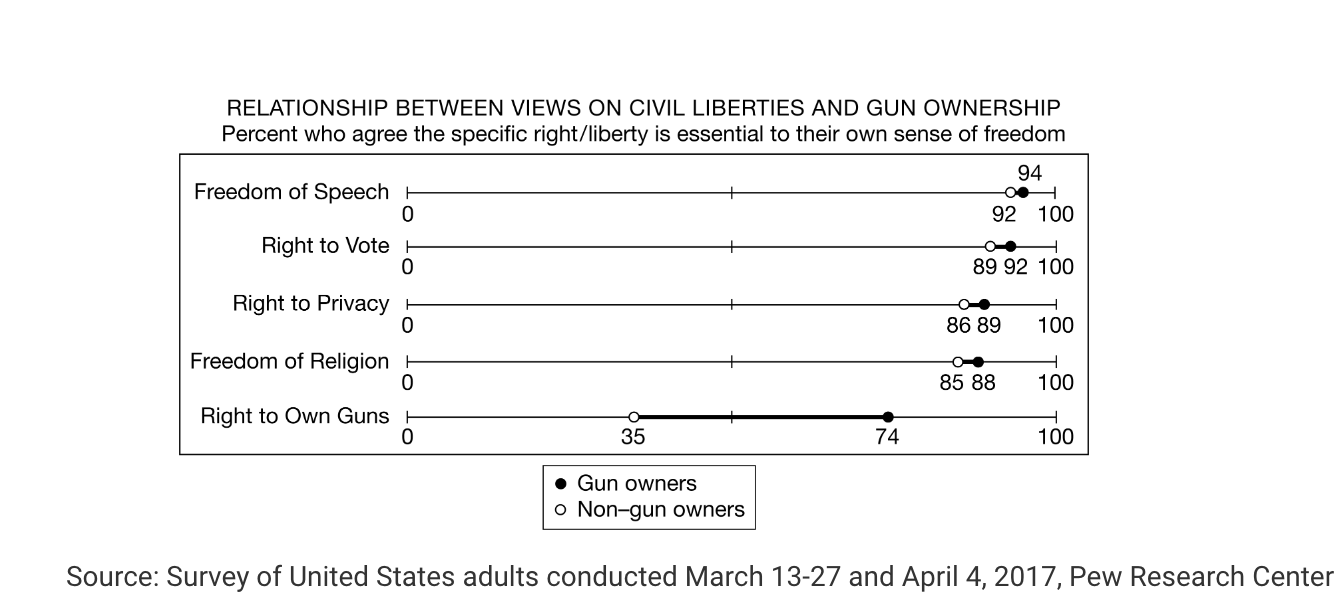
According to the data, both gun owners and non–gun owners
chose freedom of speech as most essential to their own liberty
According to the clear and present danger test, speech may be restricted
when it incites violent action
The process of extending the protections of the Bill of Rights by means of the Fourteenth Amendment to apply to the actions of state governments is known as
incorporation
Which of the following principles protects a citizen from imprisonment without trial?
Due process
Which of the following best illustrates the protection of an individual’s Fifth Amendment rights?
After arrest, a suspect is informed of the right to remain silent during interrogation.
The free-exercise clause protects
voluntary prayer by student groups before school
Which of the following is true about the right of free speech, as currently interpreted by the Supreme Court?
It protects the right to express opinions even without the actual use of words.
In Gideon v. Wainwright, the United States Supreme Court ruled that the
Sixth Amendment right-to-counsel provision applies to those accused of major crimes under state laws
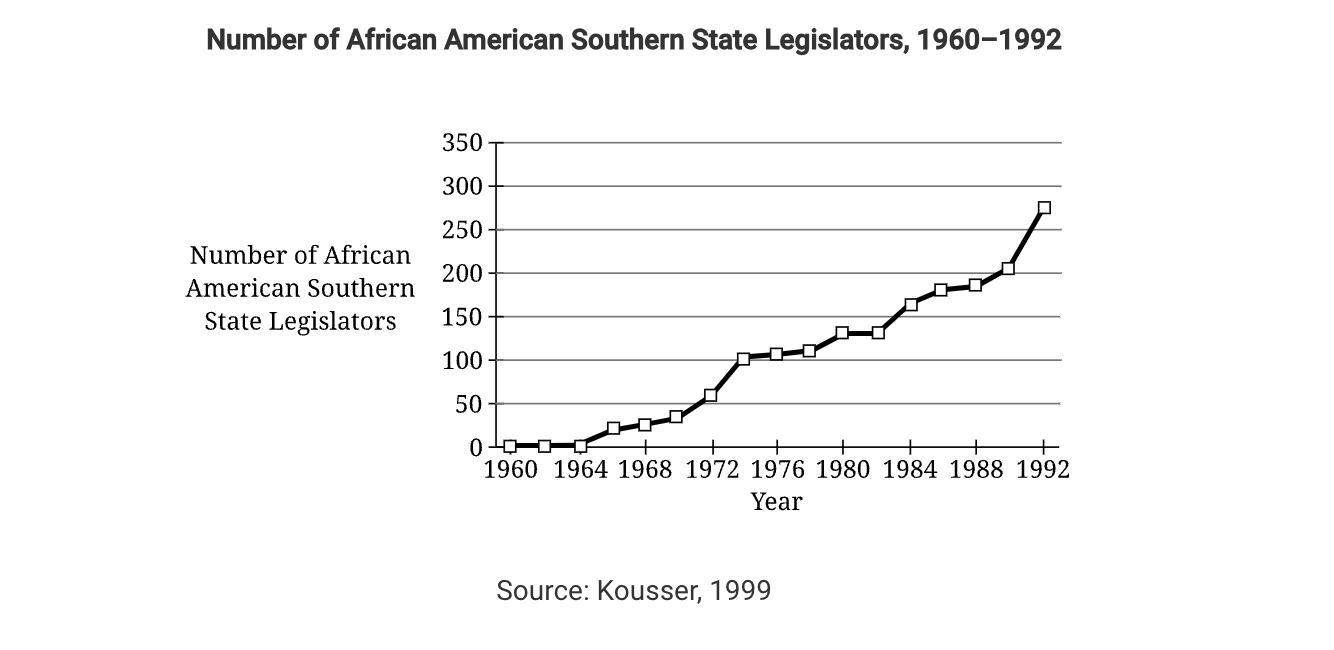
Which of the following statements presents the most important limitation of the data in the graph?
There is no information about the total number of state legislators.
In the case Guey Heung Lee v. Johnson (1971), the parents of Chinese American students who attended a primarily Asian American school challenged San Francisco’s effort to desegregate the public schools, arguing that their culture and language would be diluted if their children were dispersed from their local school. The Supreme Court denied the challenge from the parents basing their decision on the Fourteenth Amendment. Which of the following cases was most likely used in the decision as a precedent?
Brown v. Board of Education of Topeka (1954)
Which of the following is true of the Voting Rights Act of 1965 ?
It has been a major instrument for increasing the number of African American and other minority voters.
Interest groups are protected under the Constitution by the
First Amendment
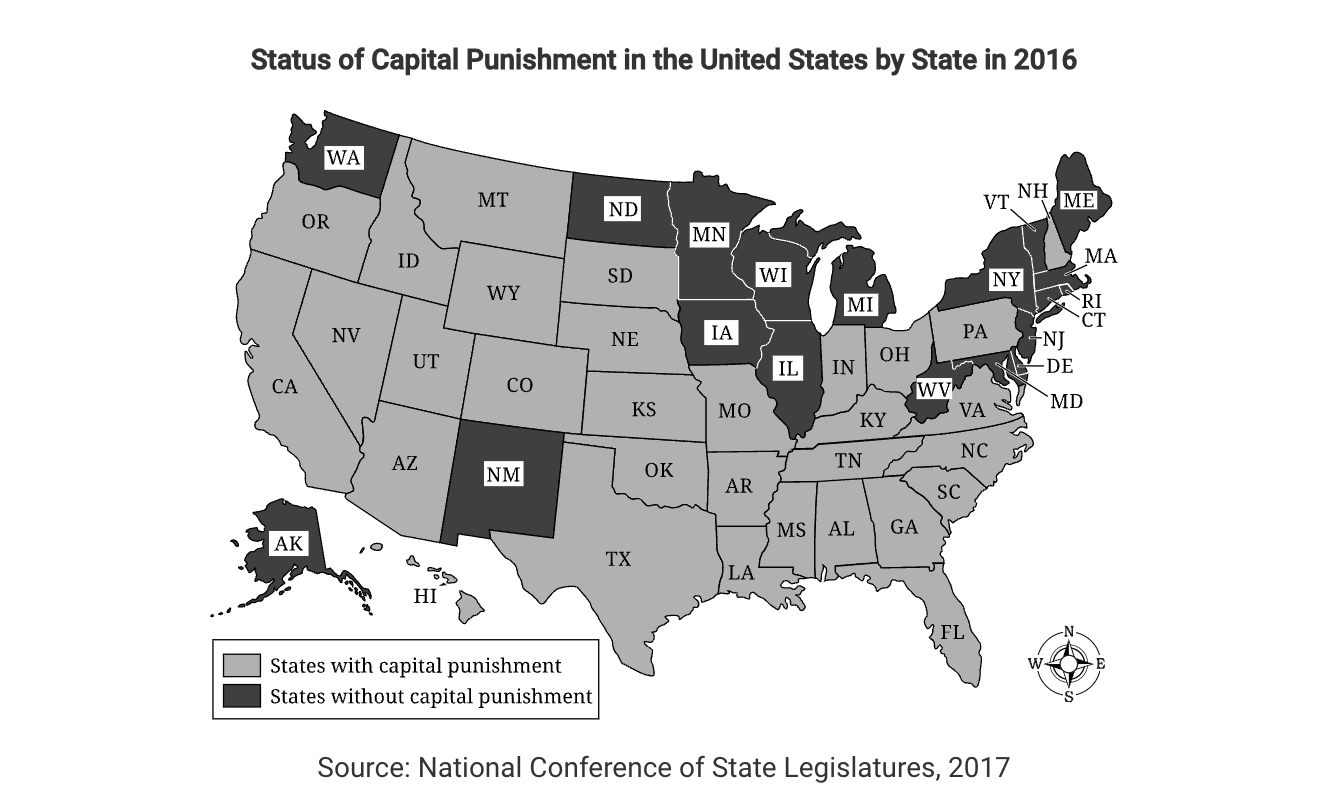
Which of the following constitutional amendments is most related to the issue shown on the map?
Eighth Amendment
The Supreme Court ruled in McDonald v. Chicago (2010) that a citizen’s right to keep and bear arms at home for self-defense is protected from state and federal infringement. Which of the following is most relevant to that decision?
Selective incorporation
In Miranda v. Arizona, the United States Supreme Court declared that
police must inform criminal suspects of their constitutional rights before questioning suspects after arrest
A classified Department of Defense study on the effectiveness of the United States involvement in the Afghanistan War is obtained by a newspaper. The president seeks to block the publication of the document. The court rules in favor of the newspaper, citing as precedent the Supreme Court’s decision in New York Times Co. v. United States (1971). Based on the ruling in the Supreme Court’s decision, which of the following lines of reasoning does the court most likely use?
Freedom of the press requires that the government show a significant danger to national security in order to stop publication.
A school district in Seattle used the race of students as a tie-breaking factor to determine which students would be admitted to the more popular schools in an attempt to maintain racial diversity. In the case Parents Involved in Community Schools v. Seattle School District No. 1 (2007), the Supreme Court ruled this plan unconstitutional under the Fourteenth Amendment. Which of the following statements offers the most accurate comparison between this case and the decision in Brown v. Board of Education of Topeka (1954) ?
Both cases ruled against the school district based on the equal protection clause.
The president privately discusses with his staff a decision to increase economic sanctions on Iran. Before a final decision is made, a draft of the proposal is leaked to a reporter. The president orders the reporter and her newspaper to suspend publication of the plan, citing issues of national and economic security. Which of the following best indicates how a court would rule in this case if the Supreme Court’s ruling in New York Times Co. v. United States (1971) was used as a precedent?
Freedom of the press includes a heavy presumption against government censorship, and the documents can be published by the press.
Which of the following best describes a purpose of the Establishment Clause?
It prohibits Congress from establishing a state religion.
Which of the following scenarios illustrates an action that would be protected by the free exercise clause in the First Amendment?
A person wears a necklace bearing a Christian cross to work.
Which of the following scenarios, related to the First Amendment, best illustrates the “right . . . to petition the Government . . .” ?
A citizen calls a member of Congress to persuade her to vote yes on a bill.
Which of the following decisions is most likely to cite the Supreme Court’s decision in Tinker v. Des Moines Independent Community School District (1969) as a legal precedent in support of the decision?
A decision in favor of students holding signs that protest a new policy
The Supreme Court established the incorporation doctrine when the Court
interpreted the Fourteenth Amendment as extending most of the requirements of the Bill of Rights to the states as well as the federal government
A group unhappy with local law enforcement distributes a memo to members encouraging physical confrontations with police officers. The leaders of the group are promptly arrested. Which of the following Supreme Court cases best justifies the actions taken by law enforcement in this scenario?
Schenck v. United States (1919)
Which of the following statements is true regarding the right to privacy?
The right to privacy is not explicitly named in the Constitution.
In McDonald v. Chicago (2010), the United States Supreme Court stated that, “[s]elf-defense is a basic right, recognized by many legal systems from ancient times to the present day” and that an individual’s right to bear arms was “deeply rooted in this Nation’s history and tradition.”
The quote points to which of the following amendments to the United States Constitution as a basis to limit state action?
The Second Amendment
In Engel v. Vitale (1962), which of the following provides the legal reasoning behind the Supreme Court’s ruling?
It ruled that the state had no justifiable interest to compel students to listen to a nondenominational prayer led by public school teachers, finding a clear establishment clause violation.
In which case did the Supreme Court hold that race based school segregation violated the Equal Protection Clause of the Fourteenth Amendment?
Brown v. Board of Education of Topeka (1954)
Brown v. Board of Education of Topeka (1954) was a significant Supreme Court ruling because it
held the “separate but equal” concept to be a violation of the equal protection clause of the Fourteenth Amendment
Which of the following scenarios best explains the inclusion of Title IX as part of the Education Amendments of 1972 ?
Members of Congress added the amendment to the bill in response to social movements seeking to address inequality in education for women.
Which of the following cases examined a state law that required all children to attend school through the twelfth grade in order to promote the general welfare of its citizens?
Wisconsin v. Yoder (1972)
(Section 8): Grants Congress the power to regulate commerce with foreign nations, among the states, and with Indian tribes.
Commerce Clause
(Elastic Clause, Section 8): Allows Congress to pass laws needed to carry out its enumerated powers.
Necessary and Proper Clause
(Section 8): Gives Congress the power to levy taxes and decide how federal funds are spent.
Taxing and Spending Clause
(Section 10): Prohibits states from passing laws that retroactively impair contract obligations.
Contract Clause
(Section 3): Requires the President to enforce all laws passed by Congress.
Take Care Clause
(Section 2): Gives the President the authority to appoint judges, ambassadors, and other high-ranking officials, with the Senate's advice and consent.
Appointment Clause
(Section 2): Limits federal courts to deciding actual legal disputes, not hypothetical cases.
Cases and Controversies Clause
(Article VI): Establishes the Constitution, federal laws, and treaties as the supreme law of the land, overriding state laws.
Supremacy Clause
(1st Amendment): Prohibits the government from establishing an official religion or favoring one religion over another.
Establishment Clause
(1st Amendment): Protects individuals' rights to practice their religion freely.
Free Exercise Clause
(5th and 14th Amendments): Guarantees fair treatment through the normal judicial system, especially as a citizen's entitlement.
Due Process Clause
(14th Amendment): Requires states to provide equal protection under the law to all people within their jurisdictions.
Equal Protection Clause
(Amendment interpretation): The interpretation of the original has been expanded in amendments and Supreme Court rulings to allow broader federal regulatory powers.
Commerce Clause
(Article IV, Section 1): Requires each state to recognize the public acts, records, and judicial proceedings of every other state.
Full Faith and Credit Clause
(Article IV, Section 2): Prevents a state from treating citizens of other states in a discriminatory manner.
Privileges and Immunities Clause
(Article I, Section 9): Prohibits the government from passing laws that apply retroactively, thereby criminalizing actions that were legal when originally performed.
Ex Post Facto Clause
(8th Amendment): Prohibits the federal government from imposing excessive bail, excessive fines, or cruel and unusual punishments.
Cruel and Unusual Punishments Clause
(5th Amendment): Prohibits an individual from being tried twice for the same offense.
Double Jeopardy Clause
(5th Amendment): Protects individuals from being compelled to testify against themselves in criminal cases.
Self-Incrimination Clause
(4th Amendment): Protects against unreasonable searches and seizures, requiring law enforcement to obtain warrants based on probable cause.
Search and Seizure Clause
(Clause 3): Requires all federal and state officers to swear an oath to support the Constitution, but no religious test can be required as a qualification to any office or public trust under the United States.
Oaths Clause
Outlines the process for amending the Constitution, allowing for changes to the document through the proposal and ratification of amendments.
Amendment Clause
(Section 4): Ensures that every state in the Union has a republican form of government and is protected against invasion and domestic violence.
Guarantee Clause
(Section 3): Gives Congress the authority to admit new states to the Union.
Admission Clause
(Section 2): Designates the President as the commander in chief of the armed forces.
Oath of Office Clause
(Section 9): Prohibits Congress from passing laws that punish individuals or groups without a judicial trial.
Bill of Attainder Clause
(Sections 2 & 3): Grants the House of Representatives the power to impeach federal officials, and the Senate the power to try impeachments.
Impeachment Clause