exam 3 neuro- chapter 12 Limbic System and Reticular Formation
 Call Kai
 Learn
 Practice Test
 Spaced Repetition
 Match
 Flashcards
 Knowt Play
1/23

There's no tags or description
Looks like no tags are added yet.
24 Terms
components of the limbic system
Cingulate gyrus
Parahippocampal gyrus
Hippocampus
Amygdala
Hypothalamus
Fornix
Mammillary bodies
Anterior thalamus
Olfactory regions
components of the reticular formation
Network of nuclei throughout the brainstem, including the reticular activating system (RAS).
Hippocampus
Formation/consolidation of new memories
Amygdala
Emotion, emotional learning and memory
Hypothalamus
Homeostasis and autonomic control
Cingulate gyrus
Emotion, motivation, attention
Fornix
Connects hippocampus with other limbic structures
Mammillary bodies
Memory circuits
Thalamus
Relay of information
Reticular formation
Arousal, sleep, motor and autonomic regulation
Limbic system
- Connected cortical and subcortical structures.
- Responsible for homeostasis, olfaction, memory, and emotion. (HOME)
Homeostasis
controlled by hypothalamus
Maintains stable internal body conditions.
Regulates temperature, hunger, thirst, blood volume, reproduction, and circadian rhythms.
Controls sympathetic and parasympathetic activity.
Olfaction
controlled by olfactory regions and medial temporal limbic structures
Processes smell.
Connections with amygdala and hippocampus explain associations between smells, emotions, and memories.
Memory
controlled by hippocampus and connected regions
3 Primary Memory Subsystems:
working
declarative (explicit)
non-declarative (implicit)
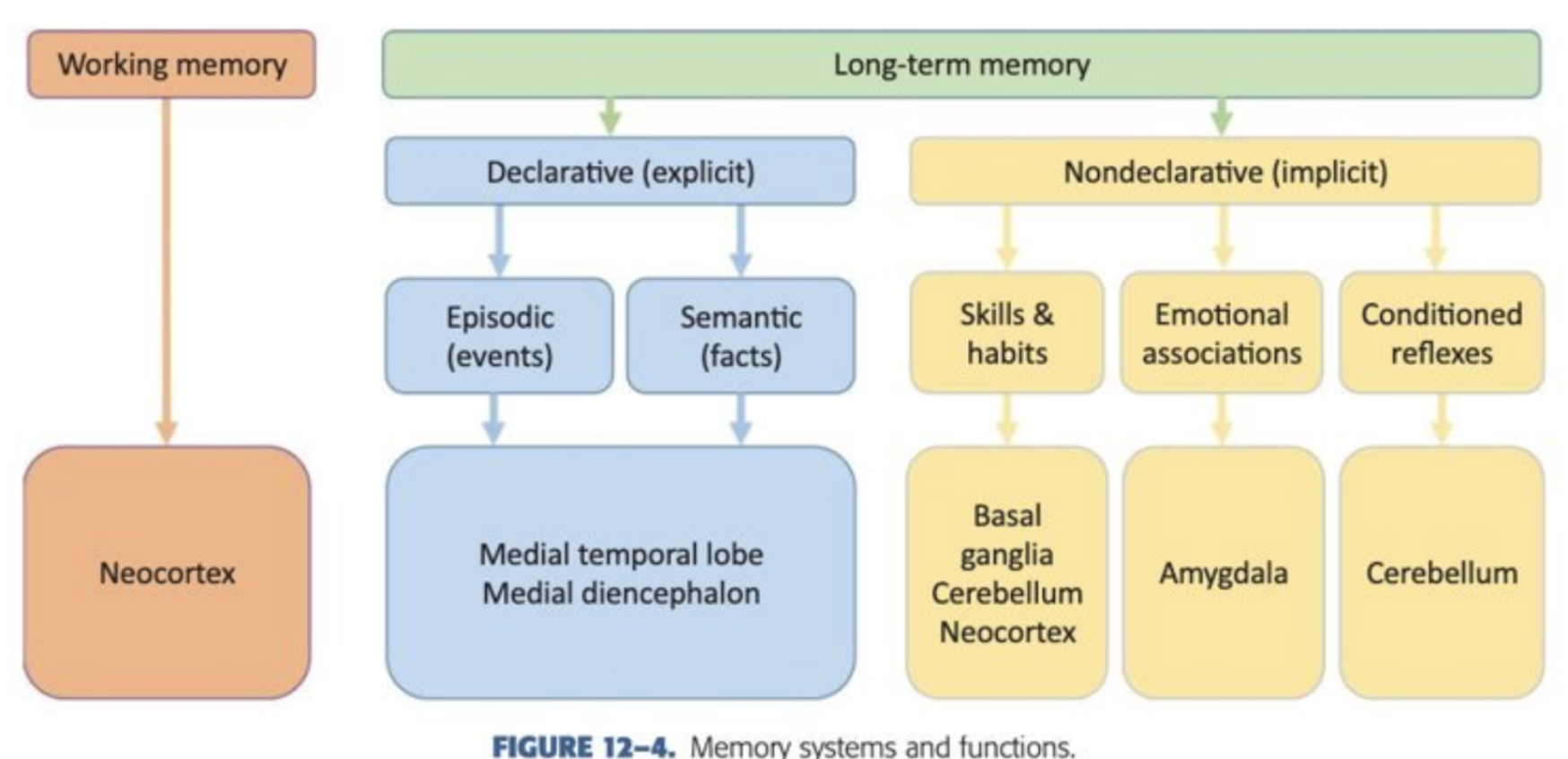
Working Memory
A system for holding and manipulating information temporarily, crucial for tasks like problem-solving and tracking information.
Declarative (Explicit) Memory:
Memory for facts and events that can be consciously recalled, including semantic (facts) and episodic (events) memory.
Nondeclarative (Implicit) Memory:
Unconscious memory for skills, habits, and procedures learned through practice, like riding a bike or tying shoes.
Emotions
controlled by amygdala
Emotional regulation and decisions.
Emotional learning and memory.
Fear, anxiety, anger, reward/punishment.
Amygdala communicates with hypothalamus to produce autonomic emotional responses.
What are disorders of consciousness?
Consciousness requires wakefulness and awareness
TBI can cause disorders of consciousness that impact these functions
Unresponsive wakefulness syndrome (Wakefulness without clear awareness)
Minimally conscious state: (Limited but detectable awareness.)
Emergence from minimally conscious state: (Recovery of functional communication or object use.)
What causes disorders of consciousness?
traumatic brain injury and damage/disruption to brain systems regulating arousal and awareness.
what makes up the peripheral nervous system?
All nerves except brain and spinal cord
Peripheral nervous system functions
Cranial and Spinal nerves makeup 2 major systems:
Somatic Nervous System
Voluntary control
Autonomic Nervous System
Involuntary control (organs)
Sympathetic System
Parasympathetic System
components of autonomic nervous system
Sympathetic: Fight or flight; increases heart rate, reduces digestion.
Parasympathetic: Rest and digest; decreases heart rate, increases digestion.
difference between CNS and PNS
CNS: Brain and spinal cord.
PNS: All nerves and ganglia outside the brain and spinal cord.
The CNS processes/integrates information; the PNS carries sensory information to the CNS and motor commands away from it.