biochem e3l1 glycolysis
 Call Kai
 Learn
 Practice Test
 Spaced Repetition
 Match
 Flashcards
 Knowt Play
1/25

There's no tags or description
Looks like no tags are added yet.
26 Terms
glycolysis:
Starting product = glucose
End product = pyruvate
E in = 2 ATP
E out = 4 ATP + 1 NADH
Location = cytoplasm
Fed v. fasted state
Starting product = glucose
End product = pyruvate
ATP in =
ATP out =
Location = cytoplasm
Fed v. fasted
Fed state = actively breaking down glucose into pyruvate
Fasted state = gluconeogenesis making glucose
glycolysis:
equation
what E is captured
NADH =
source of ATP?
equation = glucose +2NAD+2ADP+2P → 2pyruvate+2NADH+2ATP+2H20
E captured by synthesis of ATP and NADH
NADH = e- carrier
pushes e-’s into mitochondrial matrix
in the ETC, NADH ATP
NADH (nicotinamide adenine dinucleotide):
what is it
how does it do that
what does it do in biological rxns
how does it yield ATP 2 steps
how many e- does it carry/as what
2 forms = ox/red
what is the + stand for?
where are the 2 forms found
why?
NADH = e- carrier
carries 2 e- as a hydride ion
soluble coenzyme in oxidation reactions
2 steps to ATP
pushes e-’s into mitochondrial matrix
in the ETC, NADH ATP
2 forms (+ stands for oxidized form, not the charge)
NAD+ = oxidized
mostly cytosol
NADH = reduced
mostly mitochondria
NADH is high E, so it inhibits the glycolytic pathway when its in high concentration in the cytoplasm bc cell doesn’t need it to pick up e- to make more E
NADH kept in mitochondria bc its used for ETC
2 reasons phosphorylation is useful in general (last exam)
3 reasons for phosphorylated intermediates in glycolysis
in general
coupling ATP hydrolysis (favorable) w/ unfavorable
Phosphate useful as good leaving group to add groups onto other mCs bc it is unstable
phosphorylated intermediates
keeps intermediates inside cell to maintain high catalytic turnover (P- is neg charged)
substrate level phosphorylation = Pi (inorganic phosphate) will be transferred to ADP
enzymatic handles = good leaving groups
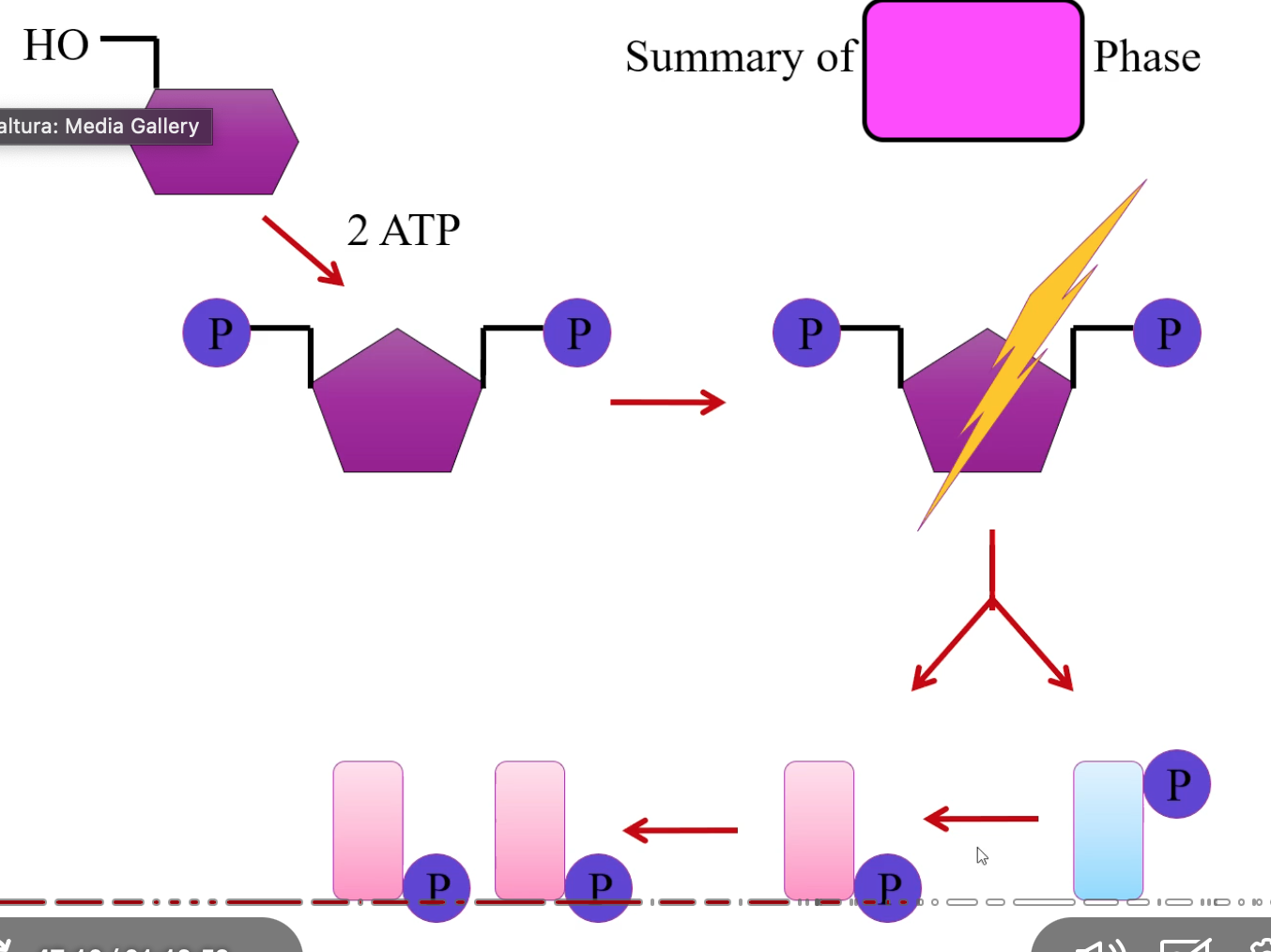
goal of preparatory phase =
preparatory phase structure change =
preparatory phase = input a little ATP to get more ATP later
6C aldose (glucose) → 6C ketose (fructose) w/ 2 phosphates
Glycolysis step 1:
rxn?
ATP used?
enzyme?
cofactor?
reversible?
# isozymes?
glucokinase?
affinity for glucose and Km?
why?
glucose → glucose 6-phosphate
1 ATP —> 1 ADP
enzyme = hexokinase
cofactor = Mg2+
humans have 4 isozymes of hexokinase
isozymes = similar structure enzymes (products of diff genes) that catalyze the same reactions
glucokinase = isozyme that carries out step 1 in liver
low affinity, high Km
liver responsible for sending glucose to brain so it needs to be low affinity to let go (not self consuming)

Glycolysis Step 1 hexokinase Rxn:
2 steps rxn
what is the cell doing
group transfer or hydrolysis
rxn
C6 OH of glucose attacks gamma phosphate of ATP
bound Mg2+ stabilizes - charge in transition state
1st priming rxn = Cell investing E to initiate glycolysis
group transfer NOT hydrolysis

Glycolysis step 2:
rxn?
enzyme
cofactor
reversible?
involves?
how guarantee go forward?
rxn = isomeration of G6P to F6P
isomeration = glucose switch to fructose
enzyme =
cofactor
reversible?
involves ring opening
ring converted to linear
recircularizes into ketone
Low DG so remove product fast to drive

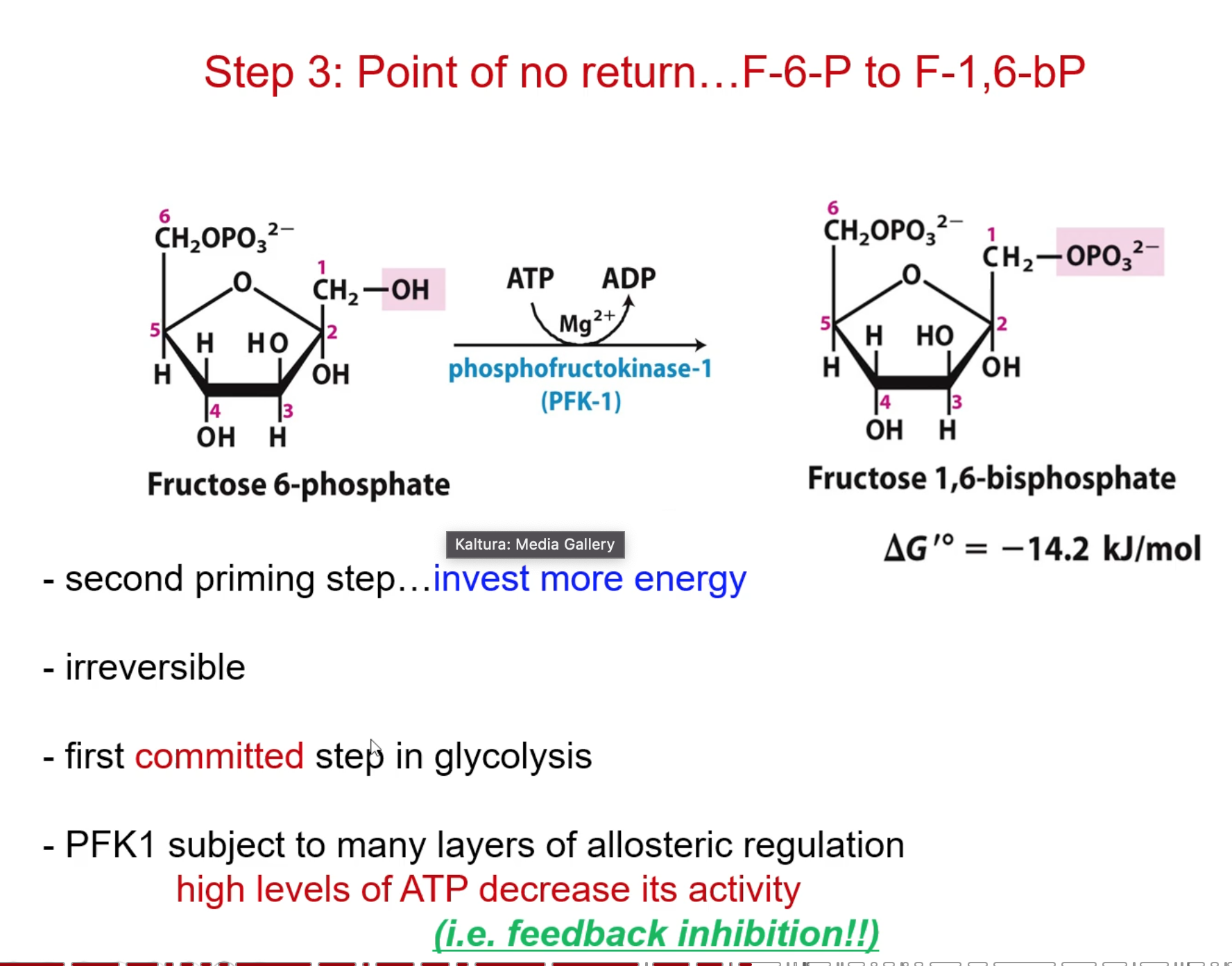
glycolysis step 3:
what is it
enzyme
ATP?
reversible
why special
what is it
enzyme = PFK-1 phosphofructokinase-1
ATP → ADP
irreversible
why specialspecial bc:
2nd priming steo
1st committed step= point of no return
point of regulation, ATP = negative feedback
Glycolysis step 4:
what is it
enzyme
ATP?
why special
how move forward despite large DG? why?
ring opening?
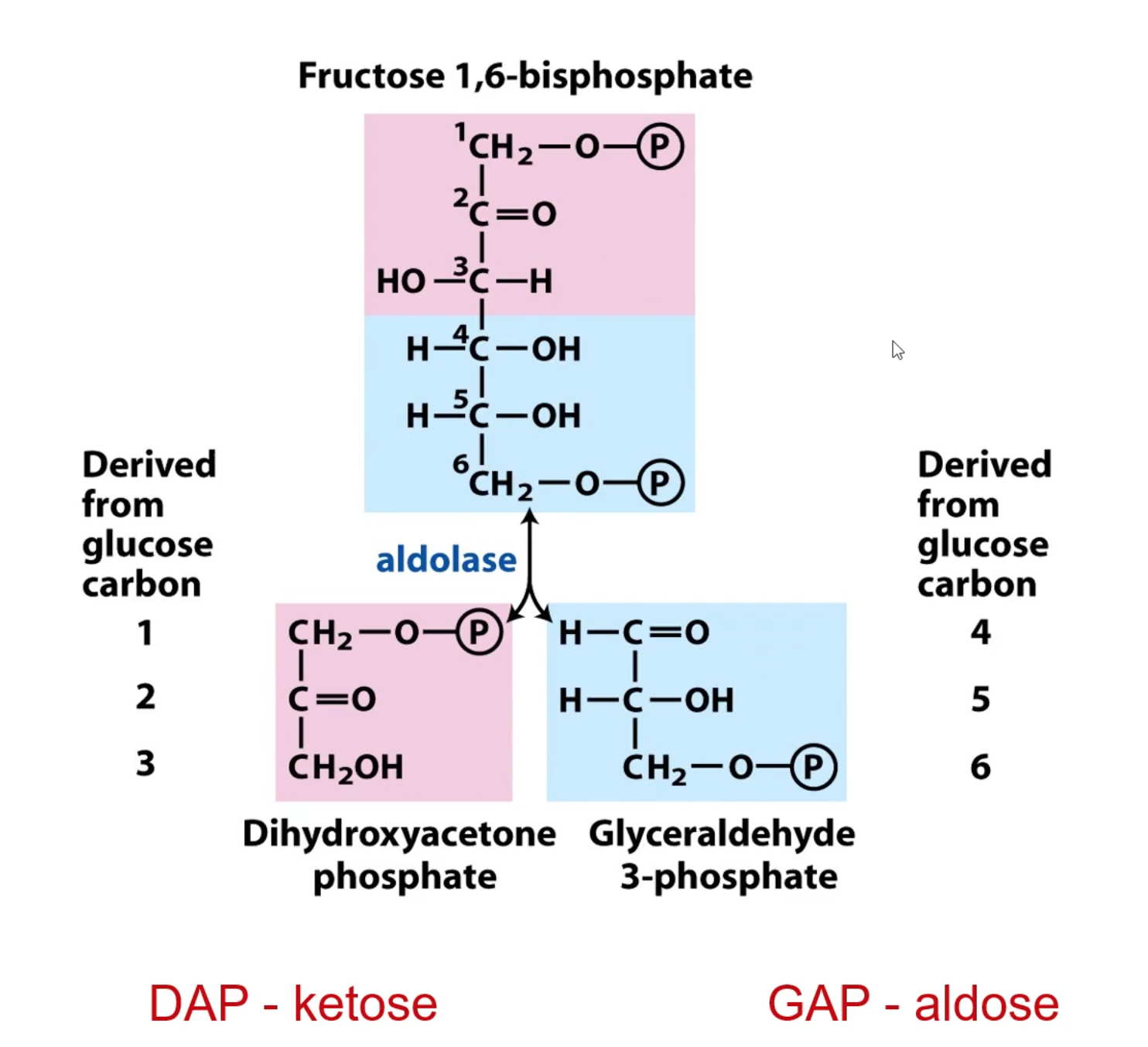
special bc cleave 6C sugar into 2 3C sugars
goes forward bc products quickly removed by next step
dihydroxyacetone phosphate is a ketose so its unstable and quickly converts to aldose

what is the mechanism behind the product being removed in step 4
how are GAP and DAP numbered (from what #C of glucose)
dihydroxyacetone phosphate is a ketose so its unstable and quickly converts to aldose
Key concept:'
why does product removal drive a rxn w/ high DG’0 forward?
equation?
drives rxn forward bc it lowers Q to get a neg DG even w/ a high

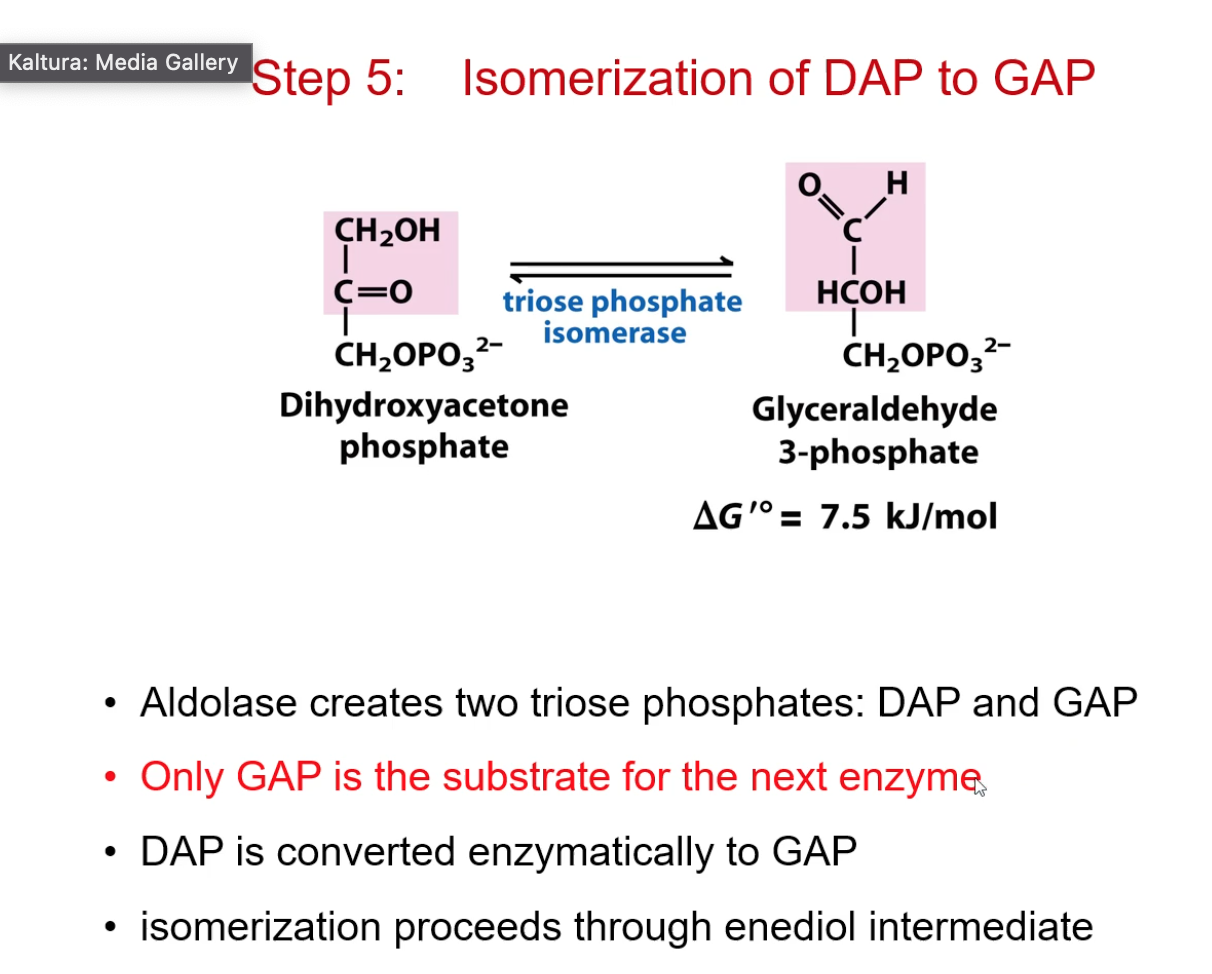
glycolysis step 5:
what is it
enzyme
what kind of reaction
why DAP converted to GAP?
isomerization through enediol intermediate
only GAP substrate for next enzyme (
glycolysis step 5:
GAP carbon numbering
dihydroxyacetone phosphate flips and becomes an aldose

prep phase

glycolysis step 6:
overall rxn
2 involved reactions
loaded gun?
first what
enzyme named correctly?
1st E yielding step =
NAD+ picked up 2 e- → NADH, which will be used to make ATP later
2 reactions
oxidation of aldehyde w/ NAD+ gives NADH
favorable
phosphorylation yields a high-E product (acyl phosphate on
unfavorable

glycolysis step 6:
“loaded gun”
phosphorylation yields a high-E product (acyl phosphate on
unfavorable
loaded gun = acyl phosphate hydrolysis has very negative DG’0

glycolysis step 7:
why special
coupled? why?
enzyme named correctly? why?
special
2nd payoff phase
1st payoff with ATP
substrate level phosphorylation #1
steps 6 and 7 are coupled with 1,3 BPG as the common intermediate
7 has a favorable (-) DG so it can drive step 6 (unfavorable)
enzyme should be phosphotase bc it removes a phosphate from sugar (makes ATP from ADP)
discovered in reverse direction hence “kinase”
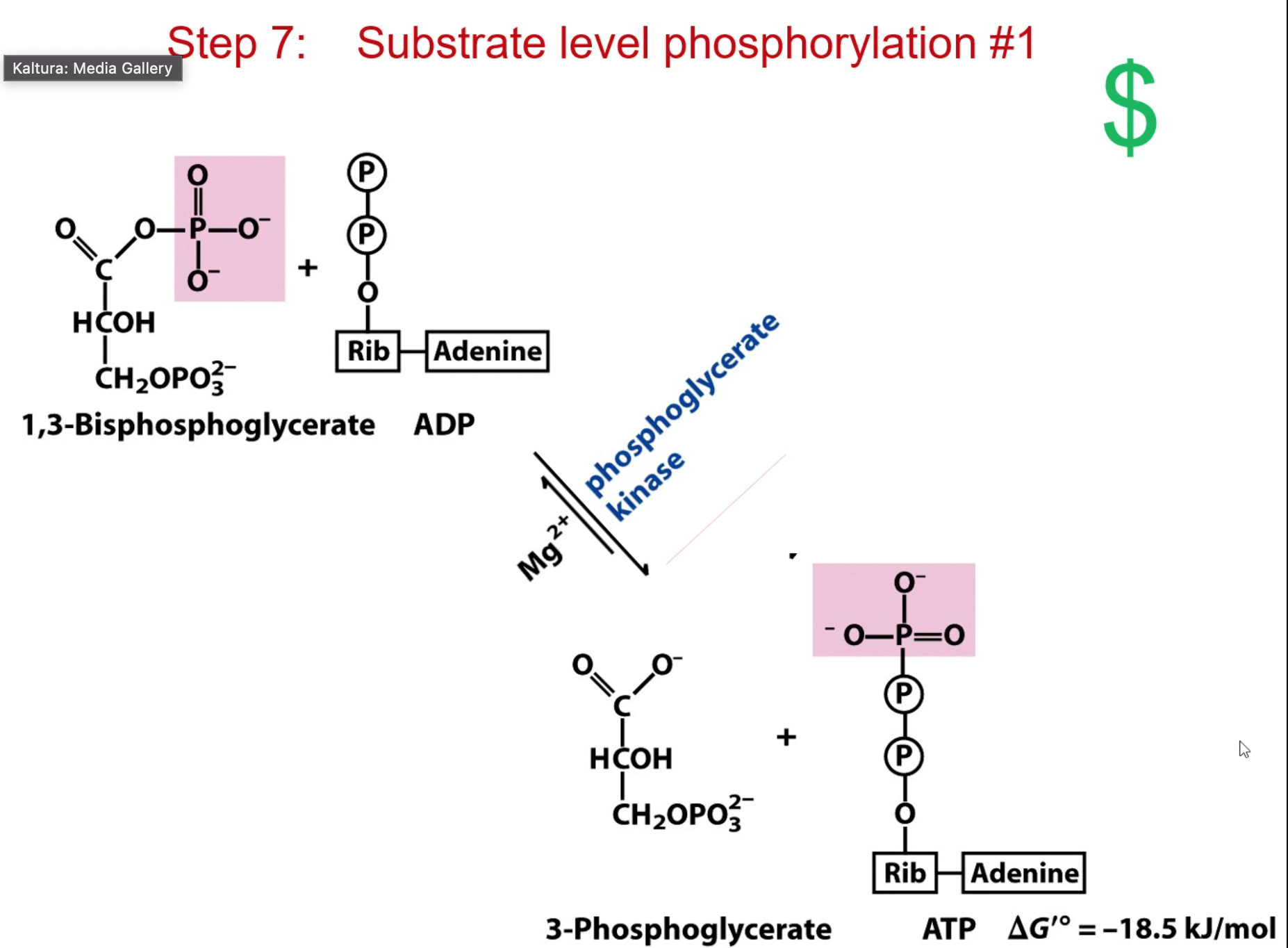
substrate level phosphorylation =
oxidative phosphorylation =
substrate level phosphorylation = generation of ATP from ADP and reactive chemical intermediates using soluble enzymes
oxidative phosphorylation = e- carrier, NADH or FADH2, donate e- to ETC and ATP synthase complex yields ATP
glycolysis step 8:
enzyme?
advantage of rearranging phosphate group?
phosphoglycerate mutase
placing Phosphate - charge nearby another O- makes it a better leaving group

glycolysis step 9:
type of reaction
role of Mg2+?
why PEP important?
type of reaction
part of enolase active site that stabilizes intermediate
PEP has high phosphorylation transfer potential compared to 2-phosphoglycerate

glycolysis step 10:
why special
enzyme correct name?
product(s)
regulation
enzyme requires
how many ATP?
special
payoff phase
2nd substrate level phosphorylation
enzyme has wrong name should be phosphatase
2 tautomers of pyruvate
enol and keto forms (keto more stable)
pyruvate kinase activity, regulated by level of Mg2+
when there is plenty of ATP, Mg ions sequestered by ATP and slows down pyruvate kinase
4 molecules of ATP bc 2 glyceraldehyde mCs

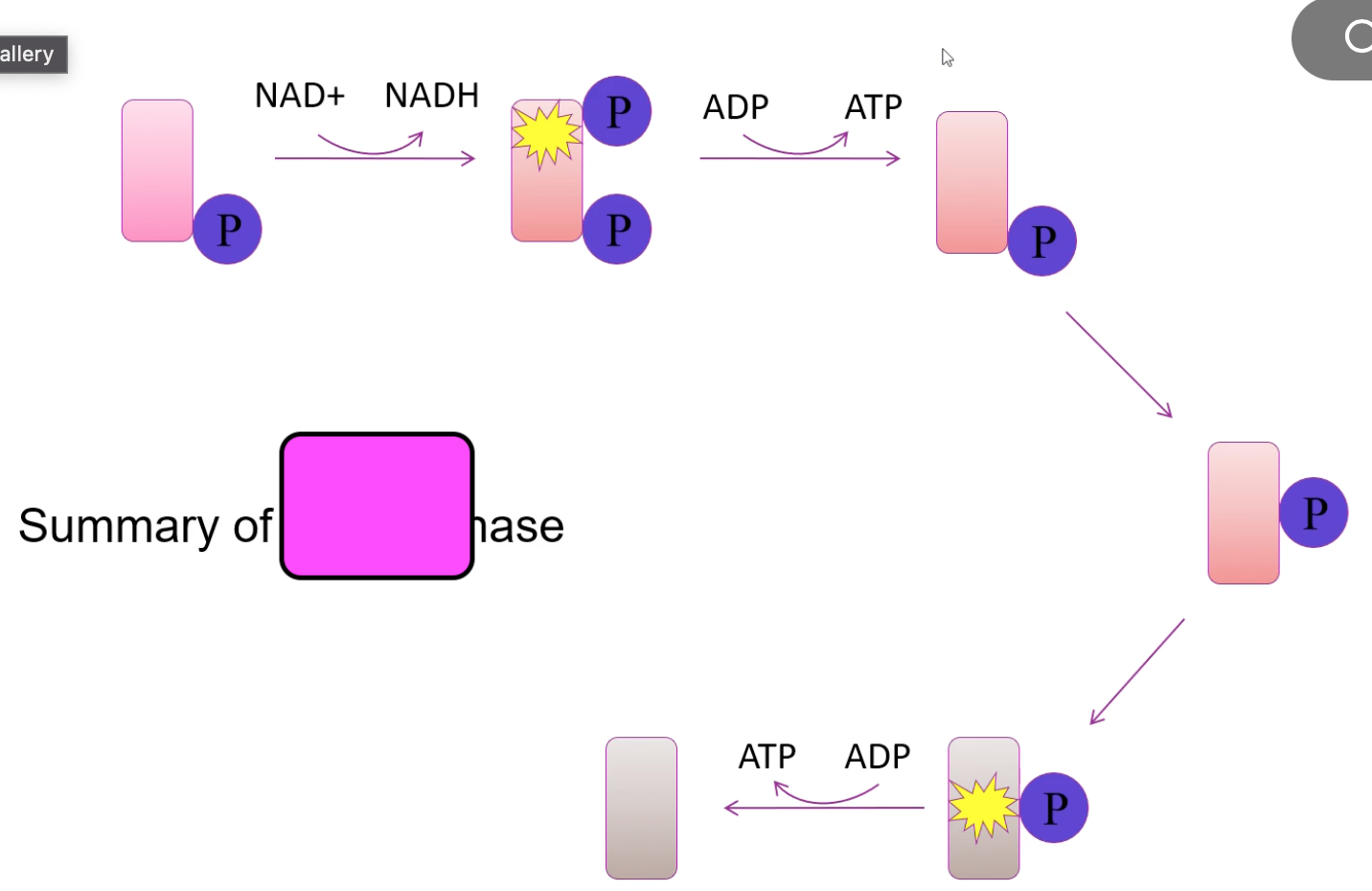
payoff phase
how many mCs of ATP did you get from payoff phase
in glycolytic pathway, what’s the total amount of ATP you get?
in glycolytic pathway, what’s the net amount of ATP you get?
4
4
2
fermentation:
what is it
reaction after glycolysis
why does it happen?
when/where does fermentation happen
fed state?
why important
what if person has LDH mutation?
fermentation = extract E but does not use O2 or change NAD+/NADH ratio
rxn in pic
NAD+ is a necessary reactant for glycolysis to run (step 6). However, running glycolysis full tilt depletes NAD+ stores
fermentation happens when you need ATP but have depleted NAD+ and can’t perform glycolytic pathway,
common in muscles during strenuous exercise
can be well fed and have plenty of sugar, NAD+ depletion will still stop glycolysis
important bc regenerates NAD+ so glycolysis can run forward again
can’t do strenuous activity
