AP Psych Unit 5 Test (1.6-2.1) Sensation and Perception
 Call Kai
 Learn
 Practice Test
 Spaced Repetition
 Match
 Flashcards
 Knowt Play
1/83

There's no tags or description
Looks like no tags are added yet.
84 Terms
Sensation
How we detect data from environment and encode it as neural signals.
Bottom-processing is an example of…..
Sensation
Perception
How we select, organize and interpret information
Top-down process is an example of…
Perception
Perception is in the ____ hemisphere
Right
Sensation is in the ____ hemisphere
Left
Top-down processing
Brain uses pre-existing knowledge to interpret incoming sensory information.
The law of closure is an example of…..
Top-down processing
Bottom-up processing
Brain comes to a conclusion from raw sensory data
Signal detection theory
The intensity of the stimuli and the psychological and physical state of the person contribute to whether or not the person is able to detect stimuli.
Signal detection theory argues that….
A person’s experience, expectations, motivation, and alertness affects detection of stimuli
Perceptual set
Mental predisposition/expectation to perceive a certain way.
Perceptual set is an example of ________ processing
Top-down
Sensory Habituation
When receptor cells become less responsive due to repeated stimulation. Ex: learning
Sensory Adaptation
Diminished sensitivity after constant stimulation
Transduction
The process that converts light into electrical signals in the cells of the retina
Sensory information from the eye travels to the….
Thalamus then occipital lobes
Retinal ganglion cells
Transmit visual information from the eye to the brain
Retinal ganglion cells help identify…
Specific elements like shapes angles and edges

1 is the…
Cornea

2 is the…
Iris

3 is the…
Lens
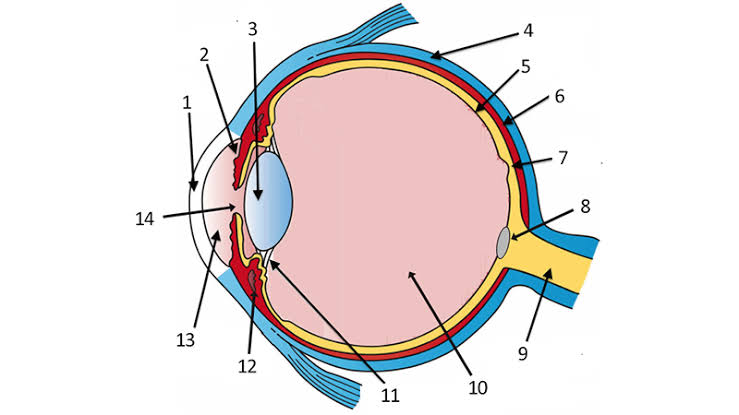
5 is the…
Retina

7 is the….
Fovea

8 is the…
Blind spot

9 is the…
Optic nerve

14 is the…
Pupil
Iris
Colored part of the eye, controls the size of the pupil to optimize light
Pupil
Opening in the iris that allows in light
Cornea
Protects eye and light enters through
Lens
Focus accomodation
Fovea
Point of central focus that contains cones but NOT rods
Blind spot
Region of the retina where the optic nerve leaves the eye, NO rods and NO cones
Optic nerve
Carries nerve impulses from retina to the brain
Retina
Inner surface of the eye sensitive to light and full of rods and cones
Rods
Low light, peripheral vision, see movement
Cones
Bright light + colors
We don’t notice out blind spot because…
The spot in one eye doesn’t match the one in the other so each eye fills in information. Also the brain sometimes fills in information.
Depth perception
Visual ability to see distance and perceive the world in 3D
Binocular cues
Visual signals that require both eyes working together to perceive depth, distance, and three-dimensional space
Monocular cues
Visual signals that allow a single eye to judge depth, distance, and the three-dimensional structure of a scene. Ex: MC Escher
Proximity (Gestalt)
Objects tend to be grouped together if they are similar
Continuity (Gestalt)
When there is an intersection between two or more objects people tend to perceive each object as a single, uninterrupted object.
Closure (Gestalt)
Visual connection or continuity between sets of elements which do not actually touch each other in a composition.
Similarity (Gestalt)
Objects tend to be grouped together if they are similar
Trichromatic theory
3 types of color cone receptors (RGB) but doesn’t explain afterimages and color blindness.
Opponent Process theory
Opposing retinal processes enable color vision + complementary color vision
Phi Phenomenon
Perceptual illusion that tricks you eyes into thinking that still images are actually moving
Stroboscopic Movement
Visual phenomenon in which viewing a series of slightly varying pictures in a rapid succession produces the effect of continuous movement.

H is the…
Outer ear

I is the…
Middle ear

J is the…
Inner ear
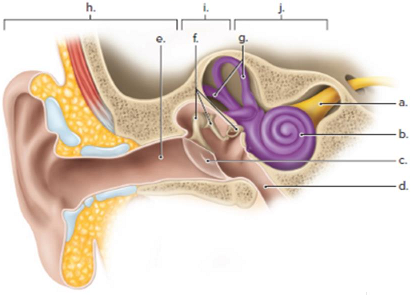
E is the…
Ear canal

F is the…
Ossicles: hammer, anvil, stirrup

G is the…
Semicircular canals

B is the…
Cochlea

A is the…
Auditory nerve
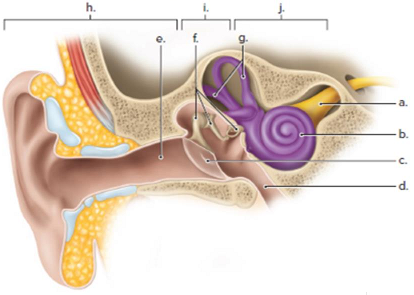
C is the…
Eardrum
Outer ear
Where hearing begins
Middle ear
Consists of 3 tiny bones
Inner ear
Maintains + controls balance
Ear canal
Where the sound waves pass through
Auditory nerve
Connects to the auditory cortex in the TEMPORAL lobe
The cochlea contains…
Hair cells, basilar membrane and the organ of corti
Organ of corti
Produces nerve impulses
Amplitude
Strength of sound (height of the waves)
Frequency
Length of the wave, determines pitch
Place Theory
Different frequency of sound allows for locating called sound localizations
Frequency theory
Tone produces vibration
Conductive deafness
Sound waves cannot travel effectively through the outer or middle ear to reach the inner ear
Sensorineurak deafness
Hair cells in the cochlea are damaged
Tinnitus
Ringing in the ears due to exposure of loud noises.
Gate control theory
The spinal cord acts as a "gate" that either blocks pain signals or lets them pass through to the brain.
Vestibular sense
Body's internal balance and spatial orientation system
Kinesthetic Sense
Body's ability to perceive its own movement, posture, and coordination without relying on sight
Sensory interaction
Vision + balance, smell + taste
Priming
Unconscious activation of perception or memory
Convergence
When eyes move inwards to enable depth perception
Change blindness
Invisible Gorilla experiment
Bipolar/Ganglion cells
Where transduction occurs in the eye
Color constancy
Color doesn’t change in different lights
Feature Detectors
Cells in the visual cortex that have specific functions (shapes etc.)
Figure ground
Perceive objects to stand out from surroundings
Basilar Membrane
Holds hair cells in the cochlea