Physics Exam 4 Content
 Call Kai
 Learn
 Practice Test
 Spaced Repetition
 Match
 Flashcards
 Knowt Play
1/61

There's no tags or description
Looks like no tags are added yet.
62 Terms
what is direct current
the flow of electric charge only in ONE direction aka a steady state of a constant-voltage circuit

what is alternating current
the flow of electric charge that periodically REVERSES direction. the source varies periodically, specifically sinusoidally

generating AC vs DC
DC: batteries provide DC via a chemical reaction
AC: produced by an alternator; it produces an alternating current
what is the main level between DC and AC
DC: voltage or current stays constant
AC: voltages and current reverse when flow of charge changes periodically
can we have a circuit with a capacitor and resistor?
yes, they are called RC circuits
what is the function of an RC circuit
To control the amount of current flowing through a circuit by limiting the rate at which the voltage across it changes. it can help with filtering signals, timing circuits, and managing voltage surges
in a RC circuit, what happens when the current reaches the capacitor
The charge will build up until it is fully charged, then the capacitor will change as a resistor
for an RC circuit, as t goes to infinity, the charge on the capacitor approaches
Q=Cε .
how do we know if the capacitor is fully charged
Q=C
what is the relationship between time and charging capacitor
it is an exponential relationship

how do capacitors in RC circuits behave at t=0
short circuits, aka when the battery were connected to two resistors R in parallel
how does a capacitor behave when fully charged
like an open switch and will redirect the circuit to only go through one of the resistors (breaks circuit)
how do you discharge a capacitor
by closing the switch in the system
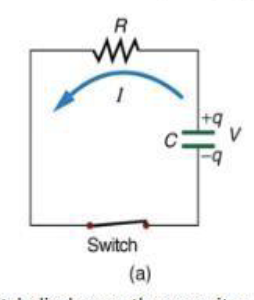
describe the rate at which capacitor discharges
voltage decreases exponentially

how do you find the time constant on the capacitor and what does it represent
R=resistance (ohms) and C=capacitor (F)
it represents how long it takes for the capacitor to get to its new voltage (either as charged or discharged)

charging vs discharging
charging: current flows and charge builds up on the capacitor
discharging: current flows in the opposite direction until charge drops to zero
describe the conditions needed for charging a capacitor
switch is closed and battery is connected to an uncharged RC circuit
describe the conditions needed for discharging a capacitor
a charged capacitor is connected across a resistor, it will discharge (usually no battery)
describe how a charging capacitor will act when t=0 vs when it is fully charged
t=0: will act like a short circuit (draws current)
when fully charged: it will behave is an open circuit and block current (as in not draw any current into it)
how do you calculate charge and current for charging capacitor

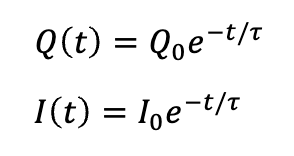
what does charge and current look like overtime for a charging capacitor
charge increase (charging) exponentially, and as the capacitor charge increases, it will behave more and more like an open circuit (stopping some current flow)

what does charge and current look like overtime for a discharging capacitor
charge is decreasing because it is discharging and current decreases (started at its maximum as charged and now decreasing)

how do you calculate finding charge and current during discharging

which ones are experiencing repulsion? attraction?

what happens when a bar magnet is broken in half
two new poles appear and each half has a north and south pole


what is wrong with this image
magnetic field lines CANNOT cross.
describe magnetic field lines
they form closed loops, no magnetic charge for them to “begin and end” on. they will point only one direction
describe a magnetic field in terms of north and south pole
magnetic field lines come out of the north pole (emerging) and enter the south pole. inside, they go from south to north

magnetic field lines always form
closed loops
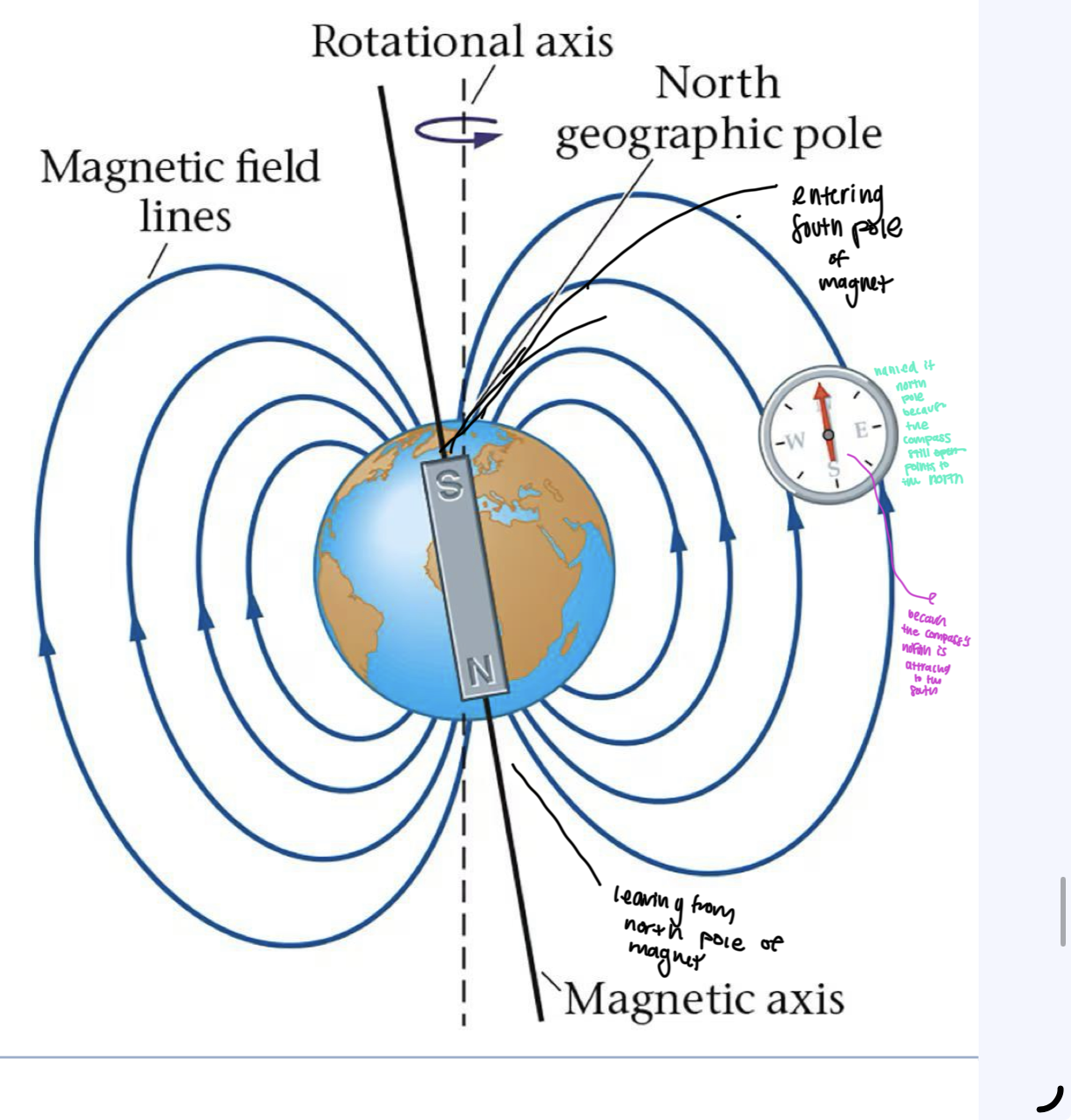
what is unique about Earth’s north and south pole
the north pole is actually the magnetic south pole and the south pole is actually the magnetic north pole. it is because a compass points north bc it is attracted to the south pole. the compass points south towards the actual north pole
what is the formula of the force the charge experience when it is moving through a magnetic field
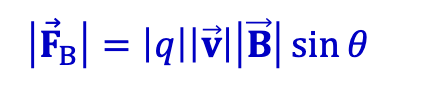

what does Fb represent here
the magnitude of the magnetic force on a moving charge
what is the magnetic force on a moving charge

what is the unit of 1 gauss in teslas
1 guass = 1 G = 10^-4 T
how do we find the direction magnetic force
right hand rule
index=velocity
middle=magnetic field
thumb=force
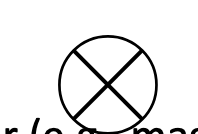
what is this direction
into the page

what direction is this vector
pointing out of the page
the right hand rule gives the direction of the force on what kind of charge
positive
you will need to flip your hand to get the negative one
in a magnetic field, the force is what direction to the field
perpendicular
how would you describe the path of the motion of a charged particle? why is this way?
the path of a particle is circular if the magnetic force and velocity are perpendicular to the magnetic field
does the constant magnetic field do work on a particle? will it change the particle’s velocity?
no, so it will not change the particle’s velocity (an electric field can do work on a particle:
what is going on to magnetic and electric forces at a velocity selector
the electric and magnetic forces will be balanced
what is the relationship to velocity, electric, and magnetic forces
at the right speed (velocity), electric and magnetic forces will be balanced
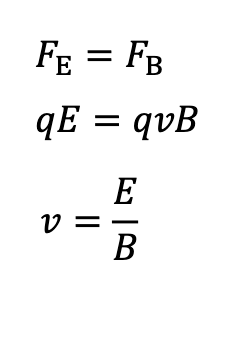
what is a flow meter
where magnetic force separates positive and negative charges to create an electric field/measurable potential difference

how does the flow rate affect force and separation of charges in a flow meter
the faster the flow→the greater the force→more separation the positive and negative charges→stronger potential difference
how do you define the radius of a moving charge in terms of magnetic field and velocity

charged particles moving in a magnetic field resemble what kind of force
centripetal force
if a charged particle’s velocity magnitude is constant, what is its kinetic energy
also constant
what is the relationship between radius of the path of a moving charged particle in a magnetic field and its charge
the larger the charge=smaller the radius

why do we say the magnitude velocity of a charge moving in a constant magnetic field is constant and not just velocity
because the direction is changing but not the actual value. velocity is a vector value
when figuring out which angle to find the magnetic force, do we use the smaller or the larger one
smaller one (sometimes will have to do minus 360)