Genetic Distance and Molecular Evolution Models
 Call Kai
 Learn
 Practice Test
 Spaced Repetition
 Match
 Flashcards
 Knowt Play
1/20

Earn XP
Description and Tags
Vocabulary practice flashcards covering genetic distance, forensic DNA markers, sequence distance metrics, and nucleotide substitution models (Jukes-Cantor, Kimura, Tamura, and GTR).
21 Terms
Genetic Distance
A measure of the evolutionary divergence and sequence differences between two organisms or sequences, used to estimate time frames, reconstruct phylogenies, align sequences, and evaluate functionality.
Microsatellite DNA
Fast-evolving, generally euchromatic repetitive DNA sequences consisting of repeat units of 2–4bp (most often 2bp) repeated on the order of 10–100 times, useful for population-level studies and distinguishing individuals.
CODIS (Combined DNA Index System)
An FBI-established database created in 1994 (pilot project in 1990; operational in 1998) containing DNA profiles and specimen numbers based on core Short Tandem Repeat (STR) loci.
AMEL Locus
A marker located on the X and Y chromosomes included in CODIS profiling used to determine the biological sex of an individual.
Distance Metric Requirements in genetic distance ($)
The four mathematical properties that a distance metric must satisfy:
nonnegativity (dAB≥0)
uniqueness (dAB=0 implies A=B)
symmetry (dAB=dBA)
triangle inequality (dAC≤dAB+dBC).

Hamming Distance
A distance metric defined as the minimum number of substitutions between two sequences, or the raw proportion of mismatched sites calculated as D=nk, where k is nucleotide differences and n is the total number of sites.
LCS Distance
A distance metric based on the longest common substring/subsequence, defined as the minimum number of insertions and deletions needed to transform one sequence into another.
Edit Distance
A distance metric defined as the minimum total number of substitutions, insertions, and deletions needed to convert one sequence into another.
Saturation Problem
The phenomenon where observed sequence distance levels off over evolutionary time because random mutations cause sites to change back or match by chance (a theoretical maximum difference of 75% when choosing among four nucleotides at random), causing raw Hamming counts to underestimate actual mutations.
Jukes-Cantor Model
A one-parameter nucleotide substitution model assuming that substitutions arise at any site with equal frequency, every base changes to any of the other three with equal probability (α), base frequencies are equal (0.25 each), and gaps or indels are not considered. (does not account for tranversions vs transitions)
Jukes-Cantor Distance (DJC)
An estimate of the true evolutionary divergence calculated as DJC=−43ln(1−34D), which corrects the observed Hamming distance D for multiple substitutions and back-mutations at the same site.
Differences between Hamming distances and Jukes Cantor
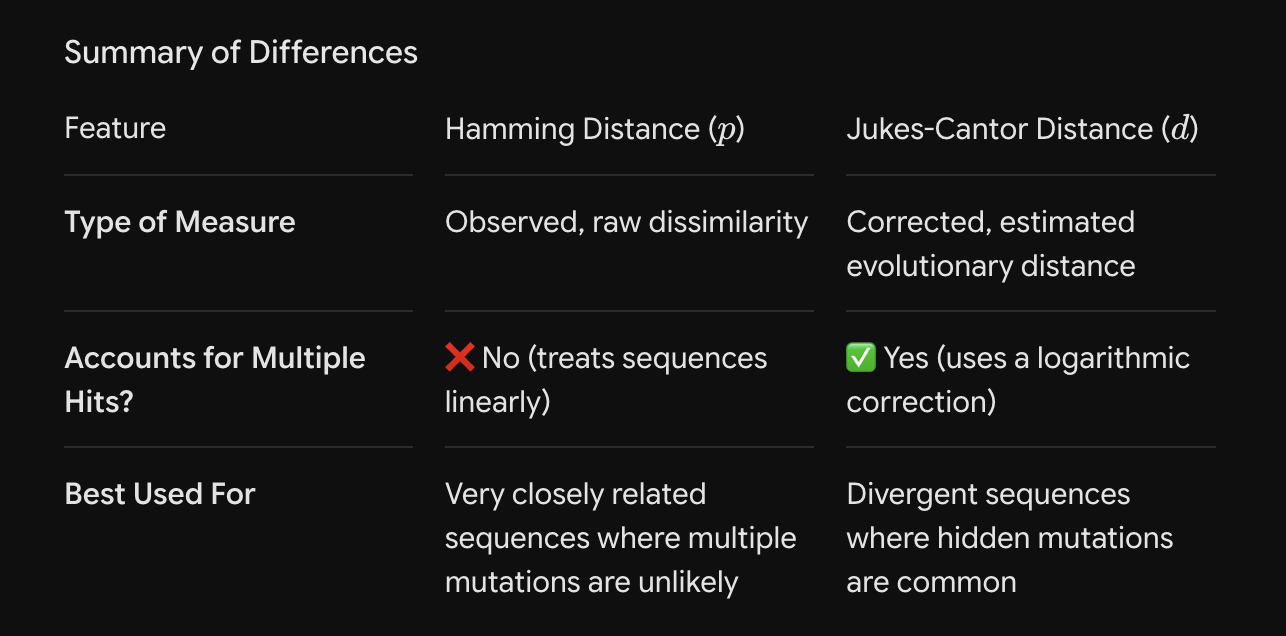
What is a con of hamming distance that Jukes cantor resolves?
Hamming distance does not account for multiple substitutions at the same site, while the Jukes-Cantor model corrects for these by estimating true evolutionary divergence.
Transition
A nucleotide substitution that occurs within the same chemical class: between purines (A↔G) or between pyrimidines (C↔T).
Transversion
A nucleotide substitution that interchanges a purine and a pyrimidine (A↔T, A↔C, T↔G, or C↔G).
Transition Saturation in mtDNA
The observation that transition substitutions at third-codon positions saturate very rapidly as evolutionary distance increases, causing the transition-to-transversion ratio to drop, while transversions continue to increase linearly.
Kimura Two-Parameter Model (K2P)
A substitution model assuming equal nucleotide frequencies (0.25 each) while allowing transitions and transversions to occur at different rates (α and β, respectively).
Tamura's (1992) Model
A nucleotide substitution model that relaxes the equal base frequency assumption of the Kimura two-parameter model by incorporating a parameter for GC-content bias (θ1=πG+πC).
Tamura and Nei's (1993) Model
A substitution model tailored for mitochondria that permits different rates between A↔G transitions and T↔C transitions while assigning a unique equilibrium frequency to each of the four nucleotides.
General Time Reversible (GTR) Model
A comprehensive substitution model that allows all six pair-exchange rates and all four nucleotide equilibrium frequencies to differ independently.
Evolutionary Divergence (2μt)
The total expected number of substitutions per site between two lineages since their divergence from a common ancestor, frequently denoted as k, where μ is the substitution rate and t is time.