chemical chirality midterm
 Call Kai
 Learn
 Practice Test
 Spaced Repetition
 Match
 Flashcards
 Knowt Play
1/107

There's no tags or description
Looks like no tags are added yet.
108 Terms
methyl salicylate structure
Functional group?
Describe
Functional Group: ester
liquid w/ minty smell

Salicylic Acid structure
Functional group?
Describe - impure vs pure form
Functional group: - Carboxylic acid
- phenol group
Solid
Impure -> white powder
Pure -> white, needle-shaped crystals
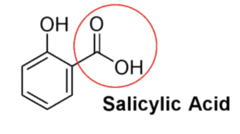
Draw Scheme 1 Synthesis of Salicylic Acid

Why do we say base promoted hydrolysis occurred versus base catalyzed hydrolysis for the synthesis of salicylic acid from Me Salicylate
Based (OH-) is the nuc that adds to the ester and forms part of the product. It participates in the rxn but is not regenerated later.
Saponification
the reaction between a fat and a strong base to produce glycerol and the salt of a fatty acid (soap)
% yield
actual/theoretical x100
Multistep synthesis % yield eq.
mult yields of each step as a decimal then mult. by 100
Recrystallization def
way to purify solid organic compound by using a suitable solvent
Recrystallization technique:
2 steps
Fast or slow cooling and why?
1. Melt impure solid in hot solvent -> breaks down impure crystal lattice
2. Slow cool (on bench top until substantial crystals formed then ice-water bath) -> leads to bigger, purer crystals because impurity molecules have enough time to return to the soln
Rule for selecting a good solvent
The solid you are trying to purify should be soluble in the hot solvent and insoluble in cold or room temp. solvent
vacuum filtration apparatus and why
(4)
- front facing
- clamped -> to keep from tipping over
- adapter used -> tight seal b/w Buchner funnel and vacuum filter flask
- heavy-walled rubber tubing -> prevent tubing from collapsing from atmospheric pressure on the outside when vacuum is applied
vacuum filtration use
quickly and completely separate a solid from the liquid with which it is mixed
Calc. melting point range
1st reading of range = temp @ which solid block first begins to liquefy
2nd reading range = temp. at which solid is completely melted
Impurities will ______ the observed MP of a compound
Lower
Thermometer lag
occurs when the sample melts before the thermometer has a chance to reach that temperature-leading to a depressed MP range
Melting point capillary tubes have ______ open ends
1 open and 1 closed end
Hazard label of NaOH
Corrosive
Hazard Label of HCl
Corrosive
At what approximate temperature will the reaction mixture containing methyl salicylate and 30 mL of an aqueous solution of 4M sodium hydroxide boil? (hint: aqueous)
100 degrees celsius
Why is it important to clamp your vacuum filter flask, even though it has a flat bottom?
to prevent it from tipping over
Salicylic acid has some solubility in water. What would happen if you washed your crystals with too much water, during vacuum filtration?
you may wash away or lose some product
Why is it necessary to empty out the the filtrate from the vacuum filter flask, before pulling air over the crystals being dried inside the Buchner funnel?
ensures vacuum's full pressure is being used to dry product
why do we break down SA crystals
make them dry faster
Purpose of Lab A:
treat Me SA with NaOH and HCl to convert ester functional group to a carboxylic acid functional group
Aspirin structure
Functional group
Functional groups:
- ester
- carboxylic acid group

Scheme 2. Synthesis of Aspirin

what's important about the esterification rxn of SA into Aspirin? Why do we use excess acetic anhydride?
Equilibrium rxn
Excess acetic anhydride is used to drive the rxn towards completion and as a solvent
Phosphoric Acid Hazard
corrosive
Why do you carry out the aspirin synthesis in an Erlenmeyer flask rather than a beaker?
Erlen flask has sloped sides so it prevents solvents from evaporating out of the flask too easily
Why do we use a powder funnel to transfer SA to erlen flask in Lab B?
Powder funnels are used for dry solids and never wet solids since wet solids will make us lose products since it'll get stuck in the stem
Small scale solvent test
two test tubes one w/ each solvent
the one that doesn't dissolve at room temp may be the better solvent of choice
based on lab B results what was the better solvent of choice for the recrystallization of aspirin
ethanol
impure aspirin
yellowish-white powder
pure aspirin
white, small, shiny, needle-shaped crystals
aq FeCl3 + pure aspirin would give
yellow solution
Immiscible
liquids that are not soluble in each other; can't form a homogenous solution
you must have two _________ liquids to carry out a liquid-liquid extraction
immiscible
extraction
technique used for the isolation and purification of organic compounds
layers settle depending on their
densities
more dense solvents go on the bottom
less dense float to the top
theory of extraction
better to do several smaller extractions than one big extraction to maximize amount extracted
what are drying agents
anhydrous salts (devoid of water) that combine with water that is mixed in with your product and retains it as water of crystallization
liquid (now free of water) passes through gravity filter paper leaving hydrated salts behind
when would you use gravity filtration vs vacuum filtration
what kind of funnel does each use
gravity
- solute is mixed w/ low-boiling solvent
- used to filter drying agents
- uses a powder funnel
vacuum
- when solute is mixed with high-boiling organic & water
- employers buchner funnel
why should vacuum filtration not be used for volatile or low-boiling solvents
solvent will evaporate during the filtration and contaminate the product crystals with impurities that have just been removed
what is in the solid after the filtration of the methyl salicylate synthesis
salicylic acid, H2O,
what is in the filtrate of the methyl salicylate synthesis
NaCl, MeOh, H2O, excess HCl
How would melting point be affected if you determined it before crystals were dry
lower b/c crystal lattice structure has more impurities making it break up faster
what is in the filtrate of the salicylic acid synthesis
acetic acid, H2O, H3PO4, acetic anhydride
what is in the solid of the salicylic acid synthesis
aspirin, water, trace salicylic acid
synthesis of aspirin performed NEAT (without solvent) and water was added later. If reaction was performed in water how would the results be different
lower yield of aspirin b/c salicylic acid has low solubility in water
aspirin could revert back to salicylic acid in water
why is it important to turn vacuum off when you aren’t using suction
damage equipment results in weaker vacuum pressure
could start to get backflow where filtrate goes into vacuum tube
what compounds will result in bright purple color with the addition of FeCl3
compounds with free OH group
The following symbol in the NFPA diamond means the chemical will react when exposed to water:
True
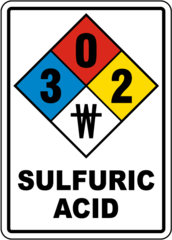
In the NFPA symbol shown here, which of the following would indicate the greatest flammability risk?
Red

For this lab class, eye protection must:
Cover the eyes fully and provide indirect ventilation.
This GHS pictogram indicates that the substance is:
Acutely Toxic

What is red on the MSDS?
Flammability
What is blue on the MSDS?
Health
What is white on the MSDS?
Special
What is yellow on the MSDS?
Reactivity
On the MSDS, the higher the number in the quadrants, the more?
Hazardous
On the white quadrant of the MSDS, what does W with a line through it mean?
Dangerous reaction with water
On the white quadrant of the MSDS, what does OX mean?
Strong oxidizer
During a melting point determination, why is it important to use a finely powdered sample?
a.
It heats faster
b.
Ease of getting it into a capillary tube
c.
It helps distinguish the impurities from the sample
d.
The sample should be finely powdered to aid heat transfer throughout the sample
d.
The sample should be finely powdered to aid heat transfer throughout the sample
You have an unknown with an observed melting point of 90 to 93 C. Is your unknown compound A with a reported melting point of 95.5-96 C or compound B with a reported melting point of 90.5-91 C?
a.
None of the above
b.
The unknown is compound B
c.
The unknown is compound A
d.
Hard to say. It can be either compound A or B
c.
The unknown is compound A
A pure compound melts at 50-51 °C. If a trace amount of an impure compound, whose melting point is 70-72 °C, is mixed in with the first compound, what happens to the melting point?
a. The second compound would lower the melting point of the first one.
b. The second compound would raise the melting point of the first one.
c. It is impossible to determine without knowing the identity of the two compounds.
d. The second compound would have no effect on the melting point
a. The second compound would lower the melting point of the first one.
Which of the following is the most dense?
a.
1-octanol
b.
hydrochloric acid
c.
diethyl ether
d.
hexane
e.
malonic acid
e.
malonic acid
Which of the following terms does not apply to mixing a solid with a liquid?
a.
immiscible
b.
soluble
c.
partially soluble
d.
solute
e.
insoluble
a.
immiscible
If the procedure requires 250 mg of biphenyl, how many grams of biphenyl should be measured?
a.
25.0
b.
250
c.
0.250
d.
0.00250
e.
2.50
c.
0.250
Benzoic acid is soluble in what solvent and why?
a.
It is soluble in water because it reacts with water to form a water soluble salt.
b.
It is soluble in HCl because it forms a salt with the acid. The salt being ionic it is soluble in aqueous solution.
c.
It is soluble in NaOH solution because it react with the base and form a water soluble salt.
d.
It is soluble in water because it forms hydrogen bonding with water
c.
It is soluble in NaOH solution because it react with the base and form a water soluble salt.
What is the name of the property that you are instructed to calculate that is equal to:
weight of substance isolated/weight of original material x100
a.
recovery
b.
percent recovery
c.
weight percent
d.
yield
e.
percent yield
b.
percent recovery
A student starts with 1.034 g of impure sulfanilamide. After purification, the student isolates 0.724 g. of pure sulfanilamide. What is the student's percent recovery?
a.
29.98
b.
73.74
c.
142.8
d.
70.02
e.
42.82
d.
70.02
What makes for an ideal solvent for recrystallization?
a.
high solubility at low and high temperatures
b.
low solubility at low and high temperatures
c.
equal solubility at low and high temperatures
d.
high solubility at low temperatures and low solubility at high temperatures
e.
low solubility at low temperatures and high solubility at high temperatures
e.
low solubility at low temperatures and high solubility at high temperatures
The general procedure for a recrystallization is:
dissolve solid
remove insoluble impurities
crystallize
collect and dry crystals
True or False?
True
The solubility of compound A in ethanol is 0.3 g per 100 mL at 0 ºC and 5 g per 100 mL at 78 ºC. What is the minimum amount of solvent needed to recrystallize 7.0 g of compound A? How much would be lost in the recrystallization?
a.
200 mL needed to recrystallize the sample and 0.6 g is lost.
b.
140 mL needed to recrystallize the sample and 3 g is lost.
c.
120 mL needed to recrystallize the sample and 0.3 g is lost.
d.
140 mL needed to recrystallize the sample and 0.42 g is lost.
d.
140 mL needed to recrystallize the sample and 0.42 g is lost.
Which of the following is a liquid at room temperature and has the highest density?
a.
water
b.
dichloromethane (or methylene chloride, CH2Cl2)
c.
caffeine
d.
sodium sulfate
e.
sodium carbonate
b.
dichloromethane (or methylene chloride, CH2Cl2)
Why should each sample be tightly packed into the capillary tube prior to heating?
tight compaction makes heat transfer more efficient
predict the solubility of octanoic acid in water and NaOH
water - insoluble because octanoic is nonpolar
NaOH - soluble because octanoic acid reacts with NaOH (a base)

lachrymator
Irritant that causes tearing (watering of the eyes, think onions)
Carcinogen
substance that is known/believed to cause cancer (not-so-fun-fact: dichloromethane is one!)
Teratogen
Cause malformations of an embryo or fetus
aspirin structure

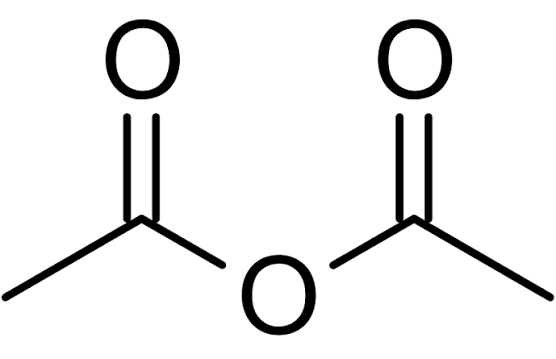
acetic anhydride structure
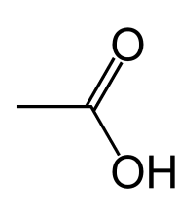
acetic acid structure
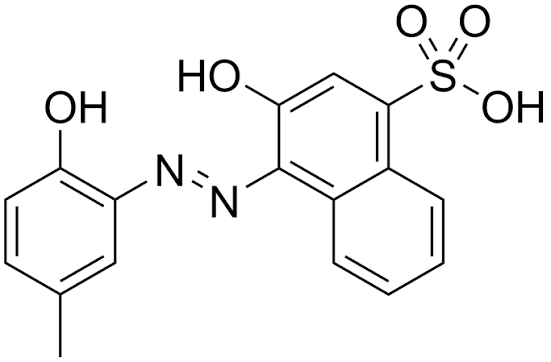
calmagite structure
benzil structure

quinizarin structure

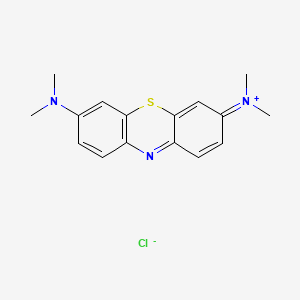
methylene blue structure
ethyl acetate structure

ethyl ether structure

chloroform

dichloromethane

(1R, 2S) - (-) - ephedrine

mandelic acid

(1R, 2S) - (-) - ephedrine hydrochloride

what layers do ethyl acetate and water form in sep funnel
water aqueous layer on bottom, ethyl acetate organic layer on top
10 ml dcm/chloroform and 10 ml water in sep funnel
dcm in bottom layer, water in top
10 ml of water and 10 ml of ethanol in sep funnel
become one solution, ethanol water soluble because of polarity in OH group
10 ml of methylene blue in dcm and 10 ml of water in a sep funnel
top layer methylene blue in water, bottom layer organic dcm
explain observed solubility of quinizarin
insoluble in water and highly soluble in dcm. when mixed with NaOH, it forms charged molecules making it soluble in aqeuous solution, separating from the dcm
what does large peak at 7.26 mean in HNMR
chloroform contamination