Avian Bio: Musculoskeletal system
 Call Kai
 Learn
 Practice Test
 Spaced Repetition
 Match
 Flashcards
 Knowt Play
1/33

There's no tags or description
Looks like no tags are added yet.
34 Terms
Bird skeletons are generally characterized by…
Fusion and reduction of elements: fingers are fused, lost phalanges, weight reduction for flight
Pneumatization: air space in bones for air sacs and weight reduction, no cost to strength.

Maxilla and premaxilla
Pink lines on image. The maxilla is upper jaw. The premaxilla is most of beak. Covered by keratin (rhamphotheca).

Mandible
Blue line on image. Lower jaw, articular (a bone at the back of the lower jaw that forms part of the jaw joint, where the lower jaw connects to the skull) and dentary (the main bone forming the front and much of the lower jaw)

Jaw joint made up of…
Purple line. Quadrate (between upper) and articular (lower jaw)

Vertebral column: Cervical vertebrae
The section in red. (neck vertebrae, there’s lot of them). There is atlas (C1) and axis (C2).

Vertebral column: Pleurophophyses
Lines in green. Cervical ribs (spikey things that jut out)

Thoratic vertebrae
“Backbone”, often fused together. Black line points to vertebral ribs that are attached.

Uncinate processes (unique to birds)
Blue line, jut out the ribs. This increases structural rigidity and muscle attachment.

Sternum: Sternal ribs and carina
Teal lines.
Sternal ribs on the top.
Carina, “keel”, bottom line this increases surface area of attachment of supracoracoideus (chest muscle that lifts the wings upward during the recovery stroke) and pectoralis (muscle that pulls the wings downward).

Synsacrum
Purple line, fused pelvis also unique to birds. Contains lilium, ischium, pubis, sacrum.

pectoral girdle: Furcula
pink line, fused clavicles (wishbone)
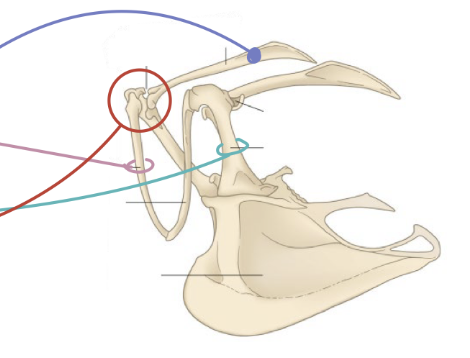
pectoral girdle: Scapula
purple line

pectoral girdle: Coracoid
teal line

pectoral girdle: Triosseal canal
red line. The space formed at the junction of the rest of the pectoral girdle. this creates a passage for the supracoracoideus tendon.

Humerous
red line

Ulna
yellow line. Site of secondary feather attachment.

Radius
green line

Radiale & ulnare
blue line

Carpometacarpus
purple line. Site of primary feather attachment

Pelvic girdle: Synsacrum
pink line
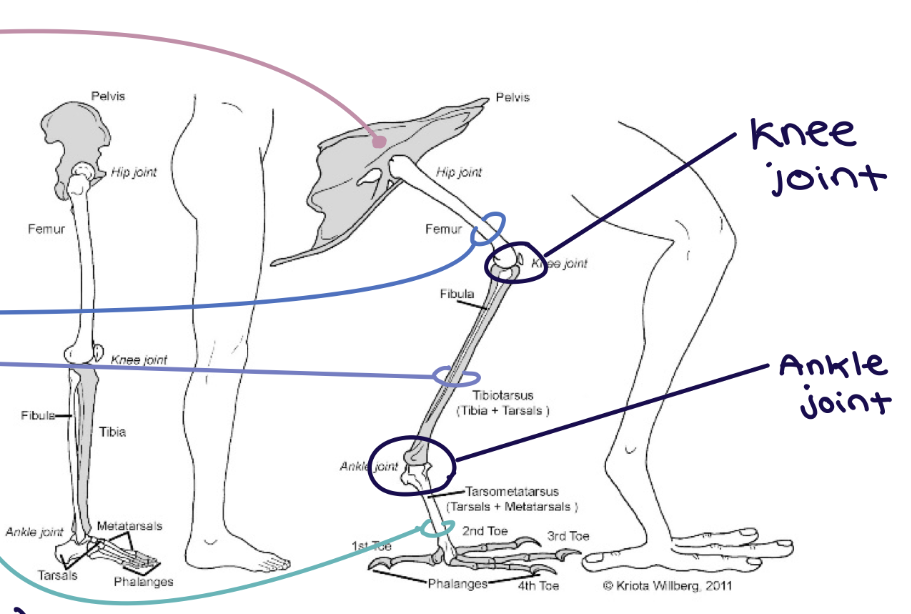
Pelvic girdle: Acetabulum
Hole for femur articulation

Pelvic girdle: Femur
Blue line
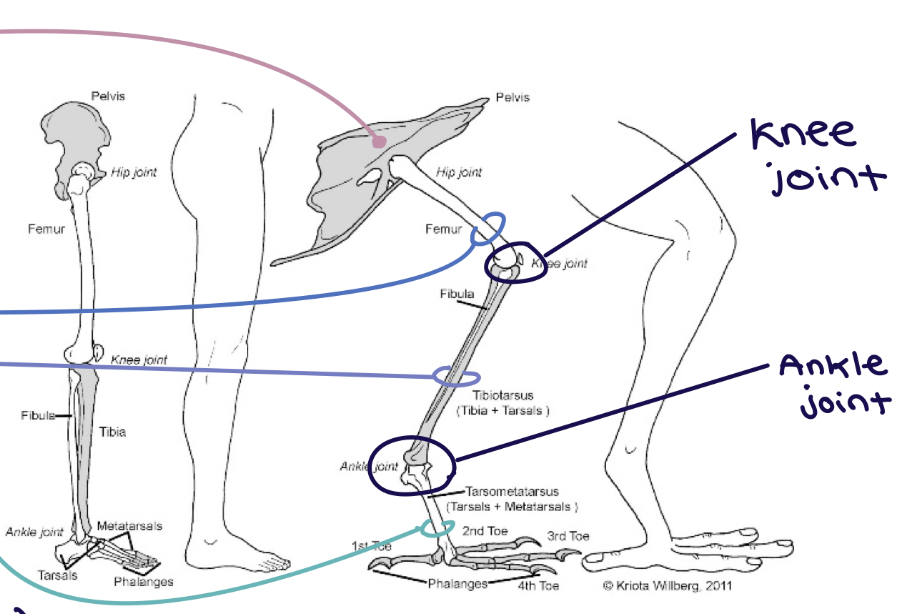
Pelvic girdle: Tibiotarsus
purple line. Fusion of tibia "+ tarsul (some).

Pelvic girdle: Tarsometatarsus
teal line. Fusion of the rest of the tarsuls + metatarsul
Pelvic girdle: digits, toe arrangements
Anisodactyl: (3rd toe forward and one back)
Zygodactyl: (2 toes forward and 2 toes back)

Pelvic girdle: digits, number
Variable between 2-4, some have lost D1 and D2. For example ostrich, the toe reduction results in a hoove-like foot that makes running easier.
Pelvic girdle: digits, claws
Vary according to ecology, curvature increases with arboreality (ability to live in trees).

Jaw apparatus: Jaw closers, Adductor mandibulae
teal line. Elevate lower jaw to close mouth.
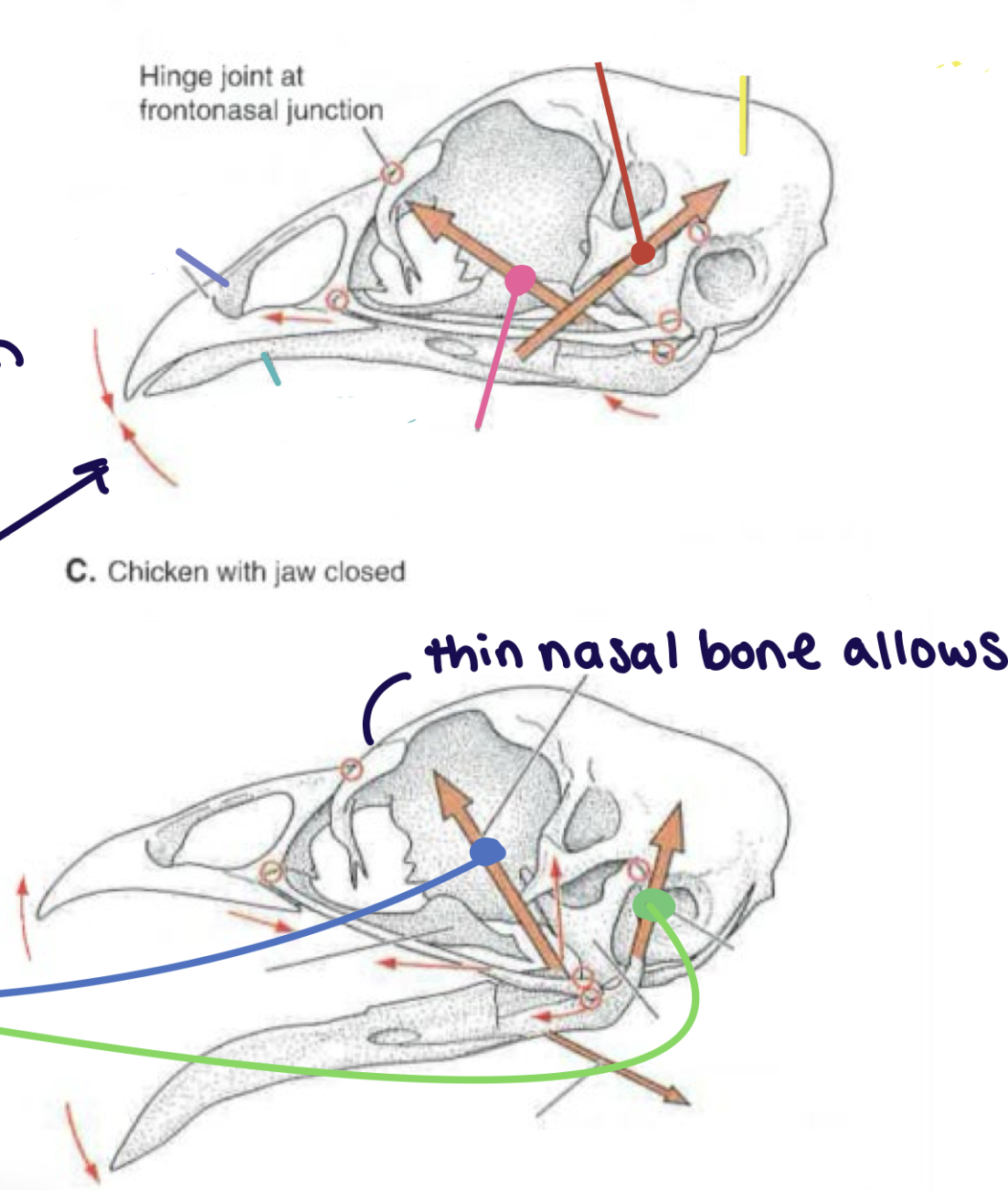
Jaw apparatus: Jaw closers, Pterygoideus
Pink line. Elevates lower jaw, depresses upper jaw.

Jaw apparatus: Jaw openers, Depressor mandibulae
green line

Jaw apparatus: Jaw openers, Protractor pterygoidei
blue line. Protrcts quadrate bone to elevate beak.
Jaw apparatus: Cranial kinesis
Mobility between upper beak and cramium.
Jaw apparatus: Prokinesis
This is the bending of the upper beak around cranial face hinge, this applies to most birds.
Jaw apparatus: Rhynokinesis
Movement of the upper beak further down the beak. This happens in ratites, sharebirds, hummingbirds