lipids (structure, nomenclature, properties)
 Call Kai
 Learn
Learn Practice Test
 Spaced Repetition
 Match
Match Flashcards
 Knowt Play
1/272

There's no tags or description
Looks like no tags are added yet.
Name | Mastery | Learn | Test | Matching | Spaced | Call with Kai | Chat |
|---|
No analytics yet
Send a link to your students to track their progress
273 Terms
lipids are ___ compounds
organic
lipids and water
mostly hydrophobic (nonpolar)
lipids are good for
storage
why are lipids good storage molecules
Stored without a lot of water (not heavy)--> good source of rapid energy when needed by the body
some lipids are _____
amphiphilic
amphiphilic lipids are commonly found in
cell and organelle membranes
define amphiphilic
both hydrophobic and hydrophilic parts
how does one classify amphiphilic lipids
has not really been determined
lipids are not made up of
monomer units
what are the functions of lipids (8)
energy storage
membrane structure
lubrication and conditioning for body surfaces
detergents
signaling molecules
pigments
antioxidants
cofactor for enzymes
lipids ____ compounds
reduced (highly reduced due to high C-H content)
lipids provide ___ kcals/g
9kcals/g
lipid detergent function?
Plays role in digestion of lipids due to emulsification requirements
for signaling, lipids can serve as what
hormones
what are the 2 main categories of hormones they serve as
paracrine and steroid
define paracrine hormones
act locally near cells that secreted them
what does autocrine mean
secreted and utilized within that same cell
steroid hormones act where?
body wide
what vitamins are hormone precursors?
vit A and D
what antioxidants are lipid based? (3)
vit E, beta-carotene, lycopene
how do lipids serve as cofactors for enzymes? (2 examples)
Vit K: blood clot formation
Coenzyme Q: electron transport chain
what is the lipid intake in U.S and how does it compare to AMDR?
intake: 35-40%
AMDR: 25-35%
based on diet, what is the % intake from different types of lipids?
95% TG
5% from cholesterol, phospholipids, Fatty acids, and phytosterols
lipids are stored in the body as
fat (adipose)
lipids overall sources in diet?
animal products (majority)
plant sources:
seeds (sunflower, tree nuts, sesame)
legumes (peanuts, coconut, soybeans)
plant tissues (olives, palm)
how are lipids stored in the body
TAGs in adipose tissue
skeletal tissue in smaller amounts as smaller droplets
cholesterol and dietary intake**
cholesterol is no longer a component of the dietary guidelines because dietary cholesterol has little impact on disease risk or diseases
raised cholesterol levels are due to the type and amount of saturated fat
FATTY ACIDS
what are FA’s
Made from hydrocarbon chain (hydrophobic) and COOH functional group (hydrophillic)
“-R-COOH”
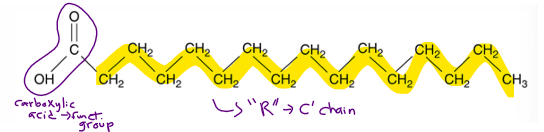
chemical structure of FA’s
a carboxyl group linked to a hydrocarbon chain

what is a fatty acyl group?
FA in esterified form
what does it mean for an FA to esterified?
when the OH group of the carboxyl end is substituted by another group (aka attached to another molecule)

what is a free fatty acid (FFA)/nonesterified fatty acid (NEFA)?
"free" meaning they are not linked to any other component
maintains the OH group on carboxyl group

what must occur to free fatty acids transported, metabolized, or utilized in aqueous solution
they must be bound to something to have a hydrophilic component
free FA’s are bound to what in the blood
albumin
what enzymes liberate fatty acids from the molecule they are bound to?
lipases
when FFA’s are liberated by lipases, what happens to them
they must be transported into the cell by a specific protein or transporter
how does one number a fatty acid
start with the carbon on the carboxylic group and work to the other side
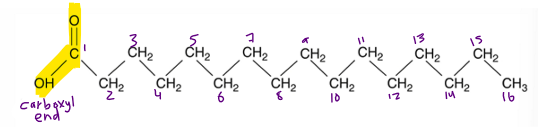
how are FA’s classified? (3)
length
saturation
position of = bonds
FA length (# of carbons)
usually length
SCFA
MCFA
LCFA
usually length: 2-40C (most 12-24C)
SCFA: 6 or less
MCFA: 8-14C
LCFA: >14
how does chain length affect solubility?
longer chains = less soluble
because longer chain means more hydrophobic area
what does saturated mean
contains the maximum number of atoms bonded to each carbon atom (so no double bonds)

what does unsatured mean?
has at least one double bond
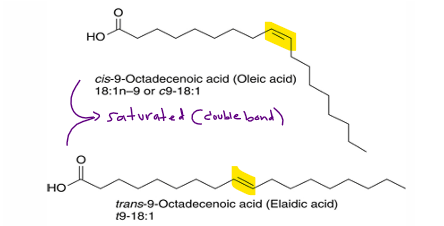
saturation and melting point?
saturated (no double bonds) has higher melting point than unsaturated (at least one = bond)
MUFA has higher melting point than PUFA
what is MUFA
FA contains only one double bond

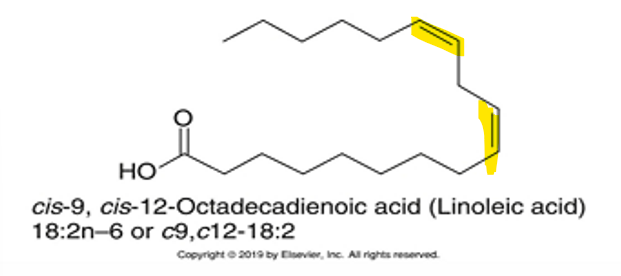
what is PUFA
FA contains more than 1 = bond
Cis and Trans configuration depends on
position of the double bond
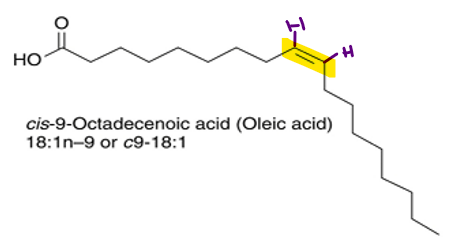
what is cis
double bond is on “same side”
aka, the H’s are on same side and causes a kink
what is trans configuration
double bond has hydrogens on opposite sides (creates linear structure)
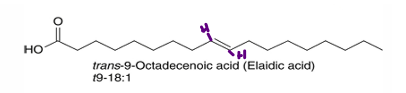
how does trans configuration impact melting point compared to cis FA
trans FA have higher MP than cis
are able to stack together like saturated FA’s
at room temp, what is the state of saturated and unsaturated FA’s
saturated: solid at room temperature (butter, lard)
unsaturated: liquid at room temperature (olive oil, veg oil)
trans FA’s and health
harmful to us and no longer generally recognized as safe (GRAS)
promote inflammation, increase risk for diabetes and cardiovascular
trans FA’s and our food supply
no longer allowed due to health effects (were used because very stable)
where are trans fats naturally found?
Ruminants (cows, goats) produce milk --> some of the milk will contain some trans FA in it
Comes from the ruminant (the bacteria used to make the milk in their stomach will produce them). BUT are in really small amounts and do not contribute to CVD or inflammatory risk--> metabolized slightly differently than those found in partly hydrogenated oils
which trans FA is found in milk?
vaccenic acid

humans cannot insert double bond past what C
carbon 9
why cant we insert double bond past carbon 9?
we lack the enzyme delta-9-desaturase
because we cannot make double bonds past C9, which FA’s are essential?
linoleic (18:2n-6) and alpha-linolenic acid (18:3n-3)
FA’s in our diets and most we learn about are in what configuration (cis or trans)?
cis

what is a conjugated double bond
those that occur every 2 Carbons (=-=)

where are conjugated double bonds seen? function?
in carotenoids (lycopene, b-carotene)
provide pigment
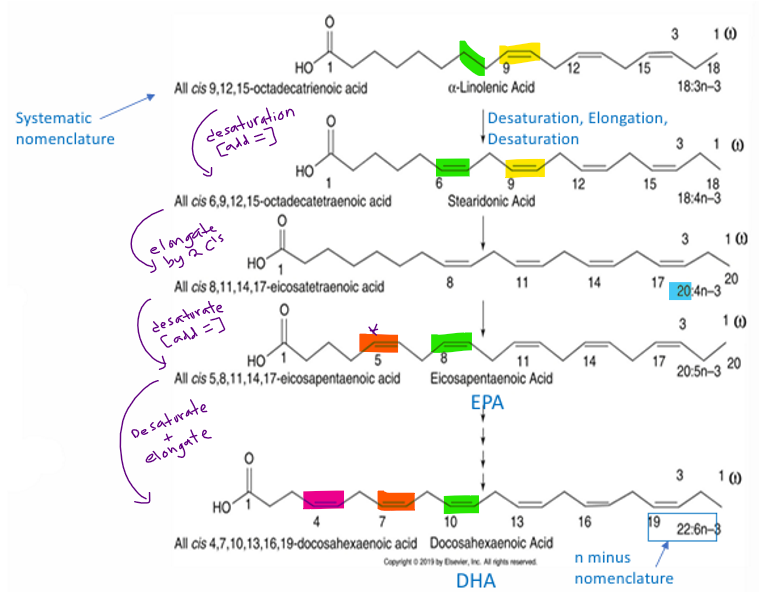
how do we synthesize long chain FA’s? (basic steps)
desaturation —> elongation —> desaturation (and repeat)

desaturation does what?
adds a double bond (BEFORE C9)
what does elongation do?
adds 2 carbons
alpha linolenic acid leads to the synthesis of what 2 FA’s
eicosapentaenoic acid (EPA) and docosahexaenoic acid (DHA)
how does ALA become EPA and DHA?
ALA (18:3n-3) is desaturated into stearidonic acid (18:4n-3)
stearidonic acid (18:4n-3) is elongated into a middle molecule that is 20:4
that is then desaturated into EPA (20:5n-3)
EPA (20:5n-3) then undergoes one desaturation and one elongation to become DHA (22:6n-3)
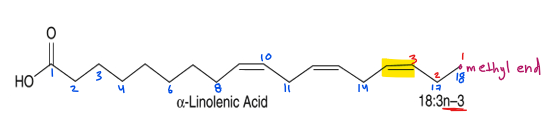
what is n-minus nomenclature
ex: 18:3n-3
18 = number of carbons
3 = number of double bonds
n-3 = the first double bond is 18-3 carbons (so at the 15th C)
elongation and desaturation effect on the “n-#”?
does not affect it because we cannot change double bonds past C9
how were the 2 essential FA’s discovered?
1982
6 year old female who developed neurological symptoms under PN treatment (an emulsion containing 76% linoleic acid 18:2n-6 and only .66% alpha-linolenic acid 18:2n-3)
Added alpha-linolenic acid to her emulsion and increased it to 6.9%
Her serum phospholipids increased drastically and her neurological symptoms were alleviated
Found out those 2 are essential to receive from diet
what are the saturated FA’s (5)
myristic acid, palmitic acid, stearic acid, arachidic acid, and lignoceric acid
myristic acid (nomenclature)
14:0
palmitic acid (nomenclature)
16:0
stearic acid (nomenclature)
18:0
arachidic acid (nomenclature)
20:0
ligniceric acid (nomenclature)
24:0
what are our unsaturated FA’s (7)
palmitoleic acid, oleic acid, linoleic acid, alpha-linolenic acid, arichidonic acid, eicosapentaenoic acid, docosahexaenoic acid
palmitoleic acid (nomenclature)
16:1n-7
oleic acid (nomenclature)
18:1n-9
linoleic acid (nomenclature)
18:2n-6
sources of linoleic acid
Sources: corn, soybean, safflower, cottonseed, sunflower seed, and peanut oils
linoleic acid is precursor to
arachidonic acid (20:4n-6)
alpha-linolenic acid (nomenclature)
18:3n-3
alpha linolenic sources
soybean and other seed oils
alpha linolenic is precursor for
EPA and DHA
arachidonic acid (nomenclature)
20:4n-6
arachidonic acid sources
small amounts in animal fats
arachidonic acid is made from
desaturation and elongation of linoleic acid (n-6)
eicosapentaenoic acid (nomenclature)
20:5n-3
EPA is found in
marine algae and fish that consume algae
**fatty fish
Docosahexaenoic acid (nomenclature)
22:6n-3
DHA sources
animal fats as phospholipid component
marine algae and dish that consume algae (**fatty fish)
breastmilk and infant formula (needed for formation of NS and memory)
physical properties of FA’s depend of what 3 things
C-chain length
degree of unsaturation
geometry of double bonds
define melting point MP
the temperature at which the lipid starts to melt
order of melting point for types of FA’s (high to low)
saturated —> MUFA —> PUFA
MP and chain length
MP increases with longer C chain
ex: SFA with 18 C have lower MP than SFA with 24C
fatty acids are how soluble
insoluble (due to hydrophobic chain being > than hydrophilic carboxyl group)
solubility and chain length
solubility decreases as chain length increases
PHOSPHOLIPIDS
What are phospholipids?
Hydrophilic polar phosphate head + 2 hydrophobic FA tails
phospholipids will form what in solution
lipid bilayer
