Unit 2: Hip and pelvis
 Call Kai
 Learn
Learn Practice Test
 Spaced Repetition
 Match
Match Flashcards
 Knowt Play
1/67

There's no tags or description
Looks like no tags are added yet.
Name | Mastery | Learn | Test | Matching | Spaced | Call with Kai | Chat |
|---|
No analytics yet
Send a link to your students to track their progress
68 Terms

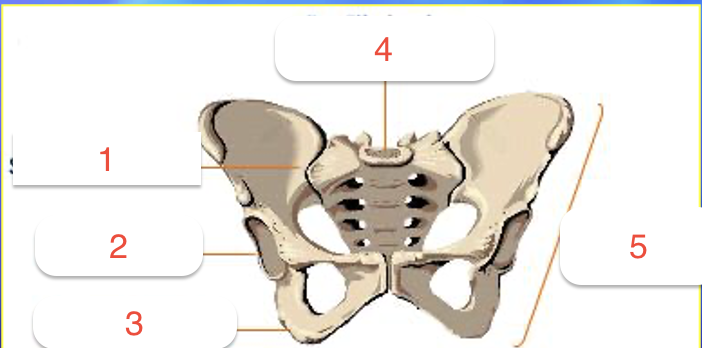
what is number 1?
Sacroilliac joint
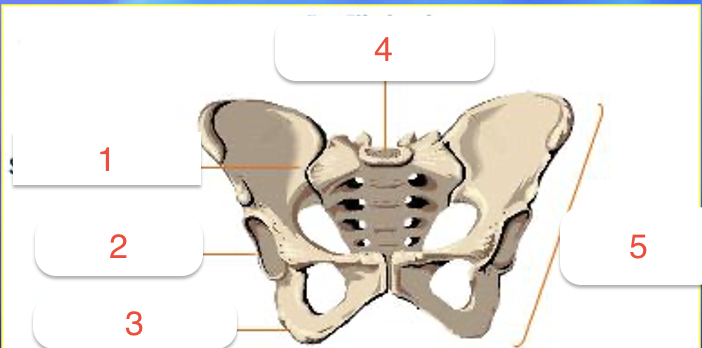
what is #2?
acetabulum
what is #3?
Ischial tuberosity

What is #4?
5th lumbar vertebra
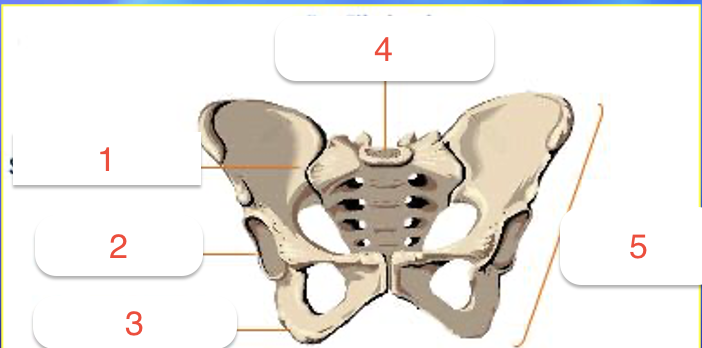
what is #5?
innominate bone
What artery is a branch of the anterior division of the internal iliac artery?
obturator artery
The obturator nerve innervates what muscles?
adductors, gracilis
The Hip joint has 3 degrees of freedom in what movement patterns?
flexion/extension, ab/adduction, Internal/external rotation
what is formed by the fusion of the ilium, ischcium and pubis?
innominate/pevic bone

what is the red ligament?
iliofemoral ligament

what is the green ligament?
pubofemoral

what is the yellow ligament?
ischiofemoral
what bony landmark marks the point of union for the ilium and pubis?
iliopubic eminence
what is the immobile cartilaginus joint that sits and joins the left/right superior rami of the the pubic bone?
pubic symphysis
what 3 ligaments make up the sacroiliac joint?
sacroiliac, sacrotuberous, sacrospinous
what makes up the triceps coxae of the hip?
obturator internus, gemellus superior, gemellus inferior
What ligament connects the fovea capitis to the acetabulum?
ligamentum teres
what is the immobile, fibrocartilaginous disc that sits between and joins the left/right superior rami of the pubic bones?
pubic symphysis
What muscles make up the posterolateral (rotator) cuff of the lower extremity
piriformis, quadratus femoris, obturator internus/externus, gemellus superior/inferior
What 3 muscles make up the triceps coxae of the hip external rotators?
obturator internus, gemellus superior, gemellus inferior
What is the hip condition that involves osteochondritis of the proximal femoral epiphysis with idiopathic necrosis of the femoral head predominalty found in children?
Legg-Calve-Perthes disease
Scissors position is the typical sign following what injury?
posterior hip dislocation
What is the most common non-traumatic hip problem in adolescents that presents with pain on IR of the femur?
Slipped Capitol Femoral Epiphysis
The sciatic nerve splits at what structure to become the common fibular and tibial nerves?
popliteal fossa
What is the generally harmless condition in which you feel snapping/popping when muscle/tendon moves over a bony landmark?
Snapping Hip Syndrome
What occurs when osseous deformities on the acetabular rim and/or femoral head/neck junction pinch at the extremes of hip motion causing injury to acetabular labrum/cartilage?
Hip Impingement Syndrome
What type of tear involves the ring of cartilage that follows the outside rim of the socket of your hip joint?
Hip Labral Tears
What is the injury that involves tears or expansion of a muscle in the groin area?
Sports Hernia

What is A?
Transverse Abdominis

What is B?
Internal Abdominal Oblique
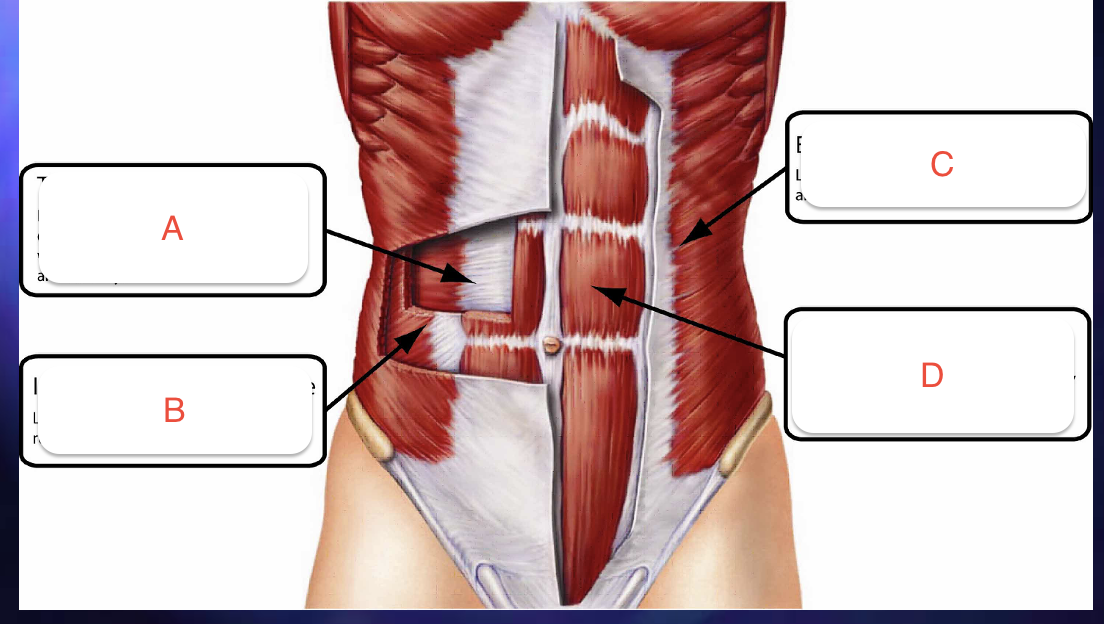
What is C?
External Abdominal Oblique
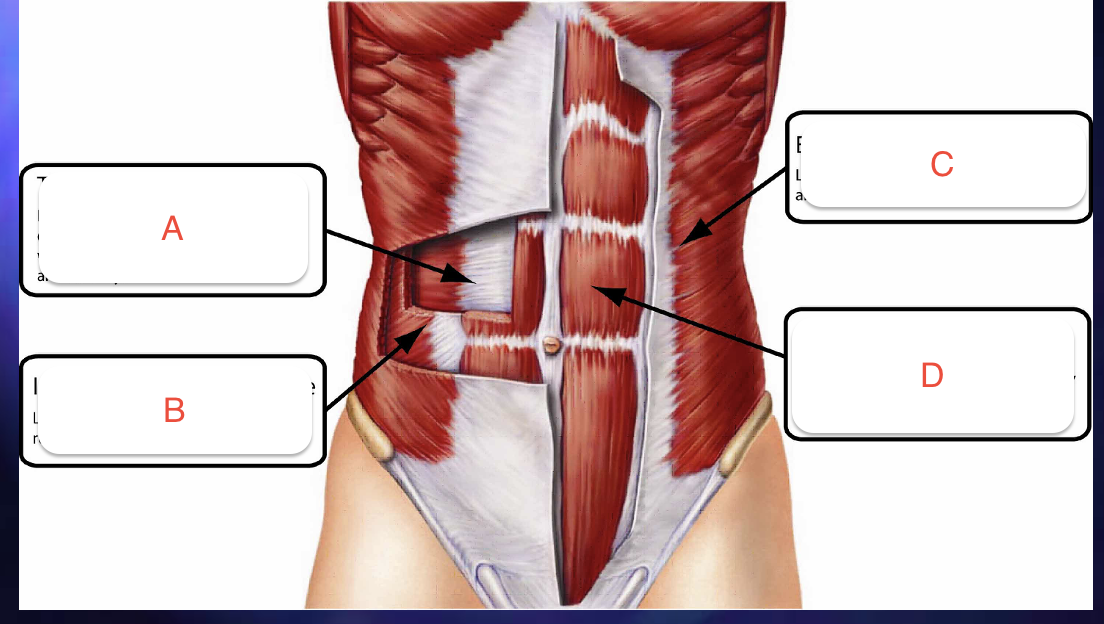
What is D?
Rectus Abdominis
What are the Soft Tissue palpation zones in order from 1-5?
Femoral Triangle, Greater Trochanter, Sciatic Nerve, Iliac Crest, Musculature
The Cluneal Nerves arise from what nerve roots?
L1-S2
How should the leg be positioned to best palpate the gracilis?
hip/knee flexion, hip ER
what shows weakness of the gluteus medius where testing positive results in standing on affected leg and opposite side falls off?
Trendelenburg Test
what is the true/structural measurement landmarks for testing leg length discrepancies?
ASIS to medial malleolus
what is the functional or apparent landmarks for leg length discrepancy measurements that are likely due to result of pelvis being laterally rotated?
medial malleolus to umbilicus
from frontal plane orientation, what is the neck-shaft angle generally ranging from 120 to 125 degrees in adults?
angle of inclination
coxa __ is an increased angle of inclination while coxa __ is a drecreased angle of inclination.
valga, vara
Coxa Valga occurs when the angle of inclination is __ where coxa vara is an angle of inclination of __?
>140, <125
what are the 3 main etiology for coxa valga and coxa vara?
congenital, trauma, disease
what is the clinical term for the flattening of the head of the femur resulting from osteochondrosis of its epiphysis?
coxa plana
what occurs in the transverse plane and the angle between the neck and shaft of the femur with a normal range of 8-15 degrees?
angle of torsion
what condition presents with a toe-in gait, increased Q angle and a dramatic increase in IR and decrease in ER?
Anteversion
what condition presents with toe out gait, excessive foot supination and increased ER on affected side?
Retroversion
what structure on the pelvic bone marks the point of union of the ilium and pubis?
iliopubic eminence
what is the ligament on the neck of the femur formed by the circular fibers of the articular capsule of the hip joint?
annular ligament/zona orbicularis
what ligament with the hip joint is a very important anterior hip stabilizer allowing upright stance posture (aka Y ligament of Bigelow)?
Iliofemoral Ligament
What ligament of the pelvis has little stabilizing function but carries femoral circumflex arteries?
ligamentum teres
what ligament of the pelvis runs from the ASIS to pubic symphysis and holds the soft tissue of the trunk back —> superior border of femoral triangle?
Inguinal Ligament
What pelvic ligament is the base of the acetabulum?
transverse acetabular ligament
what 3 ligaments make up the sacroiliac joint?
sacroiliac, sacrotuberous, sacrospinous
what is the longest muscle in the body?
sartorius
What are the 3 common etiology pieces when looking at piriformis syndrome?
inflammation/spasm, hypertrophy of muscle, anatomical anomalies
what are 3 common s/s of piriformis syndrome?
deep hip pain, parathesia along sciatic n tract, decreased strength
what is the most common type of bursitis of hip bursitis issues?
Trochanteric Bursitis
pectineus is latin for what?
comb
gracilis is latin for what?
slender
what is the consideration of fever, weight loss, fatigue and lymphadenopathy are not disease specific but have to be considered in the differential diagnosis of a disease flare or infection?
constitutional symptoms
what is an inflammation of an outgrowth, projection or swelling, especially a bony outgrowth that is still attached to the rest of the bone?
apophysitis
what muscles make up the pes anserine group?
semitendinosis, gracilis, sartorius
what are the 3 types of FAI and if they have a common muscle?
Internal - iliopsoas bursitis, external - IT band syndrome, intraarticular type
what does the FADDIR test look for?
femoral acetabular impingement, labral tears, intra-articular hip pain
what are 4 common causes of groin pain?
adductor longus dysfunction, osteitis pubis, sports hernia, pathology of hip
since the hip joint is very stable, most problems will affect what?
walking gait
what landmarks do sacral nerves and blood vessels pass through?
sacral foramina, sacral crest