NC PSY 100 Exam Three (Chapters 9, 11 & 12)
 Call Kai
 Learn
 Practice Test
 Spaced Repetition
 Match
 Flashcards
 Knowt Play
1/53

There's no tags or description
Looks like no tags are added yet.
54 Terms
What are the four basic qualities of motivation?
Activating, Directive, Sustaining, and Differing in Strength.
What does Maslow's Hierarchy of Needs define as a need?
A state of biological or social deficiency.
Maslow's Hierarchy of Needs
(level 1) Physiological Needs, (level 2) Safety and Security, (level 3) Relationships, Love and Affection, (level 4) Self Esteem, (level 5) Self Actualization

What are the four major factors that influence motivation?
Pleasure, Incentives, Intrinsic Motivation, and Extrinsic Motivation.
What is the need to belong theory?
The need for interpersonal attachments is a fundamental motive that has evolved for adaptive purposes.
What part of the brain influences eating?
The Hypothalamus.
What is the function of the ventromedial hypothalamus?
Acts as the on/off switch for hunger.
What is achievement motivation?
The need or desire to attain a certain standard of excellence.
What are primary emotions?
Emotions that include anger, fear, sadness, disgust, happiness, and possibly surprise and contempt.
What are secondary emotions?
Blends of primary emotions, including remorse, guilt, shame, submission, and anticipation.
What does the James-Lange theory state about emotions?
Emotions result from the experience of physiological reactions in the body.
What is the Cannon-Bard theory of emotion?
Emotions and bodily responses occur simultaneously due to brain processing.
What does the two-factor theory suggest about emotions?
How we experience an emotion is influenced by the cognitive label we apply to physiological changes.
What is the amygdala's role in emotions?
Processes the emotional significance of stimuli and generates immediate emotional reactions.
What are common strategies for regulating emotions?
Thought suppression, rumination, positive reappraisal, humor, and distraction.
What is affect-as-information theory?
People use their current moods to make decisions, judgments, and appraisals.
What are display rules?
Learned rules that dictate what emotions are suitable in certain situations.
What is health psychology?
A field that integrates research on health and psychology, applying principles to promote health and well-being.
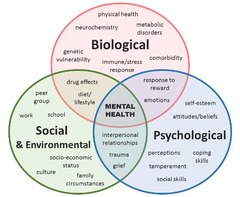
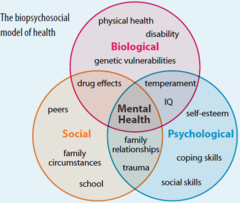
The Biopsychosocial Model
a model of health that integrates the effects of biological, behavioral, and social factors on health and illness
What are the benefits of exercise?
Improves physical health, cognitive abilities, and emotional well-being.
What is stress?
A group of behavioral, mental, and physical processes occurring when events exceed the organism's ability to respond healthily.
What are the three components of stress?
Stressors, Mediating Factors, and Stress Responses.
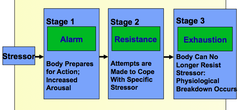
What is general adaptation syndrome (GAS)?
A consistent pattern of physical responses to stress consisting of three stages: Alarm, Resistance, Exhaustion.
What are the immediate responses to stress and trauma?
Fight, Flight, Freeze, Fawn, and Tend and Befriend.

What is primary appraisal in coping?
The part of coping that involves deciding whether a stimulus is stressful.
What is secondary appraisal in coping?
Deciding how to manage and respond to a stressful stimulus.
What is emotion-focused coping?
Coping that aims to prevent an emotional response to a stressor.
What is problem-focused coping?
Coping that involves taking direct steps to confront or minimize a stressor.
What is downward comparison?
Focusing on possible good things in a current situation, often referred to as finding the silver lining.
Define resilience in the context of coping.
The tendency to respond flexibly and bounce back quickly from stress.
What is hardiness?
The ability to adapt to life changes by viewing events constructively, characterized by commitment, challenge, and control.
List some healthy coping strategies.
Good nutrition, social support, time management, meditation, physical activities, and setting goals.
What are some coping strategies to avoid?
Avoidance, procrastination, overeating, self-medicating, alcohol, drugs, and self-injury.
What is positive psychology?
The study of strengths and virtues that allow people and communities to thrive.
What are the three components of happiness according to positive psychology?
Positive emotion and pleasure, engagement in life, and a meaningful life.
How does social support contribute to good health?
It helps people cope with stress and maintain good health by reducing overall stress and aiding in coping with stressful events.
Cognitive Dissonance
An uncomfortable mental state due to a contradiction between two attitudes or between an attitude and a behavior.
Fundamental Attribution Error
The tendency to overemphasize personality traits and underestimate situational factors when explaining others' behavior.
Self-serving bias
The tendency to attribute positive outcomes to internal factors and negative outcomes to external factors.
What is a self-fulfilling prophecy?
The tendency for people to behave in ways that confirm their own expectations or others' expectations.
Stereotype
Mental shortcuts for rapid processing of social information that occur outside of our awareness.
Prejudice
Negative feelings, opinions, and beliefs associated with a stereotype.
Discrimination
The inappropriate and unjustified treatment of people based on the groups they belong to.
Social Norms
Unwritten rules that serve as expected standards of conduct that influence behavior, such as shaking hands firmly or making eye contact.
What is the bystander intervention effect?
The failure to offer help to people in need, often due to the presence of other bystanders.
What does the frustration-aggression hypothesis suggest?
The idea that the more frustrated a person feels, the more likely they are to act aggressively.
Prosocial Behavior
Acting in ways that tend to benefit others, such as offering assistance or being cooperative.
Altruism
The act of providing help when needed, with no apparent reward for doing so.
Social Facilitation
The phenomenon where the mere presence of others improves performance.
Deindividuation
A state of reduced individuality and self-awareness that may occur in group settings.
Groupthink
Flawed decision making in which individuals favor conformity over critical analysis.
Compliance
The tendency to agree to do things requested by others.
What did Milgram's study teach us about obedience?
Personality and situational factors affect obedience.
What is the role of spirituality in well-being?
Religion and spirituality provide a sense of meaning or purpose in life and can help maintain well-being.