PHLT 304 QUIZ 3 EXAM 3
 Call Kai
 Learn
 Practice Test
 Spaced Repetition
 Match
 Flashcards
 Knowt Play
1/65

There's no tags or description
Looks like no tags are added yet.
66 Terms
How many calories do adults need a day?
approx. 1,800–3,000 calories per day
PROTEIN - 4 CALORIES PER GRAM
FAT - 9 CALORIES PER GRAM (fat free everything is actually not that healthy)
CARBS - 4 CALORIES PER GRAM
Macronutrients:
Carbohydrates
• Sugars and starches (e.g., bread, pasta, rice)
• Bulk of your energy
Lipids
• Fats, waxes, oils (e.g., butter, lard, liquid cooking oils)
• Most energy (calories) per gram
Proteins
• Humans need 9 essential amino acids from food (found for example in beans, nuts, meat & seafood)
• Amino acids combine to form proteins
Micronutrients
Vitamins
-Water soluble
-Fat (lipid) soluble: A, D, E, and K (must be eaten with dietary fat in order to be absorbed from aqueous environment of intestines) if you take too much, it’s not good
Minerals (inorganic elements)
-Major – e.g., potassium, calcium & magnesium - need a decent amount
-Trace – need very little from food, too much can be harmful (e.g., iron, iodine, zinc) biggest risk of iron overdose: little kids that love eating those vitamin gummies
-Minerals may serve:
structural purpose (e.g., calcium in bones)
as components of enzymes
to help maintain osmotic gradients that are needed for fluid balance in body (electrolytes such as sodium, potassium, calcium, magnesium, chloride)
Lipids
• Better – poly- and monounsaturated (want it liquid at room temp)
• Worse - saturated fats and trans fats
Fiber
• Make half your grains whole
• Soluble fiber – lowers cholesterol
• Insoluble fiber – good for the bowels (no effect on cholesterol)
Salt
• Present in processed foods, cured meats
• We eat way more than we should
• Use iodized salt
Dietary Guidelines
-Whole fruits & vegetables (color matters, variety matters, dark leafy greens are good for your eyes such as lutein & zeaxanthin)
needs to include vegetables
avoid juices (fiber is important)
-Whole grain foods whenever possible
-Limit alcohol intake
-Minimize salt intake (higher salt, higher blood pressure)
-Minimize use of highly processed (no longer looks like anything that came from nature) or preserved foods

Recommended minimum amount for fruits and vegetables is approximately:
1.5–2.0 cup equivalents of fruits
AND
2.0–3.0 cups of vegetables per day (for vegetables, 2 cups raw leafy greens = 1 cup here)
Eat a variety of vegetables, especially:
-red (such as tomatoes, red peppers)
-dark green (such as broccoli)
-orange (such as carrots, sweet potatoes)
make half your plate fruits and vegetables
Why is nutrition so important?
To keep you healthy and lower your risk of chronic diseases, e.g.,
-Cardiovascular disease
Hypertension and atherosclerosis
-Diabetes mellitus (type 2)
-Cancer
-Etc.
To support good overall health: the body needs many biologically active compounds (“phytonutrients”) from a variety of whole fruits & vegetables
Food, your microbiome, and the Gut-Brain Axis
-Gut-brain axis: bi-directional communication between the gut and the central nervous system
-Human microbiome: called the body’s “forgotten organ”; it is affected by what we are exposed to (including food)
Changes in diet , antibiotics, puberty, pregnancy, and menopause impact microbiome
As you get older, microbiome gets smaller
ADD VIDEO TRANSCRIPT STUFF
Chronic Inflammation
• Inflammation: process by which the immune system recognizes and removes harmful stimuli to start healing
• BUT: Chronic inflammation lasts for several months to years & is detrimental
• Chronic inflammation progresses without obvious symptoms
Which foods gets rid of inflammation? (supports good health)
Tomatoes, Fruits (strawberries, blueberries, oranges, and cherries), Nuts (almonds, walnuts, and other nuts), Olive Oil, Leafy greens (spinach, kale, collards, and more), Fatty fish (salmon, mackerel, tuna, and sardines)
think mediterranean diet
Which foods promote inflammation? (degrades good health)
Fried foods, Sodas, Refined carbs, Lard, Processed meats
Why is exercise important?
-Skeletal muscle releases cytokines and myokines into the blood, particularly during muscle contraction
reduces inflammation
-If exercise produces weight loss:
Excess visceral adipose tissue (VAT) triggers inflammation ➔ loss of excess VAT reduces inflammation
-Other benefits:

Cytokines
small proteins secreted by cells that affect the interactions and communication between cells; cytokines can be pro-inflammatory or anti-inflammatory
How do exposures/experiences influence chronic disease?
People who get little to no exercise have an increased risk for: Cardiovascular disease, Diabetes, Cancer
Prolonged sitting, even in people who exercise, is associated:
• Larger waist circumference
• Lower levels of high-density lipoprotein (“good cholesterol”)
• Higher levels of triglycerides (a type of fat in the blood)
• Higher levels of C-reactive protein (marker of inflammation)
Exposures/Experiences that are Pro-Inflammatory
Obesity, Diet high in saturated fat trans fat or refined sugar, cigarette smoking, stress (physical or emotional, irregular sleep, increasing age
Consequences of Chronic Inflammation & Chronic Disease
Cardiovascular diseases, cancer, diabetes, allergic asthma, chronic obstructive pulmonary disease (COPD), alzheimer’s disease, chronic kidney disease, inflammatory bowel disease (IBD)
Actions to reduce Chronic Inflammation
-Energy expenditure through exercise
-Exercise to maintain a healthy weight
-Manage intake of saturated fat, trans fat
-Increase fruit/vegetable consumption
-High intake of dietary fiber (both soluble and insoluble) helps feed gut microbiome slows down sugar
-Eating nuts
-Consume fish oil
-Consume foods rich in micronutrients (be careful of taking high doses in supplements) don’t take high doses, best way to get it is food
-Minimize intake of antibiotics and NSAIDS (aka painkillers)
-Don’t forget to sleep 7-8 hours/night and reduce stress too!
IL-6 and TNF-alpha are
pro-inflammatory cytokines
C-reactive protein:
indicates when there is inflammation in the body (either acute which could be due to an infection, or a chronic inflammatory disease)
Intestinal dysbiosis:
perturbations in the composition of the gut microbiome relative to the composition of the gut microbiome in healthy individuals
Causes of systemic chronic inflammation
-Chronic infections
-Physical inactivity
-Obesity
-Dysbiosis
-Diet
-Isolation and chronic stress
-Disturbed sleep
-Xenobiotics
Cardiovascular Disease - The big umbrella
is the term for all types of diseases that affect the heart or blood vessels, including coronary heart disease (clogged arteries), which can cause heart attacks, stroke, heart failure, and peripheral artery disease.
Oxygen-poor blood (blue blood)
doesn’t have oxygen
Oxygen-rich blood (red blood)
has oxygen
Cardiovascular system: heart and blood vessels - how it works GO CUT THIS FLASH CARD UP
-Includes the heart and blood vessels. Its main function is to circulate blood, deliver oxygen to tissues, and transport waste products.
-The heart has four chambers: the right atrium, right ventricle, left atrium, and left ventricle. Atria receive blood; ventricles pump blood out.
-Blood flow: Body → right atrium → right ventricle → lungs → left atrium → left ventricle → body.
The right side of the heart pumps oxygen-poor blood to the lungs. The left side receives oxygen-rich blood from the lungs and pumps it to the body.
Blood vessels:
Arteries: Carry blood away from the heart.
Veins: Carry blood toward the heart.
Capillaries: Exchange oxygen, nutrients, and wastes with tissues.
Heart valves prevent blood from flowing backward and keep it moving in the correct direction.
Heart disease
conditions that affect heart structure and function
Coronary artery disease (also called ischemic heart disease or coronary heart disease):
-Major cause of death in US
-Narrowing or blockage of coronary arteries (coronary arteries supply blood to heart)
-Result: Arteries of the heart can’t deliver enough oxygen-rich blood to the heart
-Lack of enough blood causes ischemia (condition where heart doesn’t get the oxygen and nutrients it needs)
-Ischemia can cause angina (discomfort or pain in chest) and increased risk of heart attack

Angina
-Most common symptom of coronary artery disease; pain or discomfort when your heart doesn’t get enough blood, or oxygen and nutrients
-Stable: happens under exercise or under stress (when you’re working harder)
-Unstable: happens at rest; considered a medical emergency
What are the two causes of narrowing of arteries?
-Build-up of plaque (Atherosclerosis)
-Vasospasms
Plaque buildup and vasospasms may occur individually, or may co-occur in the same artery
T or F: Atherosclerosis is the only way arteries become narrower
False
Cause of narrowing arteries: 1) Atherosclerosis
buildup of plaque (fats, cholesterol and other substances) in & on the walls of large and medium-sized arteries. This causes narrowing of the inside of the arteries
-slow process
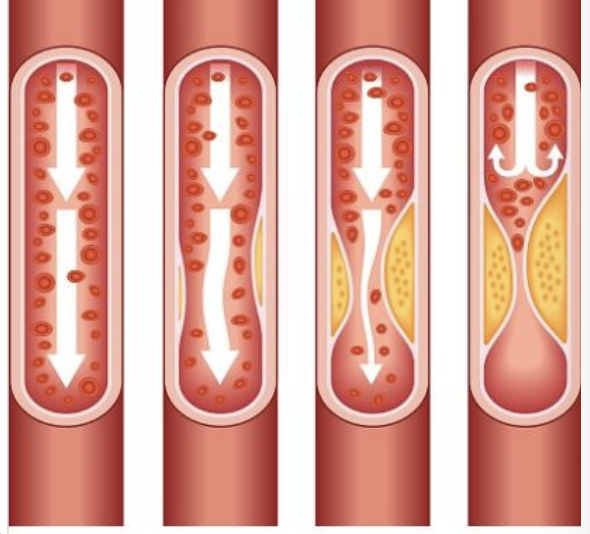
Cause of narrowing arteries: 2) Vasospasms
arteries can undergo spasms (tightening) that temporarily narrow the arteries and block blood flow to the heart

Obstructive coronary artery disease
-plaque builds up in the large arteries, causing them to narrow gradually & reducing the supply of oxygen-rich blood to the heart.
-heart’s arteries are over 50% blocked.
-Blood flow may eventually be completely blocked in one or more of the three large coronary arteries.
Nonobstructive coronary artery disease
arteries are less than 50% blocked
Plaque
substance made of fat, cholesterol, calcium & other substances that builds up and hardens in arteries
Coronary microvascular disease
-affects the heart’s smallest arteries
-Can happen either alone or with obstructive or nonobstructive coronary artery disease or other heart diseases
-most often occurs when molecular changes in the tiny blood vessels of the heart prevent normal blood flow through the small arteries
-causes damage to lining too

Heart Attack (also called a Myocardial Infarction)
-happens when a part of the heart muscle doesn’t receive enough blood; e.g., due to blood clot
-Coronary artery disease is the major cause of heart attacks
-1 in 5 heart attacks occurs without the person realizing it
-Fast medical attention reduces heart damage
Heart Attack signs and symptoms for women and men
Women & men:
-Chest pain or discomfort
-Shortness of breath
-Pain or discomfort in the jaw, neck, back, arm, or shoulder
Women only:
-Feeling nauseous, light-headed or unusually tired
Heart Failure (also called Congestive Heart Failure)
-Heart can’t pump enough blood to meet the body’s needs
-Heart is still pumping but not efficiently enough
-Blood builds up in other parts of body, especially in lungs, legs & feet
-Only curable with a heart transplant
-Both adults and children can have it (kids are priority for heart transplant)
T or F: heart attack and heart failure are very different
True
Leading causes of heart failure:
-Coronary artery disease (this can weaken the heart muscle, leading to heart failure)
-Heart attack
-High blood pressure
-Diabetes
Cardiac Arrest
-Heart stops beating
-Causes include:
Ventricular fibrillation
Coronary artery disease
Cardiomyopathy (heart muscle thickens, stiffens, or otherwise becomes abnormal: can lead to irregular heartbeat)
-Without treatment, death occurs within minutes after cardiac arrest (critical medical emergency)
-Heart attack can trigger ventricular fibrillation and sudden cardiac arrest
Cardiomyopathy
-heart becomes enlarged, stiff, or otherwise abnormal; can weaken heart
-Causes include family history, hypertension, prior heart attacks, viral or bacterial infections
Congenital heart defects (aka baby):
-Most common type of major birth defect
-Examples: abnormal heart valves or holes in the walls of the heart
Heart Disease Nonmodifiable Risk Factors
-Age
-Sex
-Family history
-Genetic predisposition
Heart Disease Modifiable Risk Factors
-Hypertension
-Smoking
-Poor diet
-Alcohol intake
-Physical inactivity
-Dyslipidemias (cholestrol and triglycerides)
-Obesity
-Diabetes
-Stress (chronic stress)
Lipids and dyslipidemia (hyperlipidemia)
High triglycerides + low HDL +high LDL ➔ increased risk of cardiovascular disease
HDL “good” cholesterol
-Higher than 40 mg/dL (men)
-Higher than 50 mg/dL (women)
LDL “bad” cholesterol
-Lower than 100 mg/dL
Triglycerides (type of fat found in blood)
-Lower than 100 mg/dL
Cholesterol
a waxy substance your body needs, but too much LDL can cause problems
Stent for treating narrowed coronary artery
-Long, thin tube (catheter) is inserted into narrowed section of artery
-A wire with a deflated balloon is passed through the catheter to the narrowed section
-Balloon is inflated, compressing the deposits against the artery walls
-The stent (a metal mesh) is often left in to help keep artery open, and may slowly release medication
-Typically less expensive and shorter recovery time/time in hospital

Treatment: Coronary artery bypass surgery
-Requires open heart surgery
-Normally done if there are multiple narrowed coronary arteries
-Graft to bypass blocked artery is created with a vessel from another part of the patient’s body

Stroke
-Blood supply to part of brain is reduced or interrupted
-Brain tissue is deprived of oxygen and nutrients ➔ cell death within minutes
-Medical emergency – quick treatment can help reduce brain damage/disability
Classic stroke symptoms (but if someone looks totally off still get someone to check it out)
F: face - when smiling side of face looks like it is drooping
A: Arm - when raising both arms, one arm drifts downward
S: Speech - does their speech sound strange
T: Time - if you observe symptoms, call 911 immediately
Three Types of Stroke:
-Ischemic stroke
-Hemorrhagic stroke
-TIA (Transient ischemic attack)
Ischemic stroke
occurs due to obstruction in blood vessel supplying blood to brain; accounts for 87% of all stroke cases (most common type of stroke)

Hemorrhagic stroke
occurs when a weakened blood vessel ruptures; most common cause is uncontrolled hypertension

TIA (Transient ischemic attack) (major risk factor for major stroke)
caused by a temporary clot; often called a “mini-stroke”. Produces stroke-like symptoms but often has no lasting effects; medical treatment for TIAs can reduce the risk of a major stroke

Modifiable Risk factors for stroke
-Smoking
-Diabetes
-High LDL cholesterol
-Carotid artery or other artery disease (carotid arteries supply most of the blood to brain)
-Physical inactivity
-Obesity
-Personal or family history of stroke or TIA
-Atrial fibrillation (upper chambers of heart quiver, don’t beat properly, can cause blood to pool & clot)
-Sickle cell anemia
-Excessive alcohol intake
-Sleep apnea
Non-modifiable Risk factors for stroke
-Increasing age
-Female gender: higher lifetime risk
-Race: Hispanics & African Americans have higher stroke risk
Systemic Chronic Inflammation: Increase risks of / Consequences
-Cardiovascular disease
-Metabolic syndrome, type 2 diabetes and NAFLD
-Depression
-Autoimmune diseases
-Neurodegenerative diseases
-Immunosenescence
-Sarcopenia and osteoporosis
-Cancer