1 - Kidney Function and CKD
 Call Kai
 Learn
 Practice Test
 Spaced Repetition
 Match
 Flashcards
 Knowt Play
1/120

Earn XP
Description and Tags
12 Questions :
121 Terms
Drug excretion?
The removal of the intact drug
How are nonvolatile and volatile drugs excreted through the body?
Nonvolatile → by renal excretion
Volatile → excreted via the lungs into expired air
Other pathways may include drug excretion into the → bile, sweat, saliva, milk or other body fluids
What happens to polar drugs in renal excretion?
Polar drugs/metabolites gets filtered in the kidneys
They typically do not undergo reabsorption
What are the 2 major drug elimination organs in the body?
Liver
Kidney
What are the 4 functions of the kidney?
Removal of metabolic waste products
Maintain salt and water balance
Secretion of renin → which regulates blood pressure
Secretion of erythropoietin → which stimulates RBC production
Renal blood flow (RBF)?
Is the volume of blood flowing through the renal vasculature per unit time
It exceeds → 1.2 L/min or 1700L/day
Renal plasma flow (RPF)?
Is renal blood flow minus - the volume of RBCs present
Is an important factor in the rate of drug filtration at the glomerulus

What is a nephron, and why is it important?
Functional unit of the kidney
Filters blood to remove waste and excess fluid
The filtered fluid is processed through the nephron to form urine
Blood is filtered → urine is formed

What are the 5 main parts of the nephron and their functions?
Glomerulus → Filters blood
Bowman’s capsule → Collects the filtered fluid
Proximal tubule → Reabsorbs nutrients and water back into the blood
Distal tubule → Adjusts electrolytes and fluid
Collecting duct → Finalizes urine concentration before urine leaves the nephron
What are 3 processes of renal drug elimination?
Glomerular filtration → main route for small drug molecules
Active secretion → important for large biotechnology meds
Reabsorption
What are the characteristics of active tubular secretion?
Is an active process
Needs energy
Requires carriers/transporters
Can transport drugs against concentration gradients
Saturable
Not specific → competition may happen
What is active tubular secretion?
Moves drugs from the blood into kidney tubules using energy and transporters
Helps eliminate drugs through urine
Where are renal drug transporters located, and what do they do?
Found mainly in the proximal tubule
Located on the basolateral and apical membranes
Work together to move drugs from blood into the tubule for elimination in urine

What 2 transporters are needed for active drug secretion into the kidney tubule?
Basolateral transporter → Moves drugs from the blood into the tubule cell
Apical transporter → Moves drugs from the tubule cell into the tubule fluid to be eliminated in urine
What 2 important considerations affect kidney drug transporters?
Acids/bases → Can increase or inhibit transporter activity near the membrane
Limited transporters → Drugs competing for the same transporter can cause drug interactions

How can herbal supplements affect OAT transporters in the kidney?
Flavonoids and phenolic acids can alter OAT activity
This can interfere with drug movement from blood, through kidney tubule cells, into urine
May change drug elimination and blood drug levels
Glomerular filtration (GF)?
Blood hydrostatic pressure pushes water and small substances from blood into Bowman’s capsule to begin forming urine
Most small drugs are filtered
Blood cells, platelets, and plasma proteins stay in the blood
Normal GFR?
Of a normal adult male → 125ml/min
About how much fluid per day is filtered through the kidneys?
About 180L of fluid per day
What is the average urine volume produced per day?
Despite large filtration volume the average is → 1-1.5 L / day
What is filtered through the glomerulus, and how much fluid is reabsorbed?
Most small molecules are filtered → proteins and protein-bound substances generally stay in the blood
Up to 99% of filtered fluid returns to the blood

Afferent arterioles?
Delivers blood into the glomerulus
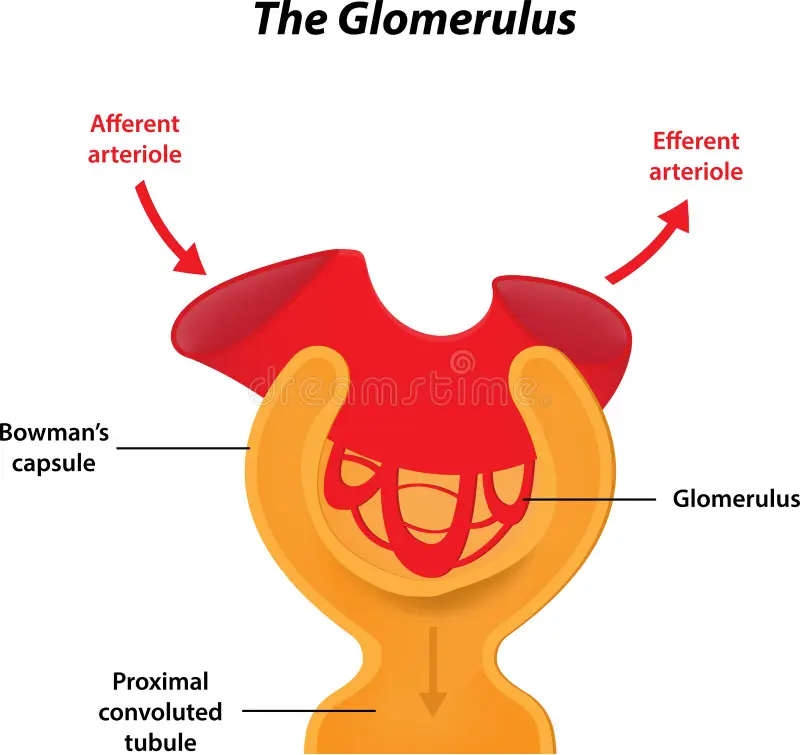
Efferent arterioles?
Carries blood away from the glomerulus.
Has a smaller diameter than the afferent arteriole
Can constrict to maintain glomerular filtration pressure in the capsule
What happens during glomerular filtration?
Blood enters the glomerulus under pressure
Water, small molecules, and ions filter into Bowman’s capsule
Proteins stay in the blood
What is nephron filtrate?
Fluid filtered from the blood into Bowman’s capsule
Contains water and small substances, but normally no blood cells or most proteins
What happens to the nephrotic filtrate that collects in the Bowman’s capsule?
It flows into the proximal tubule where →
Glucose and amino acids → Reabsorbed into the blood
Uric acid → >90% reabsorbed
Inorganic salts → ~60% reabsorbed
Water → >80% reabsorbed
How does water reabsorption affect urine concentration?
Water returns to the blood by osmosis along the path
Solutes in the remaining urine becomes more concentrated as water volume decreases
Why is the pressure difference between blood and Bowman’s capsule important?
Drives glomerular filtration
Abnormal pressure can contribute to kidney damage
How do afferent and efferent arterioles regulate filtration pressure?
Change diameter by constricting or dilating to control blood flow and pressure in the glomerulus
What affects blood and urine pressure during glomerular filtration?
Blood pressure depends → on blood volume and constriction/dilation of afferent and efferent arterioles
Urine pressure depends on → urine volume and flow, which can be affected by diuretics
What effect does renal failure have on drug dosing?
Decreases elimination → accumulation and prolongs effects
Dose adjustments may be necessary
Dialysis → may remove drugs as well
How does the RAAS affect the kidneys in CKD?
Angiotensin II constricts blood vessels and increases blood pressure
It constricts the efferent arteriole → increasing pressure in the glomerulus
Long-term activation can damage the kidneys
Why are RAS inhibitors beneficial in CKD?
Block the effects of Ang II
Help lower blood pressure and reduce strain on the heart and kidneys
What are the major effects of angiotensin II (Ang II)?
Constricts blood vessels and increases blood pressure
Promotes sodium and water retention
Increases workload on the heart and can contribute to kidney damage
Major risk factors for CKD?
High blood pressure
Diabetes
Obesity
Autoimmune diseases
Patients with major risk factors should be screened for kidney function with what tests?
Serum Creatinine (SCr)
Urine test for albumin-to-creatinine ratio (UACR)
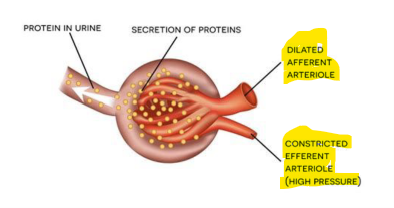
Proteinuria?
Excess protein in urine
Diabetic nephropathy → common cause
Therapeutic goal → decrease BP and/or GFR to reduce protein in urine
What are the 3 ways to block angiotensin II's vasopressor effects?
ACE inhibitors (ACEIs)
Angiotensin II receptor blockers (ARBs)
Direct renin inhibitors (DRIs)
What is the overall effect of ACEIs/ ARBs/ DRIs on blood pressure and glomerular pressure?
Lower systemic blood pressure
Lower pressure within the glomerulus
How do ACEIs and ARBs affect the efferent arteriole and GFR?
Relax the efferent arteriole → reducing glomerular pressure
May cause a temporary, small decrease in eGFR
How do ACE inhibitors work, and what are their effects?
Decrease angiotensin II production
Decrease bradykinin breakdown
Lower blood pressure and increase natriuresis → sodium excretion in urine

Enalapril?
ACEi
Prodrug → relatively inactive until in vivo esterases cleave the ester

Ramipril?
ACEi
Prodrug → CES1 converts into active ramiprilat
Pharmacogenetics → Genetic variations in metabolism, transport, and drug targets can cause differences in patient response.
Losartan?
ARB
Blocks angiotensin II type 1 (AT1) receptors, lowering blood pressure.
Uricosuric → Inhibits URAT1 → increasing uric acid excretion in urine
Telmisartan?
ARB
Blocks angiotensin II type 1 (AT1) receptors
PPAR-γ activation → Helps regulate insulin and glucose metabolism → may contribute to vascular and kidney protection
Renin?
Enzyme released by kidney cells in response to signals from stretch receptors when blood pressure is low
Starts RAAS by converting angiotensinogen into angiotensin I
Aliskiren / Tekturna ?
Direct renin inhibitor
Blocks renin at the S3bp binding site → preventing angiotensinogen from becoming angiotensin I
Decreases aldosterone levels and increases natriuresis → sodium excretion
Where are mineralocorticoid receptors (MRs) located?
In the cytosol of epithelial cells in the distal tubule and collecting duct
They have a high affinity for aldosterone
What happens after aldosterone binds to MRs?
Aldosterone enters the cell through the basolateral membrane and binds to MRs in the cytosol
The complex moves to the nucleus → binds to DNA, and activates genes → that produce aldosterone-induced proteins (AIPs)
What do aldosterone-induced proteins (AIPs) do?
Increase sodium reabsorption from urine into blood, helping maintain blood volume
Water follows sodium → increasing water retention
Blocking this with an MRA is good!!
Aldosterone receptor antagonists?
Competitively block aldosterone from binding to mineralocorticoid receptors (MRs)
The MR-drug complex is nonfunctional and cannot stimulate production of aldosterone-induced proteins (AIPs)!!
Examples of Aldosterone receptor antagonists / MRAs?
Spironolactone
Eplerenone
non steroidal → Finerenone
Finerenone?
Non-steroidal mineralocorticoid receptor antagonist
More selective for MR than steroid based agents
What causes hyperkalemia?
Renal insufficiency
Drugs like → ACEi/ARBs, MRAs, NSAIDs
Patiromer / Valtessa ?
Polymer binds free potassium ions in the GI tract in exchange for calcium → after an intermediate conversion to its acid form in the stomach
Reduces potassium absorption → lowering blood potassium levels
Increases potassium excretion in feces as a potassium–patiromer complex.
What is the onset and duration of patiromer?
Potassium lowering is detectable after 7 hours
Levels continue decreasing for at least 48 hours with continued treatment
Potassium levels remain stable for 24 hours after the last dose, then rise over at least 4 days
How is patiromer handled by the body?
Not absorbed from the GI tract and not metabolized
Excreted unchanged in feces as a potassium salt
Kayexalate?
Insoluble polystyrene sulfonate cation exchange resin
Has either a sodium or calcium form
In the stomach → exchanges sodium or calcium for hydrogen ions
Then in the colon → hydrogen ions are exchanged for free potassium ions
Resin bound to potassium is eliminated in feces
Thiazide diuretics?
Inhibit reabsorption of sodium and chloride ions from the distal convoluted tubules in the kidney by blocking the NaCl symporter
What is the difference between thiazide and thiazide-like diuretics?
Thiazides → Original Na⁺-Cl⁻ symport inhibitors derived from benzothiadiazine
Thiazide-like → Pharmacologically similar drugs that are not chemically thiazides
Thiazide diuretics is often used as an umbrella term for both classes because they inhibit the Na⁺-Cl⁻ symporter
How do thiazides affect renal hemodynamics?
Do not affect renal blood flow
Increase intratubular pressure and lower blood volume
How do thiazides affect GFR?
May decrease GFR due to increased intratubular pressure
Decrease the pressure difference driving filtration → reducing the effect of BP on kidney function
Loop diuretics?
Inhibit the activity of NaK2Cl symporter in the thick ascending limb of the loop of henle
Examples of loop diuretics?
Furosemide
Bumetanide
Ethacrynic acid
Torsemide
How do loop diuretics work?
Block the NaK2Cl symporter in the thick ascending limb → nearly stopping salt reabsorption and increasing salt in the tubular lumen
Water stays in the lumen by osmosis → increasing urine production
Effects of loop diuretics?
Increase ions in urine and urine volume
Increase pressure on the urine side of the glomerulus
Decrease GFR
What are the primary uses of calcium channel blockers (CCBs)?
Treat myocardial ischemia and hypertension
What are dihydropyridine CCBs?
More potent vasodilators
Ex → amlodipine, “ines”
What are non-dihydropyridine CCBs?
Verapamil is a more potent vasodilator than diltiazem
Ex → verapamil and diltiazem
How do all CCBs affect coronary blood flow?
Decrease coronary vascular resistance → increasing coronary blood flow
Vasodilator potency → Dihydropyridines > verapamil > diltiazem
What is the MOA of calcium channel blockers (CCBs)?
Bind to the α1 subunit of L-type Ca²⁺ channels → reducing Ca²⁺ entry into cells
Lower cytosolic Ca → decreasing contraction of cardiac and vascular smooth muscle cells
Beta blockers?
Block activation of Beta adrenergic receptors
Some block activation of all types of beta receptors while others are selective for one of the three known types
Where are β1, β2, and β3 receptors located?
β1 → Mainly heart and kidneys
β2 → Mainly lungs, GI tract, liver, uterus, vascular smooth muscle, and skeletal muscle
β3 → Fat cells
What are the normal effects of β1-adrenergic receptor activation?
Increases heart rate
Increases force of cardiac contraction
Increases renin release from the kidneys
What are the acute renal effects of beta-blockers?
Decrease effective renal plasma flow and glomerular filtration rate (GFR)
Alpha blockers?
Act as antagonists of alpha-adrenergic receptors
What are the acute effects of α₁-blockers?
Decrease arteriolar resistance and increase venous capacity → causing vasodilation
Reflexively increase heart rate and plasma renin activity
Renal blood flow is unchanged
What happens during long-term α1-blocker therapy?
Vasodilation persists
Cardiac output, heart rate, and plasma renin activity return to normal
Renal blood flow remains unchanged
Vasodilators?
Directly relaxes arteriolar smooth muscle
Ex → Hydralazine
What is the effect of a vasodilator on blood pressure and vascular resistance?
Decreases blood pressure by selectively decreasing vascular resistance in the coronary, cerebral, and renal circulations
KATP channel openers?
Must be metabolically activated to the N-O sulfate / active form for vasodilation effect
Ex → minoxidil
How does minoxidil sulfate cause vascular smooth muscle relaxation?
Opens K⁺ channels, allowing K⁺ efflux → out of the cell
Causes hyperpolarization → relaxing vascular smooth muscle and producing vasodilation
What are the renal effects of minoxidil?
Dilates renal arteries → but systemic hypotension can decrease renal blood flow
Usually improves hypertension-related renal dysfunction
Strongly stimulates renin release via sympathetic and intrinsic renal mechanisms
How do SULT1A1 polymorphisms affect minoxidil response?
Cause interpatient variability in drug metabolism
Slow sulfators: One gene deletion; most common in Caucasians (8.4%)
Rapid sulfators: 3+ gene copies; most common in African-Americans (60.9%)
How does hyperglycemia affect CKD?
Diabetes is a major cause of CKD
Better glucose control decreases the rate of kidney damage
How does high blood glucose damage the kidneys?
Increases blood pressure, damaging glomerular blood vessels
Increases reactive oxygen species (ROS), which damage vascular cells
Forms advanced glycation end products (AGEs), which stiffen blood vessel walls and damage glomerular integrity
What is the normal role of insulin?
Decreases blood glucose via inducing cellular uptake of glucose and inducing glycogen synthesis
What are insulin secretagogues?
Drugs that stimulate insulin release from pancreatic β cells
Ex → sulfonylureas and meglitinides
How does glucose trigger insulin release?
Glucose increases ATP, which closes KATP channels
This causes depolarization, Ca²⁺ entry, and insulin release
How do sulfonylureas and meglitinides work?
Close KATP channels by inhibiting SUR1 → increasing insulin release
How does diazoxide affect insulin secretion?
Opens KATP channels, preventing depolarization and decreasing insulin release
Sulfonylureas?
KATP Channel modulator
Bind to the SUR1 subunit of pancreatic β-cell KATP channels and inhibit them
Cause membrane depolarization, Ca²⁺ entry, and increased insulin release
Examples of sulfonylureas?
Chlorpropamide, tolazamide, tolbutamide, glimepiride, glipizide, glyburide, and micronized glyburide.
Meglitinides?
Non-sulfonylurea KATP channel modulator
Uses same mechanism of sulfonylureas → blocks KATP channels in pancreatic beta cells → stimulating insulin secretion
Examples of meglitinides?
Repaglinide
Nateglinide
What are incretins, and what are the two main types?
GI hormones released after meals that stimulate insulin secretion.
GLP-1 and GIP
How do GLP-1-based drugs lower blood glucose?
GLP-1 agonists → Activate GLP-1 signaling to increase insulin release
DPP-4 inhibitors → Prevent breakdown of GLP-1, allowing it to work longer
GLP-1 agonists?
Synthetic peptides that mimic GLP-1’s structure and function
Ex → liraglutide and exenatide
Examples of Dipeptidyl Peptidase-4 inhibitors (DP4-I)?
Saxagliptin
Sitagliptin
Vildagliptin
Alogliptin
Linagliptin
Alpha glucosidase inhibitors?
Slow carbohydrate absorption in the GI tract
Blunt the rise in blood glucose after meals
Increase GLP-1 release, which also helps lower glucose