Kisner Chap 12
 Call Kai
 Learn
Learn Practice Test
 Spaced Repetition
 Match
Match Flashcards
 Knowt Play
1/85

There's no tags or description
Looks like no tags are added yet.
Name | Mastery | Learn | Test | Matching | Spaced | Call with Kai | Chat |
|---|
No analytics yet
Send a link to your students to track their progress
86 Terms
Skim thru this table
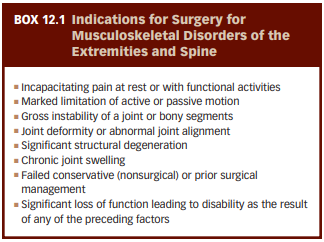
Important table as well
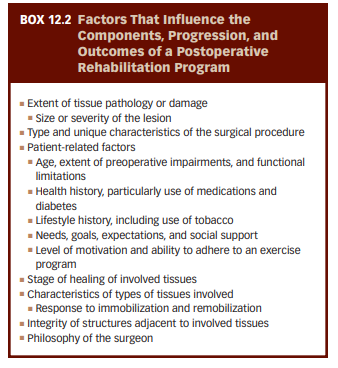
Surprise surprise, another table
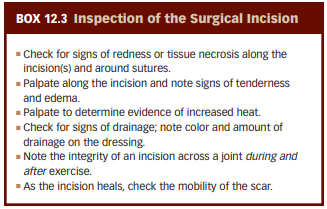
Time frame of the maximum protection phase?
few days to 6 weeks
depending on the type of surgery and the tissues involved.
This is the intermediate phase of rehabilitation when inflammation has subsided, pain and tenderness are minimal, and tissues are able to withstand gradually increasing levels of stress
Moderate protection phase
Criteria for progression to the moderate protection phase often include the absence of ______ and the availability of at least limited ______ movement of the operated extremity
absence of pain at rest
at least limited pain-free movement
Time frame of the moderate protection phase
4 to 6 weeks postoperatively and continues for an additional 4 to 6 weeks
During this advanced phase, little to no protection of operated tissues is required
Minimum protection/return to function phase.
To progress to this phase, full (or almost full) _________ should be available and the joint capsule (if involved) should be __________.
Pain-free active ROM
clinically stable
Timeframe of the minimum protection phase?
6 to 12 weeks postoperatively and may continue until 6 months postoperatively or beyond.
Refer to box 12.4 for management guidelines of postoperative rehab
Di sakto ang laki ng table punta nalang kayo page 397 ng pdf ng kisner 7th ed lol
The risk of pneumonia or atelectasis (collapse of the lung
caused by bronchial obstruction) is highest during when?
Early postoperative period
Potential Postoperative Complications
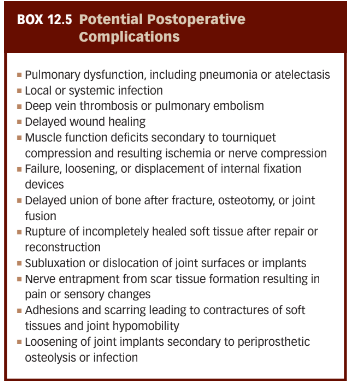
If a joint capsule has been incised during surgery, as is the
case for total joint replacement or an open labrum repair,
there is an increased risk of postoperative ___________.
Joint dislocation
This is a bolus of coagulated blood in the circulatory system.
thrombosis
During the early stages of a DVT, only how many percent of cases
can be recognized by clinical manifestations?a
25% to 50%
Clinical manifestation of DVT
aching or severe pain
swelling
changes skin temperature and color, specifically heat and redness
True or False:
After a DVT patient gets discharged, administering of anticoagulant medicine continues for about 6 months, during this time frame the patient can engage in any physical activity as long as they take the medicine regularly.
False:
They must avoid contact sports, running, and skiing
Orthopedic Surgery Procedure Category
Repair
reattachment
reconstruction
stabilization
replacement
realignment
transfer
release
resection (excision)
fixation
fusion
This is an open procedure in which joint capsule is incised to expose joint structure
Arthrotomy
This is used as a diagnostic tool and as a means of treating intra-articular disorders (out-pt, under local anesthesia)
Arthroscopy
Graft where pt’s own tissue harvested from a donor site in the body is used.
Autograft
Graft that uses fresh or cryopreserved tissue from a different source, typically a cadaveric donor
Allograft
True or False
For articular cartilage implantation, an allograft is the golden standard.
False:
An allograft is not an option for articular cartilage implantation because cryopreserve destroys articular chondrocytes
Graft that uses an alternative to human tissue but have high rate of failure and have not maintained their integrity over time
Synthetic graft
True or False
Immediate surgical repair of a severe tear or even complete
rupture of a muscle is uncommon because inflammation
affects the texture of muscle tissue, making it difficult to hold
sutures in place.
True
A complete muscle tear patient can achieve a more satisfactory outcome with a _______ which is approximately ___ to ____ hours after injury.
Late Repair
48 to 72
True or False:
Gradual muscle-setting exercise of the sutured muscle may
be initiated immediately after surgery.
True
Vigorous stretching or the return to full activity level are
contraindicated until soft tissue healing is complete as
long as ______ weeks postoperatively.
6 to 8 weeks
Tendons usually rupture at which part of the muscle?
Musculotendinous or Tendo-osseous junctions.
Common sites of acute tendon tear or rupture:
Bicipital tendon (shoulder) and Achilles tendon
In patients with ___________ of the hand and
wrist, the extensor tendons can erode over time and may
eventually rupture along the dorsum of the hand.
chronic tenosynovitis
True of False:
A complete tear or laceration of a tendon should be repaired
immediately or within a few days after injury.
True
After the tendon is sutured, the repaired
muscle-tendon unit is maintained in a ________ position,
as with a complete tear of a muscle.
Shortened position.
heavy lifting activities are often contraindicated for as long as _________ after an upper extremity repair.
6 to 8 weeks
vigorous stretching and high-intensity resistance exercise should not be initiated for at least how many weeks after tendon repair.
8 weeks
Ligament ________ involves approximating and suturing the
torn ligament, whereas __________ is accomplished with
a tissue graft taken from a donor site.
Repair
Reconstruction
For ligamentous surgery patients wishing to return to high-demand work or sports activities, how long would rehabilitation take until they are ready?
6 months to 1 yr
Joints particularly vulnerable to instability are those with minimal inherent stability, most notably which joint?
Glenohumeral jt.
True or False:
An closed procedure with arthrotomy is used if an
open reduction of the joint is required or if there is extensive
damage to the labrum, avulsion of the capsule, or a fracture.
False:
Open procedure
This approach is most often used to reduce capsular laxity and for some reconstructive procedures.
Arthroscopic approach
Reconstruction procedure where a specific portion of the capsule is incised and tightened by imbrication/plication (overlapping and then suturing) of the redundant tissue.
Capsulorrhaphy (Capsular Shift)
Reconstruction procedure where it involves reattaching the labrum to the rim of the glenoid in combination with capsule stabilization.
Capsulolabral reconstruction
Reconstruction procedure where thermal energy (laser or radiofrequency) is delivered to the capsule to shrink identified regions of laxity.
Electrothermally assisted capsulorrhaphy
The _____________ of a muscle-tendon unit alters the line of pull, potential force generation, and excursion of the muscle.
Transfer or realignment
True or False:
During a typical tendon transfer or realignment procedure, the proximal attachment of the muscle-tendon unit is removed from its bony insertion and reattached to a different bone, to a different location on the same bone, or to adjacent soft tissues.
False:
Distal attachment
True or False:
After release, lengthening or decompression of soft tissues, CPM and/or active-assistive ROM is typically initiated within a week or two after surgery.
False:
A day or two after surgery
True or False:
After release, lengthening or decompression of soft tissues, Strengthening of the agonists of the lengthened muscle and functional use within the available ROM are started early to maintain active control of movement within the newly gained range.
False:
Strengthening of the antagonists of the lengthened muscle
involves arthroscopic removal of fibrillated cartilage, unstable chondral flaps, and fragments of cartilage or bone from a joint. Osteophytes also may be
excised.
Indicated for joint pain, clicking, ratcheting or catching during joint movement.
Arthroscopic Debridement and lavage
involves removal of the synovial lining of the joint in the presence of chronic joint inflammation.
Typically, it is performed in patients who have rheumatoid arthritis with chronic proliferative synovitis but minimal articular changes.
Synovectomy
Synovectomy is indicated when medical management has failed to alleviate joint inflammation for how many months?
4 to 6 months.
Synovectomy is usually performed using what approach?
Arthroscopic approach
Synovectomy is most commonly performed on which joints?
Knee, elbow, wrist and MCP jts.
When synovium proliferates in the synovial sheaths of tendons, it is
referred to as?
Tenosynovitis
Removal of excessive synovium from tendon sheaths is known as?
Tenosynovectomy
most often done for chronic synovitis of the wrist to clear synovium from the extensor tendons of the hand and is also called a dorsal clearance procedure
After synovectomy of the knee, partial weight bearing as tolerated during ambulation progresses to full weight bearing by how many days?
10 to 14 days.
True or False:
After wrist or elbow synovectomy, lifting heavy objects is
restricted for several weeks.
No shit.
True or False:
After open synovectomy, progression of exercises and ADLs proceeds faster than after arthroscopic synovectomy.
False:
Open mas mabilis? bruh
These procedures are commonly used to promote healing of small chondral defects in symptomatic joints
Common in chondral lesions of the medial femoral condyle and posterior aspect of the patella
Abrasion Arthroplasty, Subchondral Drilling, and Microfracture
Mechanical disruption of articular surface down to superficial layer of subchondral bone using a motorized, arthroscopic burr or dril
Abrasion Arthroplasty
True or False:
Abrasion arthroplasty is no more effective than arthroscopic debridement.
True
Use nonmotorized arthroscopic awl to penetrate subchondral bone and expose bone marrow, to repair osteochondral defects <1.5 cm2.
Relieves sx more effectively
Microfracture of Articular Cartilage
This transplantation is designed to stimulate growth of hyaline cartilage for repair of articular cartilage focal defects and to prevent progressive deterioration of joint cartilage leading to osteoarthritis.
Chondrocyte Transplantation
Which stage of chondrocyte transplantation involves healthy cartilage being harvested arthroscopically to extract chondrocytes and culture them to increase volume.
First stage
This stage is the open procedure of chondrocyte transplantation
Second stage.
Transplantation of intact articular cartilage along with underlying bone
Osteochondral Autograft and Allografts
How long after operation can a patient who underwent osteochondral autografts and allografts do full WB?
8-9 weeks
How long do progressive exercises last for a patient who underwent osteochondral autografts or allografts?
6 months to a year
Reconstructive joint procedure designed to relieve pain and improve function
Arthroplasty
also known as resection arthroplasty, involves removing periarticular bone
from one or both articular surfaces.
Excision Arthroplasty
Procedure that involves the resection of the distal ulna for late-stage arthritis of the distal radioulnar joint.
Darrach Procedure
excision arthroplasty of the hip which is only used now as a salvage procedure after a failed total hip replacement when revision arthroplasty is not feasible.
Girdlestone Procedure
This arthroplasty is the same as excision arthroplasty but an implant is inserted in order to help the remodeling of a new joint.
Excision Arthroplasty with an implant
Yeeaahh ik..
biological resurfacing of a joint to provide a new articulating surface. After the involved joint surfaces are débrided, a foreign material is placed, or interposed, between the two joint surfaces.
Interposition Arthroplasty
Two types of joint replacement arthroplasty.
Total joint replacement and hemireplacement arthroplasty
________ Involves resecting of both articular surfaces and replacing them with artificial components.
________ involves resection and replacement of only one articulating surface.
Total joint replacement arthroplasty
Hemireplacement arthroplasty
Arthroplasty to relieve pain and improve function in patients with severe joint degeneration associated with late-stage arthritis
Total joint replacement arthroplasty
Table for materials designs and methods of fixation for joint replacement arthroplasty
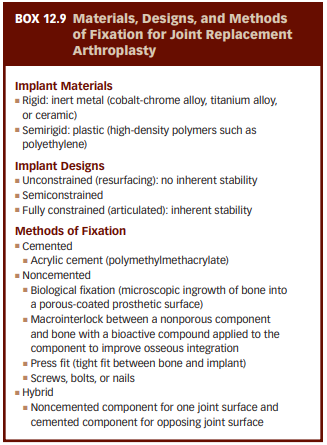
________ fixation is used primarily for older or sedentary patients who are unlikely to place high stresses on the implants
Cemented fixation
___________ fixation, a form of cementless fixation, is achieved by growth of bone into the porous-coated exterior surface of an implant
Bio-ingrowth fixation
advocated for younger, more active patients
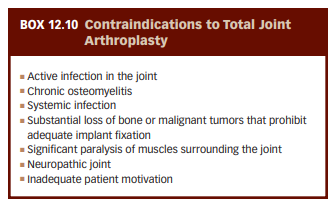
Contraindications to Total Joint Arthroplasty
surgical fusion of the joint surfaces. It is indicated as a primary surgical intervention in cases of severe joint pain associated with late-stage arthritis and joint instability in which mobility of the joint is a lesser concern
Arthrodesis
Optimal Positions for Arthrodesis
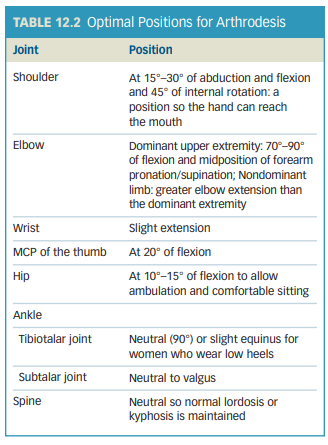
After arthrodesis, Initially, the joint is immobilized in a cast above and below the site of arthrodesis for how many weeks postoperatively?
6 to 12 weeks
Some osteotomy procedures require additional external (cast) stabilization of the joints above and below the osteotomy site until bony union occurs, which may take as long as?
8 to 12 weeks
Following osteotomy weight bearing is typically protected for how long?
4 to 6 weeks or more.