PE studies test Y10T4
 Call Kai
 Learn
 Practice Test
 Spaced Repetition
 Match
 Flashcards
 Knowt Play
1/47

There's no tags or description
Looks like no tags are added yet.
48 Terms
•2 factors affect stability;
•1 – Base of Support
•2 – Centre of Gravity
Centre of gravity
– The hypothetical point around which the force of gravity appears to act
Standing in the anatomical position the COG sits around the belly button, but humans are constantly moving therefore the exact location of the COG is always changing.
what makes cog more stable
When the line of gravity is within the base of support = STABLE
When the line falls outside base of support = UNSTABLE
how to determine cog

Base of Support
•The base of support (BOS) is the area of your body that is in contact with the ground / surface
•BOS increases as distance between the feet increases
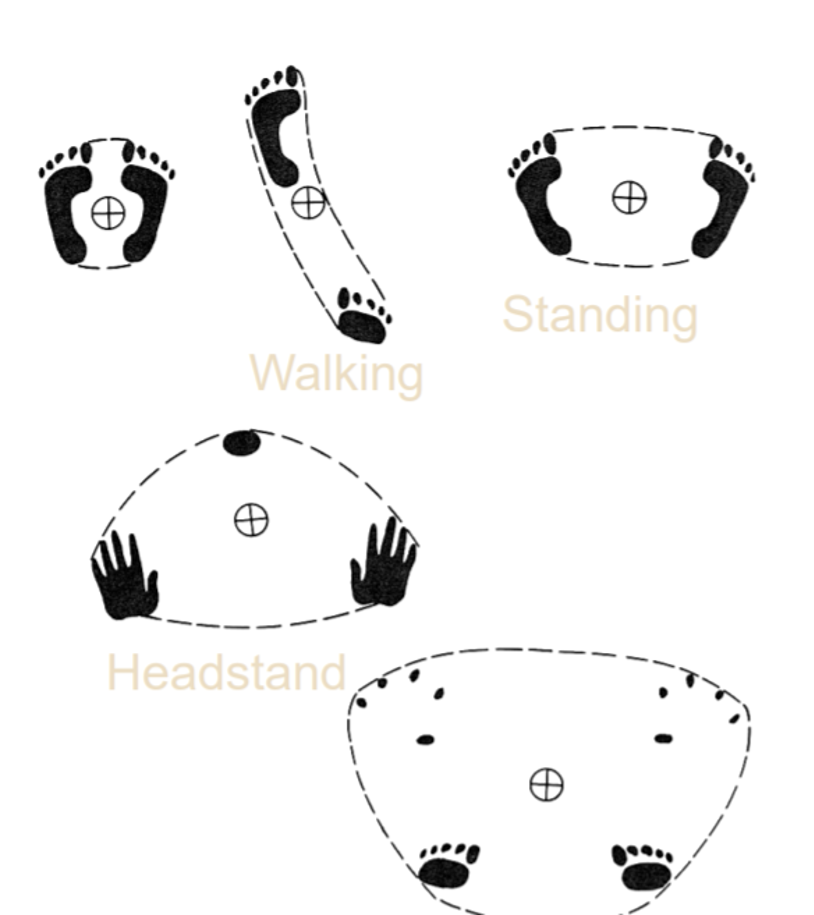
what makes bos more stable
•BOS increases as distance between the feet increases
•The larger the BOS the more stable the person is able to be
What is the line of gravity
is an imaginary vertical line that passes from the center of gravity (COG) of a body or object straight down to the ground or supporting surface, representing the direction of gravitational force acting on the body
what makes line of gravity more stable
the line of gravity is more stable when it falls within a larger base of support, because the body is less likely to tip over. Stability also increases when the centre of gravity is lower, making balance easier to maintain.
inertia
•Inertia is a body’s resistance to change its’ motion and is proportional to the body’s mass.
•More mass = more inertia = greater resistance to change.
The heavier the object, the greater the inertia and therefore the greater the force required to move it or change its state of motion
Newton’s first law and example of sporting
•An object at rest will remain at rest and a moving object will continue moving unless acted upon by an unbalanced (external) force.
e.g A soccer ball remains still until a player kicks it.
Newtons second law and example
•The rate of change of acceleration of a body is proportional to the force applied to it, and inversely proportional to the mass of the object.
•
•Force = Mass x Acceleration (F = ma) or a = F/m
e.g A sprinter pushes harder against the starting blocks to accelerate faster.
•
Newton’s third law and example
•For every action there is an equal and opposite reaction.
•Whenever one object exerts a force on a second object, the second object exerts an equal and opposite force on the first object.
e.g When a swimmer pushes water backwards, the water pushes the swimmer forwards.
Angular motion
the motion of a body about a fixed axis
•e.g. Ice skater twirls
•e.g. Hitting or throwing a ball
•e.g. A gymnast rotating around a high bar
•e.g. A diver performing a somersault
Moment of inertia
•; this is where the mass lies from the point of rotation. It is the rotating bodies resistance to angular acceleration or deceleration
Low and high moment of inertia and examples
•If the mass is close to the point of rotation, the Moment of Inertia (MI) is low
Low moment of inertia: A figure skater with their arms tucked in spins faster.
•If the mass is far from the point of rotation, the Moment of Inertia (MI) will be high.
High moment of inertia: A figure skater with their arms stretched out spins slower.
Angular velocity
•This is the speed in which an object will rotate around the axis. Angular velocity is greatly impacted depending upon the MI.
low and high angular velocity
Low angular velocity = slow rotation,A merry-go-round turning slowly.
High angular velocity = fast rotation, : A merry-go-round turning quickly.


stages of learning
1.Cognitive
2.Associative
3.Autonomous
Cognitive
•Beginner stage of learning – lots of thinking required
•Frequent errors, errors are large
•In this stage of learning performing the skill requires all of the athlete’s attention
•Rely on their coaches for cues and reinforcement
•2 -3 out of 10 are successful
Associative stage
•Intermediate stage
•Lower level of errors, errors not as large
•Performances are becoming more consistent
•Simpler parts of the skills are very fluent, but the more complex parts still require more attention
•5-7 out of 10 attempts are successful
Autonomous
•Performing a skill automatically
•No need to think about the skill
•Little to no errors when performing
•The motor programs involved are well learned and there is now spare attention which can be focused on opponents and tactics.
two types of feedback
intrinsic and extrinisc
intrinsic
•Intrinsic
•Comes from within
•Comes from the feeling of the movement – feeling balanced during a handstand
•This type of feedback is important for autonomous learners
extrinsic
•Comes from external source – teacher or coach
•Received by: seeing, hearing and is used to support intrinsic feedback
•Extrinsic feedback is important for beginners / cognitive learners who have yet to develop the feel of the movement
•The feedback can be positive or negative
•Types of Extrinsic Feedback
Verbal, Visual, Written
How many points of feedback should be given for optimal performance
•Always keep feedback positive and aim to give no more than 2 features for improvement
Why is feedback important
•Feedback helps athletes understand what they are doing well and what they need to change. It is essential for improvement
types of feedback
Verbal, Written, Visual
open skill vs closed skill - open
•The environment is constantly changing and skills and movements need to be continually adapted
•Requires quick decision making
•Examples – Team sports - football , netball, hockey, soccer
open v closed skill - closed
•Skills that take place in a stable and predictable environment
•The performer knows exactly what to do and when
•Skills are not affected by the environment
•There is a clear beginning and end to the skill
•Examples – Free throw in basketball, serving in tennis
simple vs complex skill - simple
•Straightforward, do not have to process much information
•Requires little concentration and cognitive ability
•Athlete does not require much feedback during performance
•Example à Sprinting
simple v complex skill - complex
•Involves a large attention span because they are complicated
•Skills are practised in training repeatedly to make easier in competition
•The skill has many sub-routines or parts
•Example à Tennis serve
fine vs gross - fine
•Movements involve precision and control of small muscle groups
•Accuracy
•Examples à Writing, playing piano
fine vs gross - gross
•Movements that involve large muscle coordination
•Big powerful movements
•Examples à running, jumping, skipping
discrete
•Discrete tasks have distinct beginning and ending points
•They are single specific skills
•Examples à Batting a baseball, throwing a javelin, kicking a soccer ball
serial
•Serial tasks consist of a string of discrete skills performed in sequence
•Examples à floor exercise routines in gymnastics
continuous
•Continuous skills have no obvious beginning or end
•The end of one cycle marks the beginning of the next
•The skill is repeated in a cycle
•Examples à Running, swimming, cycling, rowing
roles and responsibilities of a coach
Organisation
•The coach prepares equipment, plans sessions, manages time, and keeps training structured
Building Rapport
•The coach builds trust, respect, and strong relationships with athletes to create a supportive environment.
Providing Instruction
•The coach explains skills, drills, and tactics in a way athletes can easily follow. Athletes know what to do and how to do it.
Demonstration
•The coach performs the skill (or uses a model) so athletes can see correct technique
Types of coaches
autocratic
democratic
laissez-faire - casual
autocratic
Key Characteristics
•Coach makes all decisions
•Clear rules and expectations
•Little athlete input
•Fast, direct communication
When it works best
•With beginners who need clear guidance
•In dangerous or high‑risk sports (e.g., gymnastics, diving)
•When time is limited and quick decisions are needed
Can push some players away from the club or sport due to stress or lack on enjoyment
democratic
Key Features
•Athletes have input, shared responsibility
•Coach encourages questions and ideas
•Focus on teamwork and communication
•Builds trust and motivation
When it works best
•With experienced athletes, intrinsically motivated
•When time is not limited in sessions
•When developing leadership within a team
Can lack focus/ direction and cause time wasting
laissez faire
Key Features
•Minimal coach direction, less structure
•Athletes lead their own practice, puts onus on players
•Encourages independence
•Coach acts as a supporter rather than a director
When it works best
•With highly skilled, self‑motivated athletes, encourages independence and self correction
•In elite or professional environments
•When athletes need to develop autonomy, can help identity leaders
Can lack focus/direction, waster time. No improvement
phases of a lesson
Warm Up
Skill Development
Culmination
Cool down
warm up
The warm‑up prepares athletes physically and mentally for the session. It reduces injury risk and gets the body ready for movement.
•Light aerobic activity to raise heart rate, light sweat. Approx 5-10mins long
•Dynamic stretching to warm muscles and joints
•Simple movement patterns, specific to the skill and directed at the right age
•Mental preparation: focus, motivation, understanding the session goals
skill development
This is the main part of the session where athletes learn, practise, and refine skills. It focuses on improving technique and building confidence.
•Approx 30% of the training session
•Demonstration of correct technique
•Can be performed as a whole group or by breaking into small groups
•Skills should be broken down into steps before bringing them all back together again.
•Allow of repetition
•Allow for questions
•Coach observes and supports learning
culmination
This phase allows athletes to apply the skill in realistic, game‑like situations. It helps transfer the skill from practice into performance
•Approximately 20-25% of the session
•Skills previously developed in skill development phase are put into either a game scenario or the skill is practise as a whole and at correct speed
•Small sided games or modified activities
•Encourages teamwork, communication and decision making under pressure.
cool down
The cool‑down helps the body recover and gives athletes time to reflect on what they learned. It closes the session in a calm, structured way
•Approximately 5-10mins long – depending on activities in session
•The cool down helps to return the body to its regular state and remove any waste products that could result in sore muscles
•Should consist of a light jog, stretches and rehydration
•The cool down is a good chance for athletes to consolidate what they have learnt and to ask any final questions