Verrucal-Papillary Lesions
 Call Kai
 Learn
 Practice Test
 Spaced Repetition
 Match
 Flashcards
 Knowt Play
1/41

There's no tags or description
Looks like no tags are added yet.
Name | Mastery | Learn | Test | Matching | Spaced | Call with Kai | Chat |
|---|
No analytics yet
Send a link to your students to track their progress
42 Terms
Verruca:
is the medical term for a wart
Wart:
is a growth on skin (usually the feet or hands) that is caused by a virus (human papilloma virus (HPV))
A wart that is found intraorally is called a ________. Papillomas generally appear differently intraorally than they do when on the skin even though they are both caused by HPV
papilloma
Human Papilloma Virus (HPV)
is a common and ubiquitous group of well over 200 viruses that are usually designated by number
Certain HPV strains are responsible for wart (and papilloma when intraoral) development
HPV infection usually lasts a few years and most people shed the virus without medical intervention
Most individuals with HPV will show NO signs of the infection
HPV 6, 11, 14, 16, 18 can be sexually transmitted and is estimated to be the most widespread STD, with most people who are sexually active being exposed to it at some point, however in most cases it goes unnoticed
HPV 16 & 18 are linked to oropharyngeal cancer and is the most common cause of OSCC in this area
There is a vaccine for HPV (called Gardasil 9) which covers the "high risk" strains such as 16 and 18, as well as common "low risk" strains such as 6 and 11

Papilloma (also called squamous papilloma)
is a relatively common growth caused by HPV infection
Cause of Papilloma (also called squamous papilloma):
o Certain subtypes of HPV (6 &11) cause intraoral growths comprised of benign epithelium and a minor amount of supporting connective tissue hyperplasia
o Exposure of saliva infected with HPV (through kissing or sharing a drink, e.g.) or auto-inoculation (such as spread from a wart on another body part) can expose the pt to HPV

Visual Appearance of Papilloma (also called squamous papilloma):
o Papillomas typically appear as a whitish "frond-like" (finger-like) exophytic growth
o Papillomas may have a "cauliflower" like apperance and are usually solitary lesions, though multiple separate papillomas may be present
o Papillomas are usually pedunculated (narrow base growing from a stalk), rather than sessile (broad base)
o Papillomas can appear on ANY intraoral mucosal surface but may be present on the soft palate and ventral tongue more often

Clinical Info: Papilloma (also called squamous papilloma)
o Papillomas will be painless and usually persistent, but may resolve on their own
o Oral papillomas can occur in otherwise healthy people, though are more commonly found in immunocompromised pts
o PLEASE NOTE: There is a distinction between papillomas and verruca vulgaris (common skin wart). Verruca vulgaris rarely appears in the oral cavity, however it will have much the same appearance as a papilloma
Differential Diagnosis: Papilloma (also called squamous papilloma)
Verruciform xanthoma, papillary hyperplasia, condyloma accuminatum
Tx recommendations: Papilloma (also called squamous papilloma)
Excisional biopsy is the tx of choice for papillomas. Once excised, they rarely re-occur in the same area
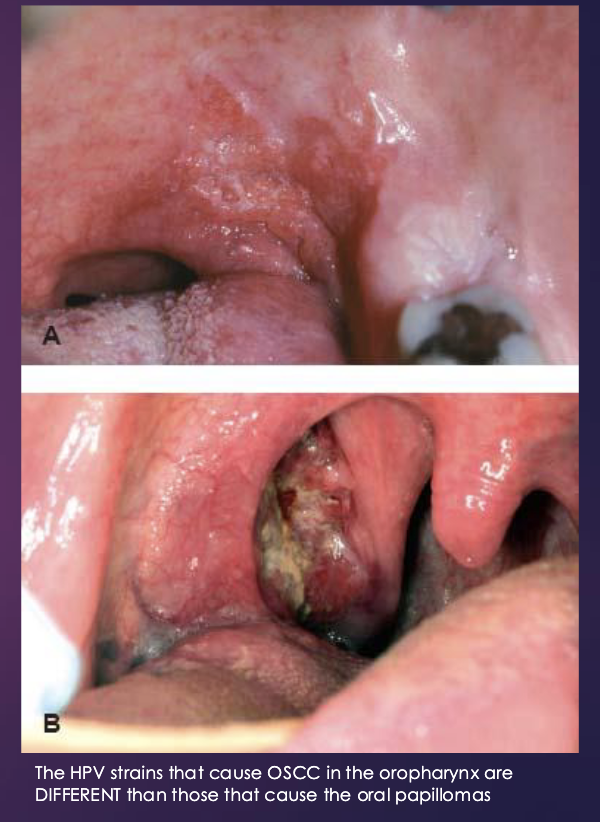
Papilloma and Oral Cancer (OSCC):
As we've previously learned, HPV is the MAIN cause of oral cancer (specifically OSCC) in the oropharynx region
o HPV-16 and -18 are thought to be the main causes of oropharyngeal OSCC
Though oral papillomas are caused by HPV infection, they are generally caused by DIFFERENT STRAINS of the virus than what causes OSCC development (OSCC caused by "high risk" HPV strains 16 and 18) and clinically appear differently from the strains which cause OSCC
Currently, it is thought that oral papillomas have a VERY LOW (but possibly not 0%) chance to turn malignant and the vast majority of these lesions are benig
Condyloma Accuminatum:
is another term for genital warts which may be spread to and affect the oral cavity
Cause of Condyloma Accuminatum:
Condyloma acuminatum is caused by infection of HPV 6 & 11 (the same as for oral papillomas) and is spread intraorally by sexual contact with an already infected person ***

Visual Appearance of Condyloma Accuminatum:
o Condyloma acuminatum generally appear as clusters or groups of exophytic pink nodules that grow and may coalesce and are typically caused by sexual contact with an infected partner (unlike with squamous papillomas)
o Will generally have sessile (broad) bases
o Most often seen on the lips, tongue, and soft palate/tonsillar area
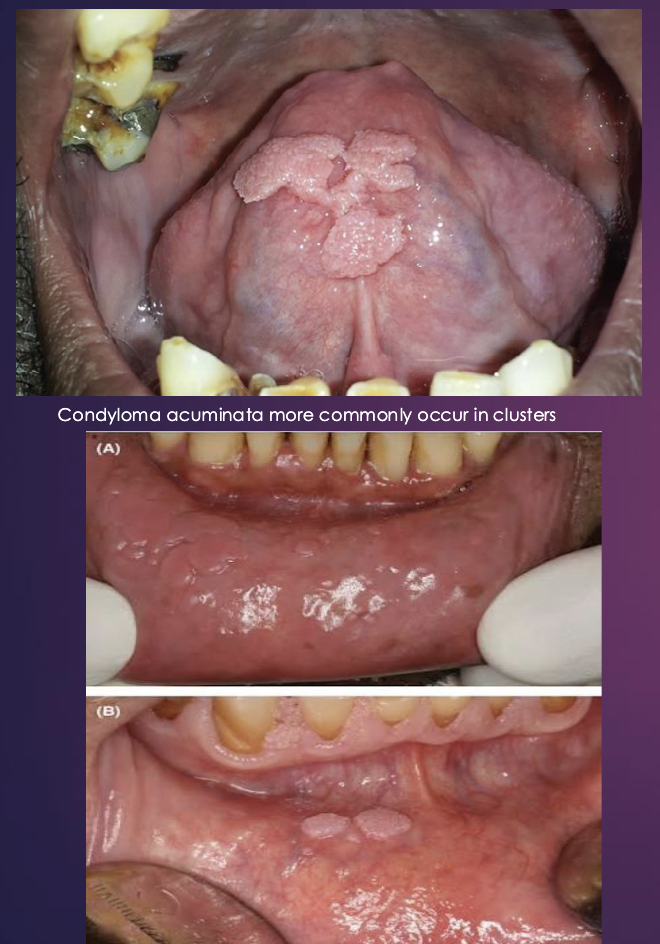
Clinical Info: Condyloma Accuminatum
o Lesions generally appear larger and clustered as opposed to squamous papilloma
o Lesions will be painless
Differential Diagnosis: Condyloma Accuminatum
Squamous papilloma, focal epithelial hyperplasia, verruciform xanthoma
Tx recommendations: Condyloma Accuminatum
o Condyloma acuminatum are usually surgically excised or laser ablated
o Recurrence is possible

Oral Papillomas Vs Condyloma Acuminatum
Both oral papillomas and condyloma acuminata lesions are caused by HPV-6 and 11 strains though they differ on route of infection:
o Oral papillomas are not necessarily caused through sexual contact (though HPV can be spread via kissing/saliva exchange) and can also be caused through auto-inoculation (transferring the virus from another part of your own body, such as from a hand wart)
o Condyloma Acuminatum lesions are ALMOST ALWAYS caused through sexual contact with a person with genital warts and appear differently clinically than oral papillomas
o BOTH oral papillomas and condyloma acuminatum are considered LOW RISK for malignant transformation however surgical treatment is still recommended for removal
Focal epithelial hyperplasia (Heck's disease):
is a rare, virus- induced benign proliferation or oral squamous epithelium more often found in children and adolescents
Cause of Focal epithelial hyperplasia (Heck's disease):
Focal epithelial hyperplasia is caused by infection by HPV-13 & 32

Visual Appearance of Focal epithelial hyperplasia (Heck's disease):
Generally appears as multiple, nodular, soft tissue masses with a papillary appearance. Most often appear on the lips, buccal mucosa, and tongue
Clinical Info Focal epithelial hyperplasia (Heck's disease):
Focal epithelial hyperplasia is contagious and is contracted via saliva from an infected individual. Lesions will be painless and persistent
Differential Diangosis: Focal epithelial hyperplasia (Heck's disease)
Squamous papilloma, condyloma acuminatum, verruciform xanthoma
Tx recommendations: Focal epithelial hyperplasia (Heck's disease):
Biopsy should be performed to determine diagnosis. If lesions are large, excision may be warranted. Otherwise areas may regress on their own
Inflammatory papillary hyperplasia (IPH):
is a benign papillary- appearing growth, usually found on the hard palate associated with a removable prosthesis such as a denture
Cause of Inflammatory papillary hyperplasia (IPH):
IPH is thought to grow in response to repeated mechanical trauma from a removable prosthesis, coupled with chronic candidiasis infection ***

Visual Apperaance of Inflammatory papillary hyperplasia (IPH):
o IPH almost exclusively occurs on the hard palate with an existing ill-fitting denture or partial denture
o Appears as multiple erythematous, sessile papillary-like lesions which are usually less than 2-3 mms in diameter, however they are not true papillomas

Clinical Info Inflammatory papillary hyperplasia (IPH):
o More common in older, edentulous pts who wear a prosthesis continuously and do not take prosthesis out overnight ***
o Lesions are benign and painless, however trauma from prosthesis may be present
Differential Diagnosis: Inflammatory papillary hyperplasia (IPH)
Nicotine stomatitis due to "cobblestone" appearance, squamous papilloma
Tx recommendations: Inflammatory papillary hyperplasia (IPH)
Treat candidiasis, if present. Reline or remake denture. Lesion may be laser ablated or cryosurgery performed to remove lesion before denture reline/remake
Verrucous Carcinoma:
is a subtype of OSCC and is most commonly found intraorally, however may occur elsewhere on the body
Cause of Verrucous Carcinoma:
o The cause for intraoral verrucous carcinoma is unknown, however smokeless tobacco in combination with alcohol consumption is a major risk factor for its development
o Areca (betel nut) chewing has also been strongly linked

Visual Appearance of Verrucous Carcinoma:
o Generally will appear as diffuse, white, exophytic, mass with papillary-appearing projections
o Commonly occurs on the mandibular buccal vestibule or gingiva near site of smokeless tobacco usage

Clinical Info Verrucous Carcinoma:
o Most often occurs in older men with a chronic use of smokeless tobacco
o Verrucous carcinoma is a subtype of OSCC, however it is slower growing and rarely metastasizes
o OSCC may develop in the area secondaril
Differential Diagnosis Verrucous Carcinoma:
Leukoplakia, OSCC, Deep fungal infection, smokeless tobacco keratosis
Tx recommandations Verrucous Carcinoma:
Biopsy followed by surgical excision is tx of choice
Verruciform Xanthoma:
is a rare, benign oral mucosal lesion that can closely resemble a squamous papilloma
Cause of Verruciform Xanthoma:
The cause of VX is unknown and it is NOT a HPV- related lesion, it only appears as such. It is more likely to occur in areas with constant irritation or trauma and histologically contains foam cells (cells filled with fat)
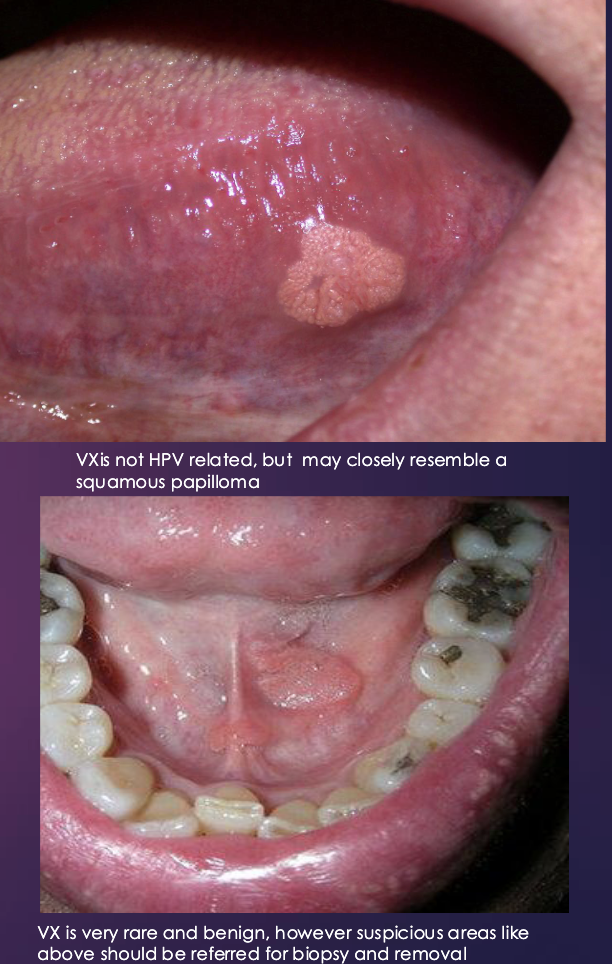
Visual Appearance of Verruciform Xanthoma:
VX is generally well circumscribed, with a granular or papillary surface that may ulcerate. Most often occurs on the hard palate and may vary in widely in size from 2mm to 2 cm
Clinical Info Verruciform Xanthoma:
VX is rare and are impossible to distinguish from a "normal" squamous papilloma. Lesions will be painless and persistent
Differential Diagnosis: Verruciform Xanthoma:
Squamous papilloma, condyloma acuminatum, focal epithelial hyperplasia
Tx recommendations: Verruciform Xanthoma
Pt should be referred for biopsy and lesions will generally be excised in ful