AP Psychology Uni 1
 Call Kai
 Learn
 Practice Test
 Spaced Repetition
 Match
 Flashcards
 Knowt Play
1/55

There's no tags or description
Looks like no tags are added yet.
56 Terms
Mean
Sum of all scores divided by the number of scores. Sensitive to extreme outliers.
Median
The middle score when data is ordered from least to greatest
Mode
The most frequently occurring score(s).
Experiment
Manipulates an independent variable to measure effect on a dependent variable. Only method that proves cause-and-effect. Uses random assignment.
Case Study
In-depth study of one individual or small group. Rich detail, but cannot be generalized to the population.
Naturalistic Observation
Observing behavior in natural settings without manipulating the environment. High ecological validity; cannot control variables.
Correlation
Measures the strength and direction of a relationship between two variables. Correlation DOES NOT equal causation. Third-variable problem (confounds).
Sympathetic Nervous System
"Fight or Flight." Accelerates heart rate, dilates pupils, inhibits digestion, releases adrenaline.
Parasympathetic Nervous System
“Rest and Digest." Calms the body, slows heart rate, stimulates digestion, contracts pupils.
NREM-1
Light sleep. Theta waves. Hypnagogic sensations (falling feeling).

NREM-2
Deeper relaxation. Marked by Sleep Spindles (bursts of rapid activity) and K-complexes.

NREM-3
Deep slow-wave sleep. High-amplitude Delta waves. Sleepwalking/night terrors occur here.
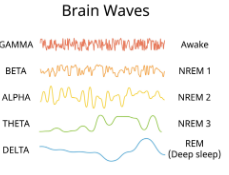
REM (Paradoxical Sleep)
Rapid Eye Movement. Beta-like active brain waves. Vivid dreaming, but motor cortex is blocked (body is paralyzed).

EEG (Electroencephalogram)
Records electrical brain waves on the scalp. Great for sleep/seizure study (high temporal resolution).
PET Scan
Measures radioactive glucose consumption to reveal active brain areas. Great for functional activity.
MRI
Uses magnetic fields and radio waves to produce detailed static structural images.
fMRI
Combines MRI and PET features—tracks blood flow (oxygenation) to show structure AND functional activity in real time.
Informed Consent
Participants must know risks and agree voluntarily beforehand.
Protection from Harm
Participants must be protected from unnecessary physical/psychological distress.
Confidentiality
Individual participant data must remain anonymous/private.
Debriefing
Full explanation of the study’s purpose, hypothesis, and any deception must occur immediately after testing.
Mean 1 SD
68% of total data (34% between mean and +1 SD, 34% between mean and -1 SD).
Mean 2 SDs
95% of total data (13.5% added on each side between 1 SD and 2 SDs).
Mean 3 SDs
99.7% of total data (2.35% added on each side between 2 SDs and 3 SDs).
Qualitative
Descriptive words/text (interviews, observation logs).
Quantitative
Numbers/statistics (test scores, times).
Independent Variable (IV)
What the researcher manipulates/changes.
Dependent Variable (DV)
What is measured (the outcome).
Correlation
Means two things vary together (predict each other).
Causation
Only controlled experiments prove causation.
Hippocampus
Processing and forming new explicit (declarative) memories.
Amygdala
Processing emotions, particularly fear and aggression.
Cerebellum
Voluntary motor movement, balance, posture, and implicit (procedural) memory.
Thalamus
Sensory relay station for all senses except smell (olfaction).
Hypothalamus
Regulates bodily homeostasis (hunger, thirst, body temperature, endocrine system/pituitary gland).
Medulla
Controls vital autonomic functions (breathing, heart rate, blood pressure).
Contralateral Hemispheric Organization
The left hemisphere processes sensory/motor functions for the right side of the body, and vice versa.
Left Hemisphere
The left hemisphere controls sensory and motor functions on the right side of the body.
Right Hemisphere
The right hemisphere controls sensory and motor functions on the left side of the body.
Random Sampling
Choosing participants from a population so everyone has an equal chance of being selected. Ensures your sample is representative and allows you to generalize results.
Random Assignment
Sorting participants into experimental or control groups by chance. Eliminates confounding variables and allows you to prove causation.
Control Group
The baseline group that does NOT receive the treatment (or receives a placebo).
Experimental Group
The group that receives the independent variable treatment.
Confounding Variable
An unintended difference between groups that affects the dependent variable (e.g., time of day, participant age).
Placebo effect
Expectation alone causes an effect.
Double-blind procedure
Neither the participant NOR the researcher knows who is in the control or experimental group (prevents experimenter bias).
Positively Skewed (Right-Skewed)
Most scores are low, but a few extremely high scores pull the tail to the right.
Mode<Median<Mean
Negatively Skewed (Left-Skewed)
Most scores are high, but a few extremely low scores pull the tail to the left.
Mean<Median<Mode
Sign (+ or -)
Indicates direction.
Positive
Variables move in the same direction (e.g., studying hours up, test scores up).
Negative
Variables move in opposite directions (e.g., exercise hours up, stress level down).
Number (0 to 1.00)
Indicates strength. -0.85 is stronger than +0.40 because absolute value determines strength, regardless of the plus or minus sign.
Illusionary Correlation
Perceiving a relationship between two variables when none actually exists (e.g., "it always rains after I wash my car").
Deception
Allowed ONLY if necessary for the study, causes no harm, and is fully revealed during debriefing.
Institutional Review Board (IRB)
The committee that must review and approve human research before it begins.
Animal Research Ethics (IACUC)
Requires clear scientific purpose, humane care/housing, and minimizing pain or distress.