Biochem: chapter 6
 Call Kai
 Learn
Learn Practice Test
 Spaced Repetition
 Match
Match Flashcards
 Knowt Play
1/17

There's no tags or description
Looks like no tags are added yet.
Name | Mastery | Learn | Test | Matching | Spaced | Call with Kai | Chat |
|---|
No analytics yet
Send a link to your students to track their progress
18 Terms
1st order rxn
rate depends on one reactant
rate=k[A]^1
2nd order rxn
Rate= k[A][B]
Zero Order rxn
k=[A]^1
rate does NOT depend on concentration of reactants
instead depends on catalyst/other factors
occurs when reactant saturates enzyme
active site
substrate gets bound noncovalent forces
E+S=
enzyme substrate complex
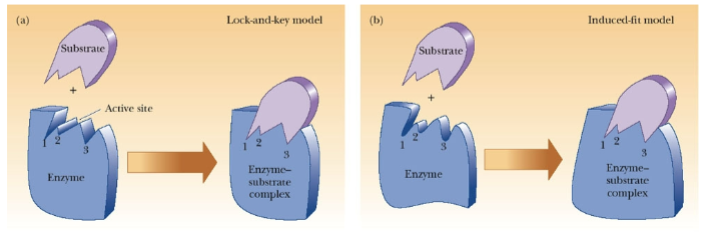
Lock and Key model
similar shape of the substrate
model doesn’t take into account conformational flexibility of protein
Induced fit model
binding induces a conformational change in the enzyme
shape of the protein is different before and after substrate is bound
most probable
lower activation energy
transition state
important to not be too tightly bound so substrate can release easier
Michaels Menten Equation
K1= rate constant foward rxn to ES complex
K-1= rate constant for reverse back to substrate
k2= rate constant to product, not reversible
v=
(Vmax[S])/(Km+[S])
![<ul><li><p>K1= rate constant foward rxn to ES complex</p></li><li><p>K-1= rate constant for reverse back to substrate</p></li><li><p>k2= rate constant to product, not reversible</p></li><li><p>v= </p></li><li><p>(Vmax[S])/(Km+[S])</p></li></ul><p></p>](https://assets.knowt.com/user-attachments/f43254aa-a92e-42f3-ac50-ff06850538f6.png)

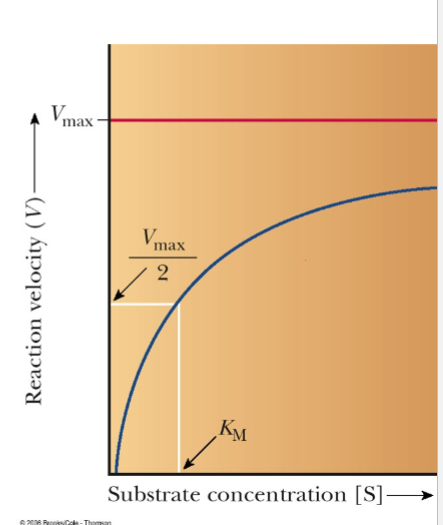
Km
substrate conc at which rxn proceeds at ½ the max velocity
½ active sites are occupied
substrates affinity to enzyme
lower Km value= higher affinity of substrate to enzyme
Vmax
when enzyme is saturated with substrate
units are in per second s^-1 only when rxn is in zero order
non allosteric enzyme
hyperbolic graph
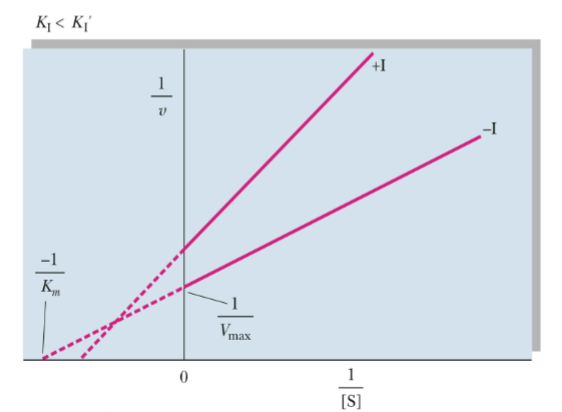
lineweaver burk plot


Competitive inhibitor
reversible
blocks substrate from binding
Vmax Unchanged: this is the max amount of substrate enzyme can react with
Km increases: amount of S needed to reach ½ maximum V increases dur to inhibitor
can be overcome by adding high conc of substrate

Non competitive inhibitors
irreversible
binds to a different site on the enzyme, substrate can still bind but cannot catalyze the reaction
Km: stays the same: substrate can bind, x intercept doesnt change
Vmax: decreases: vmax is at turnover (equal to catalytic constant)

uncompetitive inhibition
inhibitor can bind to ES complex, but not to free E
Vmax and Km decrease
Km decreases because it makes more enzyme substrate to compensate to increase binding affinity

Mixed inhibitors
binding of inhibitor affects the binding of substrate and vice cersa
Km increases: doesn’t allow substrate to bind
Vmax: decreases, can produce product
lines cross at left hang quadrant