Neurobiology Midterm II
 Call Kai
 Learn
 Practice Test
 Spaced Repetition
 Match
 Flashcards
 Knowt Play
1/24

There's no tags or description
Looks like no tags are added yet.
25 Terms
What is microdialysis?
What is pholtammetry?
PHOLTAMMETRY uses light as a MEASURE! requires an optical brain implant, where a piece of glass is wrapped in ceramic to join the cable and the laser to stimulate the DS, VS, or PBN
GCaMP is a measure of CALCIUM, when shone a blue excitation light glows GREEN!!
fluroscent peaks of change in calcium help us infer there is electrical activity in neurons leading to ACTION POTENTIALS
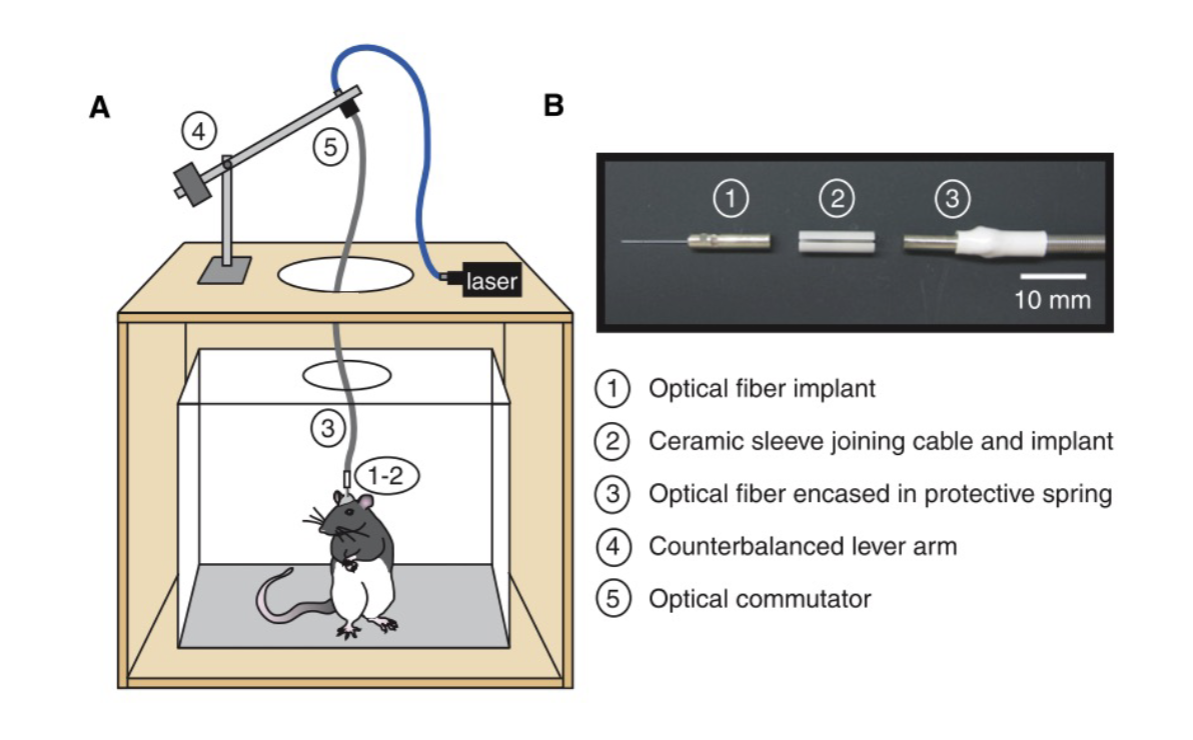
How can optogenetic stimulation be used as an Unconditioned Stimulus?
Injecting DIO-ChR2 Cre-dependent construct to observe activity in Cre+ rats with optogenetic stimulation, Cre+ rats without stimulation, and Cre- rats (can’t read ChR2)
eliciting a 7 second CS light, pairing it with optogenetic stimulation of midbrain dopamine neurons in the last 5 seconds to either VENTRAL STRIATUM OR SNc
VTA STIMULATION RATS: lots of predicted movement after the pairing and cuing of Cre+ and paired rats
SNc STIMULATION RATS: far larger amounts of movement at the cue and the laser
Over trials, VTA stimulated Cre+ mice had a learned Conditioned Response CR to the cue, for SNc stimulated Cre+ mice, this is almost IMMEDIATE
What does the optogenetic stimulation of ___ from Tellez paper produce as an effect?
In the Tellez reading, compartmentalization is established of:
HEDONIC Ventral Tegmental Area (VTA) → Ventral Striatum → Ventral Pallidum
Incentive Motivational View
NUTRITIONAL Substantia Nigra Pars Compacta → Dorsal Striatum → Substantia Nigra Reticulata
Drive Reduction View
Optogenetic stimulation of the Dorsal Striatum is sufficient to induce feeding of unpalatable solutions, as caloric information is established
Dopamine in the VTA is diminished for unpalatable solutions, dopamine in the SNc is increased for caloric solutions
What are labelling procedures? What types of unisynaptic or polysynaptic labels are there?
Labelling includes the use of polysynaptic Herpes construct H129 injected in R-NG, which is cre-dependent and used in a VGLUT mouse (glutamatergic)
they found labelling in the PBNdl and the SNc after injecting tracer in the RIGHT NODOSE GANGLION
Further strengthened by PHAL injected in the PBNdl neuron terminals of the SNc, and FLUOROGOLD in the Dorsal Striatum bodies of the SNc → PBNdl shows same activity as that of herpes construct supporting CCK to suppress feeding, and PBNel shows CGRP correlated activity supporting LiCl
Labeling with unisynaptic Rabies construct DeltaG in SNc, cre-dependent in DAT-CRE and VGAT-CRE mice (dopaminergic and GABAergic)
finding DeltaG labeling in the PBNdl, but not the PBNel
Licl reduced movement + speed → SUPPRESSING DOPAMINE IN DS
CCK had no effect on movement → INDUCED DOPAMINE IN DS
In experiment combining optogenetic and chemogenetic approaches, what occurs?
The EXCITATORY artificial drug CMO in the VENTRAL PALLIDUM reduces licking
typically the NT output to VP is inhibitory/GABAergic from the Ventral Striatum
No licking will occur if CMO is administered
Once you optogenetically stimulate the Ventral striatum or the Ventral Tegmental Area, licking will persist and overwrite the excitatory CMO effects to lead to inhibitory GABA effects on the VS
What were the consequences of changing how often mice are fed in Milan’s paper?
Mice given constant food eat about the same amount of food everytime
Mice given food every 3 days, fed a lot more for 4% sugar solution, but at a point stopped
If a construct is injected into the Dorsal Striatum of a transgenetic mouse, and it leads it to (presence in the SNc and PBNdl) what type of mice was it?
What is example of sufficiency test?
SUFFIENCY TEST is to see if a chemical process is sufficient in establishing a theorized outcome
OPTOGENETIC STIMULATION of the dorsal striatum can mimic sugar, being sufficient to overcome aversion of a bittered solution
OPTOGENETIC STIMULATION of D1 neurons in Dorsal Striatum is sufficient to support flavour preference after CMO manipulation (chemogenetic) and induce self-stimulation (nose pokes)
OPTOGENETIC STIMULATION of PBNdl to SNc projections, seeing they are sufficient for self sitmulation, flavour and place preference, decreased feeding + dopamine in the DS!!!!!
When optogenetically stimulating the R-NG terminals in the NTS, what occurs?
OPTOGENETICALLY STIMULATING the R-NG terminals in the NTS (gut to brain - vagal complex area), will lead to dopamine activity in the DORSAL STRIATUM from the Substantia Nigra Pars Compacta (SNc)
this also is SUFFICIENT to support flavour and place preference, as well as self-stimulation + increased dopamine in the DS
What is example of necessity test?
Necessity tests tell us if the INTEGRITY of a STRUCTURE is necessary to the normal operation of a psychological process
CASPASE (DS casp, VS casp, and WT) shows that D1 neurons (of DS) are necessary to learn that flavour is associated with calories, leading to consumption of unpalatable solutions
How can we establish CAUSALITY in research?
CAUSALITY between a structure and its function, requires the injection of SIGNAL through ELECTRICAL STIMULATION in order to show that artificially induced activity mimics that of natural stimuli
Which opsins are compatable with GCamp, and which are not? Which opsins can be combined with biosensors?
GCaMP is a biosensor for calcium, implying ACTION POTENTIALS that emits GREEN LIGHT when stimulated by blue light
ISOSBESTIC PURPLE LIGHT is a control, emitting green light that is unresponsive to calcium
STIMULATION OF AREAS uses CHRIMSON, a red-shifted opsin does not interfere with GCaMP measurement of calcium
chrimson has no spike fidelity, like ChR2
How can we predict the DA activity of the VTA or the SNc as well as further projections to the core or the shell? How does this demonstrate CONDITIONED APPROACH, ROTATION, SELF STIMULATION, and CONDITIONED REINFORCEMENT?
A CONDITIONED RESPONSE is elicited from a conditioned stimulus (CS cue) - rotation, approach, etc.
CONDITIONED REINFORCEMENT is the work from an animal (nose pokes or lever pulls) to earn presentations of a primary reinforcer stimulus - CS cue
When we stimulate neurons of the VTA or the SNc upon an ommission of the reinforcer, what occurs to further projections to either the Ventral striatum shell and core, or the Dorsal lateral striatum or Dorsal medal striatum?
What are neuropixels? What does it show in the medial PFC?
NEUROPIXELS use a small silicone probe with MANY electrical sites that can record signals from many units
the Medial PFC can be recorded using neuropixels in VGAT-Cre (GABAergic rats) rats to observe selectivity for FOOD and WATER → gel food preference for hungry rats, water preference for thirsty rats
How does the selectivity of food and water in the mPFC work?
Around 20% of mPFC neurons are for food and water, within this 20% even amount!!
Under HUNGER: food selective neurons fire a lot
Under THIRST: water selective neurons and food selective neurons fire
What an animal consumes can be predicted by firing rates of mPFC neurons
SUPRESSING mPFC GABA NEURONS OPTOGENETICALLY:
mPFC is not involved in motor components of licking - no impact when suppressing or not suppressing
INTRODUCING 2AFC (cue sound to signal trial, right lever for food, left lever for water)
Under HUNGER or THIRST (constant need states): mice are very good at picking need appropriate stimuli + THROUGH BREAKPOINT food is as satisfying for hunger, as water is as satisfying for thirst
mPFC is NOT INVOLVED

What are the effects and findings on switching between motivational states in the mPFC?
When animals are given alternating need states → performance on task suffers compared to constant need states (not involving mPFC)
Animals continue to eat food even if they are now thirsty, and continue to drink water even if they are now hungry
Problems in switching behaviours is worse for switching from HUNGER TO THIRST > THIRST TO HUNGER → FOOD SEEKING BIAS that persists about 10 trials after switching
Food seeking bias is not motor, they are actually faster at responding to thirst, it is an issue of relearning
HOW TO SOLVE FOOD SEEKING BIAS: giving the mice a little bit of food, and a little bit of water helps them to relearn STATE QUELLING REINFORCERS TO GUIDE BEHAVIOUR
What are the findings when OPTOGENETICALLY INHIBITING the mPFC and switching need states? Pre-choice, Post-choice?
Hunger, Thirst + Opto, Hunger → can’t readjust, and continue pressing lever for food!!!
Thirst, Hunger + Opto, Thirst → no changes in behaviour
Where optogenetics inhibits the mPFC
PRE-CHOICE inactivation of mPFC doesn’t do anything to future behaviour, but reduces thirst response, but not hunger
POST-CHOICE inactivation of mPFC reduces thirst response, but not hunger
mPFC is required for shifting states to update a previously dominant behaviour to align with a new need state we acquire from new information → for hunger and thirst
What can occur from manipulations using a GASTRIC FISTULA on calories and taste?
SWEET NO CALORIES
SWEET CALORIES
SWEET NO CALORIES
SWEET BITTER CALORIES - CASPASE of the DS leads to inability of consuming palatable solutions despite caloric benefits
Opto stim of terminals from PBN into the SNc - measure DA in Dorsal striatum, does this test necessity, sufficiency, correlation, etc.
This is a sufficiency test, looking if this procedure is enough to produce DA in DS
Using H129 Herpes variant, and lesioning the PBNdl, where will we see the Herpes variant?
H129 is a herpes variant consruct injected into VGLUT mice, targeting GLUTAMATERGIC excitatory RIGHT Nodose Ganglion Cells
it is polysynaptic, jumping to multiple synapses
After 2 days: R-NG → AP and NTS
After 3 days: R-NG → AP and NTS → PVH paraventricular hypothalamus
After 4 days: R-NG → AP and NTS → PBNdl → SNc
strong innervation of H129 in both dopaminergic TH+ (dopaminergic) and TH- (gabaergic) cells - way more than in the VTA
Injecting H129 in LEFT nodose ganglion does not show labelling in PBNdl or SNc
TESTING sufficiency of Gut Nodose to get to SNc: upper gut transfection with AAV-CRE, WAITED, hen injecting R-NG with H129, PBNdl and SNc had labelling again
Right NG stim is enough to get to SNc - providing CCK leads to same neuronal activity as PBNdl herpes infected areas, providing LiCL leafs to same neuronal activity as PBNel associate with CGRP malaise expression
How do CCK and LiCL relate to Parabrachial neuron regions?
CCK when administered to mice, leads to the same neuronal activation of the R-NG → AP NTS → PBNdl → SNc pathway as the labelling of Glutamatergic VGLUT mice with H129 herpes
these regions have activation of CGRP negative, CCK responsive cells
LiCL leads to neuronal activity that is most responsive from CGRP+ cells, and LiCL cells, found primarily in the PBNel
Which neurobiological substrates are necessary for the suppression of eating from CCK, which are not? How can optogenetics be sufficient to supress feeding in one of these complexes?
In the AVERSION PBNel complex - optogenetic stimulation of the _____ is sufficient to induce diminished feeding
VTA?
IN SUMMARY, what are the effects of stimulation on VTA → Ventral striatum core and shell?
VTA
↑ conditioned approach (Optogenetic stimulation)
↑ calcium presence for a cue light (CS + optogenetics)
↓ calcium for omission of an unconditiond stimulus (US gone, optogenetic stimulation)
VENTRAL STRIATUM
↑ dopamine from VTA stimulation (optogenetics)
↑ dopamine for sweet taste
↓ dopamine for bitter taste
CORE (vta stim, ACCS, omission)
↑ dopamine in response to VTA optogenetics
↑ conditioned approach (optogenetics)
↑ dopamine during cue light presentation
↑ conditioned reinforcement, working for US (optogenetics of US)
↑ self stimulation from VTA optogenetics
↓ dopamine for omission of an US (optogenetics)
SHELL
↑ dopamine during VTA OPTOGENETICS
↑ self stimulation
IN SUMMARY, what are the effects of stimulation of the SNc → Dorsal lateral and dorsal medial striatum?
SNc
↑ conditioned rotation response (optogenetics US)
↑ calcium during Conditioned Cue Stimulus (optogenetics + cue light)
↓ calcium during US omission (optogenetics - US omission)
DORSAL STRIATUM
↑ dopamine in response to calories
↑ self-stimulation from SNc optogenetics
DORSAL MEDIAL STRIATUM (vta stim, c, omission)
↑ dopamine during cue light (optogenetics + cue light)
↑ dopamine during VTA optogenetics
↓ dopamine during US omission (optogenetics - US omission)
DORSOLATERAL STRIATUM
↑ dopamine during VTA optogenetics