AP Statistics Unit 3
 Call Kai
 Learn
 Practice Test
 Spaced Repetition
 Match
 Flashcards
 Knowt Play
1/47

There's no tags or description
Looks like no tags are added yet.
48 Terms
population
entire group of individuals we want information about
census
collects data from every individual in population and is often very difficult to do
parameter
population info, such as population mean, or population standard deviation
sampling frame
subset of population from which sample is actually taken (ex. company buys numbers)
sample
subset of individuals in the population from which we collect data
statistic
sample info, such as sample mean "x bar", or sample standard deviation "s"
-the goal of sampling is to give us statistics that are representative of the parameter
simple random sampling
every group of size "n" has the same chance of being selected (not just every individual having the same chance)
-ex. every student in the school has their name in a hat and 250 names are selected
-NOT an SRS: 2 students from every seminar are randomly chosen
stratified random sampling
researcher breaks the population into groups/strata that are different, then takes an SRS from each group/strata that only represents that strata (ex. age, race, income)
cluster sampling
the population is already broken into groups that are similar, so researcher can randomly select one group/cluster and just take all the data from one group/cluster, and it should represent all groups
-ex. seminar home rooms, 11th grade SAT test rooms in a building
systematic random sampling
every "nth" member is included
-ex. every 10th person in line
describing how to conduct an SRS
-ex.#1 to randomly select 10 cars from 900 in a parking lot, put all 900 license plate numbers in a hat, mix it up, and draw 10 license plate numbers
-ex.#2 assign each car a 3 digit number from 001 to 900 and use a random number table to select 10, 3-digit numbers between 001 and 900 with no repeats
bias
something in a study that makes it very likely to underestimate or very likely to overestimate the parameter of interest. it can be who is asked (or not asked), how they are asked, or what they are asked
unbiased estimator
a statistic that is expected to vary on both sides of the mean (symmetric)
convenience sample bias
including individuals that are easy to sample at the expense of randomness
voluntary response bias
everyone is invited to respond, but only those who respond are counted
-ex. a website has a survey for everyone who visits, and you can choose whether or not to respond
non-response bias
specific people are chosen for a survey, but some choose not to respond.
-ex. you are selected and called by a marketing company and you can choose whether or not to pick up
undercoverage bias
some members of the population cannot be chosen or are less likely to be chosen
-ex. a company is doing a survey by sampling from people with land phone lines, and they miss cell-phone only people, or out-of-town people, homeless
response bias
pattern of inaccurate responses from wording of question, lying, interviewer, etc.
observational study
no treatments are imposed. since potential confounding variables are not controlled, causation cannot be determined
retrospective study
subjects are selected and then their past behavior is recorded
prospective study
subjects are selected and then collect data as events unfold in the future
experiment
treatments are imposed. through proper design and control, causation can be determined.
experimental units
anything being experimented on (people usually called subjects/participants)
explanatory variable
the variable (x) used to predict outcomes
factors
in an experiment, the variables that are manipulated
levels
the values the factors can take on in an experiment
treatments
the combinations of levels of the factors (that are applied to subjects in the experiment)
response variable
the observed outcomes (y)
confounding variable
a variable that we did not control for that affects results
-AKA lurking variables
4 principles of experimental design
comparison, random assignment, control, replication
comparison
use a design that compares 2 or more treatments
random assignment
use a chance process to assign treatment to experimental units. if they choose their own treatment, it is not longer an experiment with causal conclusion-it is observational
-randomization spreads out some of the unknown/uncontrollable variation
control
keep all other variables besides treatment constant
control group
group receiving no treatment or a neutral treatment as a baseline
single blind
subject does not know which treatment is assigned
double blind
subject nor researcher know which treatment is assigned. someone else knows and tracks it
placebo
a fake treatment that should have no effect
placebo effect
the fake treatment works and influences response (due to expectations)
replication
applying each treatment to more than one experimental unit. can't do experiment with only 2 people
blocking
an optional step in an experiment where similar individuals are grouped together, and then all treatments are randomly assigned within the groups
why are blocking and stratified sampling different?
blocking is used in experiments, stratifying is used for samples
completely randomized experimental design
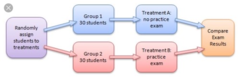
most basic design, subjects are randomly assigned to treatments. can have multiple factors
randomized block experimental design
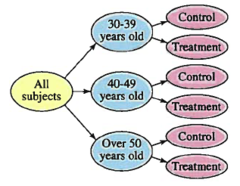
divide subjects into subgroups (blocks) by a common characteristic (ex. age) and then randomly assign treatments inside each block
matched pairs experimental design
a special type of block design where subjects can be naturally paired into blocks of 2, and are randomly assigned one of two treatments. (ex. with twins, highest to lowest GPA pairs). a person can be paired with themselves and receive both treatments (like on different days)

statistical significance
the differences observed between the treatment groups is too large to be by random variation. this allows you to draw a conclusion (cause and effect for experiments)
generalizing
who does the conclusion apply to? the population, or people "just like those" in study?
-only if individuals were randomly selected and randomly assigned can inferences about the population AND cause and effect be drawn
if individuals are randomly selected...
then an inference about the population can be drawn
if individuals are randomly assigned to groups...
then an inference about cause and effect can be drawn