Cultural & Spiritual care
 Call Kai
 Learn
 Practice Test
 Spaced Repetition
 Match
 Flashcards
 Knowt Play
1/34

There's no tags or description
Looks like no tags are added yet.
35 Terms
transcultural nursing
learning and comparing cultures to provide care sensitive to cultural patterns, beliefs, and values.
▪ Clients may identify with multiple cultural/spiritual groups and choose how closely to adhere to traditions
spirituality
personal, subjective methods of self-discovery, coping, and health maintenance.
▪ Clients may identify with multiple cultural/spiritual groups and choose how closely to adhere to traditions
cultural assessment questions
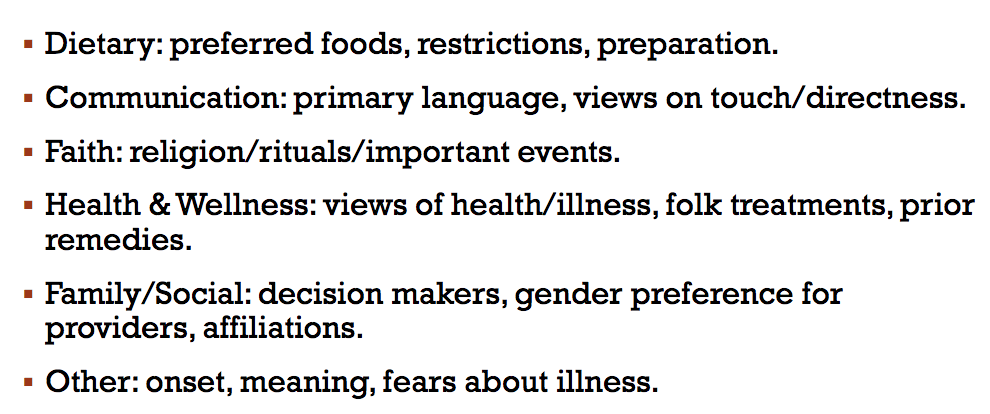
tone of voice
soft vs. loud respect
Nonverbal Communication Across Culture
eye movement
direct eye contact valued in many; disrespect/private in others.
Nonverbal Communication Across Culture
facial expressions
stoic vs. expressive.
Nonverbal Communication Across Culture
touch
ask permission; observe response.
Nonverbal Communication Across Culture
space
mirror client’s preferred distance; seek consent before approaching.
Nonverbal Communication Across Culture
silence
may indicate respect/agreement.
Nonverbal Communication Across Culture
body use
posture/gestures vary; avoid hand symbols unless client uses them.
Nonverbal Communication Across Culture
cultural awareness
self-reflection to identify bias.
cultural sensitivity
knowledge of prevalent cultures in practice area.
cultural appropriateness
applying cultural knowledge in care.
cultural competence
addressing whole cultural context; lifelong development.
cultural imposing
imposing one’s cultural rules on others (cultural blindness).
pain
expressions vary; consider alternatives to 0–10 scale; explore spiritual meanings.
-Practice Areas Affected by Culture
nutrition
align choices/prep with beliefs; allow family foods if safe; communicate ethnicity-related intolerances.
-Practice Areas Affected by Culture
family/gender roles
include the recognized decision maker; clarify roles.
-Practice Areas Affected by Culture
Life Transitions
support rites of passage (puberty, pregnancy, birth, dying, death).
-Practice Areas Affected by Culture
repatterning
(LIFESTYLE CHANGE)
▪ Accommodate beliefs/values when possible.
▪ If a practice hinders health, collaborate to modify to a health-promoting alternative.
▪ Plan with knowledge/respect for client/family differences.
interpreters
Best Practices
▪ Use facility-approved medical interpreters (not family/friends or non-designated staff).
▪ Brief interpreter on purpose, question type, and expected response length.
▪ Speak clearly/slowly; avoid metaphors; ask one question at a time.
▪ Address the client directly; observe verbal/nonverbal cues; check understanding periodically.
▪ Pause/repair if communication falters; apologize for cultural missteps.
discrimination
unfair treatment limiting rights/opportunities based on group membership.
prejudice
assumptions without adequate info → wrong actions.
ethnocentrism
belief one’s culture is superior; undermines culturally congruent care.
connectedness
intra- (self), inter- (others/environment), transpersonal (higher power).
-Spirituality: Core Elements
faith
belief/relationship with higher power.
-Spirituality: Core Elements
hope
anticipation/optimism in crisis.
-Spirituality: Core Elements
transcendence
belief in a superior force beyond self;
self-transcendence = authentic inner connection.
-Spirituality: Core Elements
spiritual well-being
connection to higher power and others.
-Spirituality: Core Elements
Spiritual distress
challenge to beliefs/well-being (often after catastrophic events) → hopelessness, withdrawal.
▪ Interventions: identify distress; restore/reconnect to spiritual strengths; support with presence; pastoral/spiritual care referral.
Environment
sacred texts/symbols (Bible, Quran, rosary, cross).
Spiritual Cues & Deeper Assessment
▪ Affect: anger/depression may signal distress.
▪ Assess: beliefs, life perception, satisfaction, culture, fellowship, rituals, workplace integration, expectations for care.
Behaviors
prayer before meals/bedtime.
Spiritual Cues & Deeper Assessment
▪ Affect: anger/depression may signal distress.
▪ Assess: beliefs, life perception, satisfaction, culture, fellowship, rituals, workplace integration, expectations for care.
Verbalization
references to higher power.
Spiritual Cues & Deeper Assessment
▪ Affect: anger/depression may signal distress.
▪ Assess: beliefs, life perception, satisfaction, culture, fellowship, rituals, workplace integration, expectations for care.
Patient Centered Care
▪ Identify perception of higher power; facilitate spiritual connection.
▪ Provide privacy/time for rituals; engage pastoral care.
▪ Use client-identified resources; support rituals (icons, prayer rugs, texts, music).
▪ Support restorative practices (prayer/meditation/grief work).
▪ Evaluate and adjust as client/family process changes through spiritual identity.
Religious Practices
▪ Sacred texts → strength/guidance
▪ Symbols (jewelry/icons) → faith expression
▪ Dress/modesty → cultural/religious norms
▪ Health beliefs → may differ from biomedical model
▪ Death beliefs/rituals → support when possible
▪ Prayer/meditation → comfort and connection
▪ Sacred days → fasting/reflection/special foods/rituals