Create a New Flashcard Set
 Call Kai
 Learn
 Practice Test
 Spaced Repetition
 Match
 Flashcards
 Knowt Play
1/31

There's no tags or description
Looks like no tags are added yet.
32 Terms
determining stereoisomers
2^n, n= chiral centers
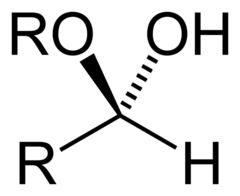
hemi-acetal
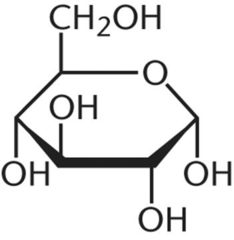
haworth form
anomeric carbon
the newly formed chiral center
-electrophilic carbon
T or F: C6 is always up for D-hexose if you draw the anomeric carbon to the right
T

what is this
glucose

what is this
galactose

what is this
fructose
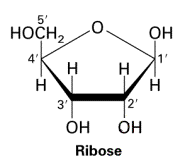
what is this
ribose
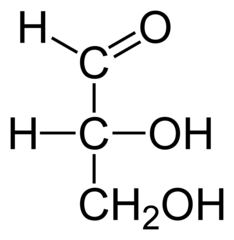
what is this
glyceraldehyde

what is this
dihydroxyacetone
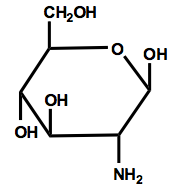
what is this
glucoseamine

glucosamine
attached to proteins and lipids and lipids
- building blocks of connective tissue
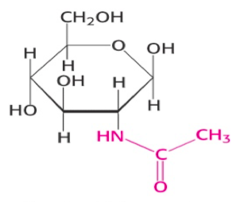
what is this
N-acetylglucosamine
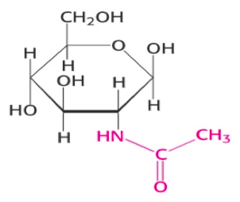
N-acetylglucosamine
chitin and bacterial cell wall

what is this
glucose-6-phosphate

glucose-6-phosphate
metabolism
what bond connects monosaccharides
O-glycosidic linkage
mutarotation
The rapid interconversion between different anomers of a sugar
reducing sugars
sugars
lactose
glucose + galactose
B1 to 4
sucrose
glucose and fructose

cellulose function
fibrous, strong, water-insoluble found in cell wall

cellulose structure
Glu B1 to 4 Glu
- no branching
- extensive H-bonding within chains
- parallel chains

chitin function
main structural component of exoskeletons

chitin structure
N-acetylglucoseamine (NAG)
beta 1 to 4
- no branching
- parallel and antiparallel chains
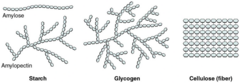
starch function
plant energy storage

starch structure
glucose subunit
a1 to 4 with a1 to 6 branching (branched)
- branched every 24 Glu units
and a1 to 4 (linear)

starch components
amylose and amylopectin
glycogen structure
glucose subunit
a1 to 4 with a1 to 6 branches every 10 Glu units
glycoproteins
main component: protein
proteoglycan
main component: carbohydrate