Turning operations
 Call Kai
 Learn
Learn Practice Test
 Spaced Repetition
 Match
Match Flashcards
 Knowt Play
1/13

There's no tags or description
Looks like no tags are added yet.
Name | Mastery | Learn | Test | Matching | Spaced | Call with Kai | Chat |
|---|
No analytics yet
Send a link to your students to track their progress
14 Terms
What are the different forms of turning operations
Turning - removing material from the outer diameter of the workpiece
Facing - Process of removing metal from the end of the workpiece and creates a flat surface
Parting off - Cuts workpiece to specific Length (Tool driven transversely into workpiece)
Thread Cutting - Creates threads by cutting a helical ridge on workpiece (The cutter needs to be driven at a specific speed driven by the leadscrew or controlled by a monitor in a CNC machine)
Boring - Removes internal material from workpiece (Straight or tapered holes can be bored and the tool is fixed and material revolves unlike a boring machine)
Knurling - Creates a textured workpiece by applying pressure onto the workpiece by the tool or by removing material)
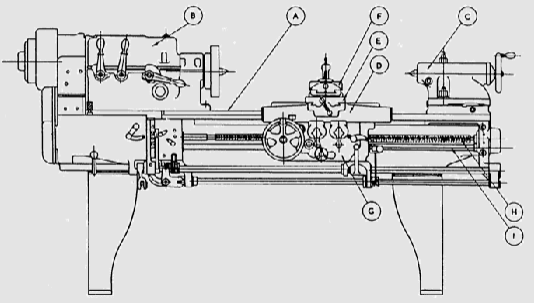
The Centre Lathe
A = Lathe bed - its the base for the machine and holds the components in alignment
B = Headstock - Holds bearings witch support the spindle and is driven to turn the workpiece
C = Tail stock - moving holder for various tools including drills and centres and is aligned with the headstock
D = Saddle - holds cross slide and moves axially along bed
E = Cross slide - moves transversely across workpiece and holds the cutting tool
F = Compound slide - an additional slide for further cutting control
G = Apron - Holds controls for slides and feeds
H = Leadscrew - Drives saddle along bed for thread cutting
I = Feed Shaft - Used to drive saddle when not thread cutting
Ways of holding the workpiece in the Lathe
3 jaw “self-cantering” chuck
4 jaw chuck
Collet chuck
Turning between centres
3 jaw “self-centring” chuck
all jaws move at the same time
Component automatically gripped
Low accuracy (+- 0.25mm)
Easy to use

4 Jaw “independent” Chuck
All jaws move independently
Allows workpiece to be manually aligned accurately
can accommodate more complex structures
Need to “set true” to make sure material is aligned
takes longer to set up

Collet chuck
Precision made and very high accuracy (0.025mm)
Only accommodates specific sized workpiece
Expensive
good for batch production if the workpieces are all the same size and shape (e.g. A batch of bolts can be produced using a collet chuck as initial cylindrical shape can be held and turning processes can be used to shape material)

Turning between centres
mounts workpiece centrally on its axis (holds material at its face and end)
allows accurate transfer between processes e.g. if workpiece was taken off the lathe and moved to a different machine when taken back to the lathe the centre will always remain even if workpiece has changed its shape on an alternative machine)

Capstan Lathe
AKA Turret lathe
tools selected sequentially (the turret rotates as it can hold multiple different tools. this saves time in the manufacturing process)
Good for Batch production

Better image of the turret of the capstan lathe

CNC Lathe
Computer numerically controlled
follows programme operation sequence
Motors drive movement (no leadscrew, handles etc)
reduces human error

What does it mean to “set true”
When a gauge is used to ensure material mounted correctly and central to rotating axis.
A gauge has a needle equipped which will make contact with the workpiece. The workpiece is than span into rotation. If its not aligned centrally then the needle will move in and out.
To set true you first find the lowest region on the gauge and then zero the gauge at that measurement. You then find the highest reading on the gauge and half that reading. Then turn the workpiece until the reading is half the largest measurement. Then zero the indicator at that measurement at that point on the workpiece. Then turn the chuck with the workpiece until the next jaw faces us and adjust that jaw until reading is zero.
you can also add different gauges with different resolutions so be more accurate
however not 100% accurate e.g. needle may be worn down and components in gauge may be damaged.
Machining sequences
its important to machine in a sequence in which the material stays strong throughout the process.

machining sequences examples

Similarities and differences between a 2 and 3 axis lathe
Similarities
x axis transverse across workpiece
Z axis axial/ longitudinal across workpiece
Differences
3 axis lathe has a Y axis used for cutting off centre machining