Chapter 6 - Prokaryotic Transcription I
 Call Kai
 Learn
Learn Practice Test
 Spaced Repetition
 Match
Match Flashcards
 Knowt Play
1/112

There's no tags or description
Looks like no tags are added yet.
Name | Mastery | Learn | Test | Matching | Spaced | Call with Kai | Chat |
|---|
No analytics yet
Send a link to your students to track their progress
113 Terms
The Central Dogma of Molecular Biology
describes the genetic information flowing from DNA to DNA (DNA replication), from DNA to RNA (transcription), and from mRNA to protein polypeptides (translation)


Transcription
the process of duplicating a segment of DNA into RNA for the purpose of gene expression
DNA can be transcribed into what 2 different forms of RNA?
messenger RNA (mRNA) and non-coding RNAs (ncRNAs)


messenger RNA (mRNA)
RNA molecules that can encode proteins
What type of RNA molecule is used to express the proteins?
mRNA

How much of the total cells RNA is actually mRNA?
less than 5%

non-coding RNAs (ncRNAs)
RNA molecules that are not translated into proteins
What does non-coding mean?
RNA molecules will not be translated into proteins. However they have diverse functions for other cellular processes.
How many layers are there in the RNA structure?
3 layers
DNA is generally double-stranded. What about RNA?
single-stranded
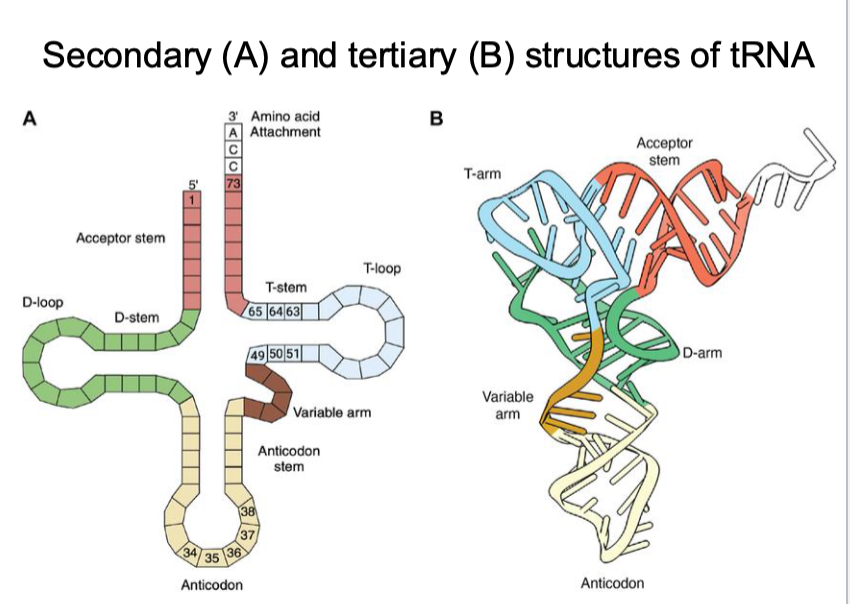
What does the single-strand in RNA allow for?
it can fold back on itself and form complementary base pairs within the same RNA molecule
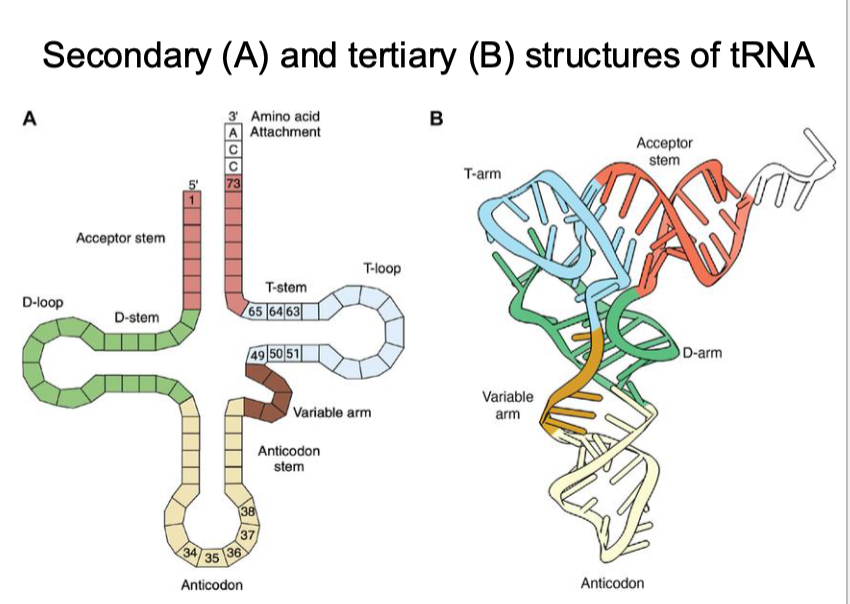
Primary structure of RNA
the nucleotide sequence of the RNA


secondary structure of RNA
formed by base pairing within a single RNA strand, generating structures such as stems and loops

tertiary structure of RNA
the overall three-dimensional (3D) structure formed by further folding of the RNA molecule

tRNA looks like what?
the letter “t”
the tertiary structure of RNA has different structures, it’s kind of similar to…
proteins

The different structures of tertiary RNA allows it to…
have many functions, unlike DNA which is mainly used for coding information
What important functions does RNA have?
enzymatic activity, structural support, and regulation of gene expression
All cells (prokaryotes and eukaryotes) make what 3 main kinds of RNA?
messenger RNA (mRNA)
ribosomal RNA (rRNA)
transfer RNA (tRNA)
What type of RNA occupies most of the RNA in the cells?
ribosomal RNA (rRNA)
messenger RNA (mRNA)
encodes proteins
ribosomal RNA (rRNA)
forms the structural and catalytic core of the ribosome
ribosome
the cellular machinery that synthesizes proteins
transfer RNA (tRNA)
carries the appropriate amino acids into the ribosome for inclusion in the new protein
Which type of RNA helps build a growing protein chain?
(mRNA, rRNA, or tRNA?
tRNA
What do small ncRNAs and long ncRNA molecules do?
play a role in the regulation of transcriptional and translational processes
What are the 3 differences in prokaryotes vs. eukaryotes transcription and translation?
location
mRNA type
chromatin

Where does transcription occur in prokaryotes?
in the cytoplasm, because there’s no nucleus

Where does transcription occur in eukaryotes?
in the nucleus

True or False: In prokaryotes, mRNA can be transcribed and translated at the same time, before mRNA is even finished being transcribed, it can start binding with the ribosome to initiate the translation.
True

True or False: In prokaryotes, RNA transcripts must exit the nucleus before encountering ribosomes in the cytoplasm.
False, in eukaryotes
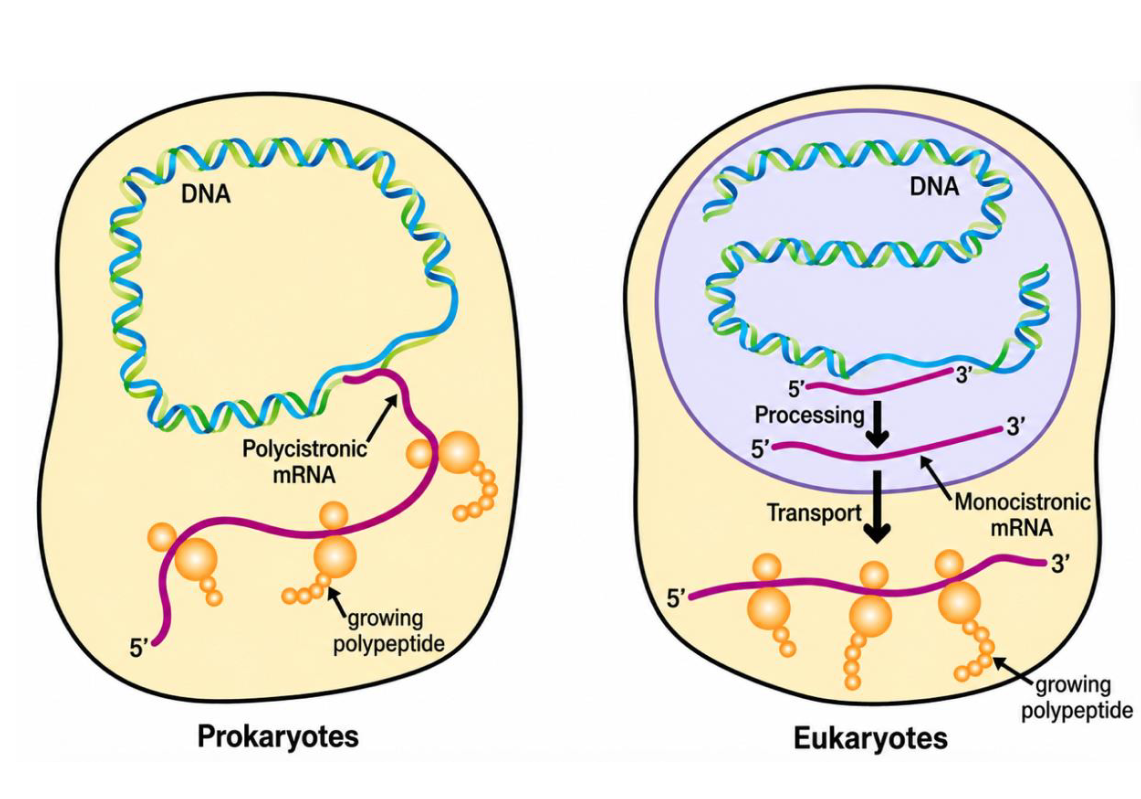
In eukaryotes, what must occur in order for mRNA to be translated?
Because translation occurs in the cytoplasm, mRNA is transcribed in the nucleus. It must be processed and exported outside the nucleus so that it can be translated.

Which can encode multiple genes at a time, prokaryotes or eukaryotes?
prokaryotes

operon
a group of related genes in prokaryotes that are controlled together and transcribed into a single mRNA molecule

polycistronic
1 mRNA encodes multiple polypeptides

monocistronic
1 mRNA encodes 1 polypeptide
In eukaryotes what additional processing occurs?
mRNAs undergo trimming, splicing, or both

Are prokaryotes RNA polycistronic or monocistronic?
polycistronic

Are eukaryotes RNA polycistronic or monocistronic?
monocistronic

What does the chromatin/DNA in prokaryotes look like in the cell?
virtually “naked” in the cytoplasm

What does chromatin/DNA in eukaryotes look like?
DNA is wrapped around chromatin proteins and contained within the nucleus
Building a RNA strand is similar to building a…
DNA strand, because DNA and RNA are very similar molecules
Transcription is catalyzed by what enzyme?
RNA polymerase
RNA polymerase
an enzyme that makes RNA
There are several different kinds of RNA polymerases in eukaryotic cells. How many RNA polymerases are there in prokaryotes?
a single type of RNA polymerase that’s responsible for all transcription in prokaryotes
Unlike DNA replication, only _____ sections of the genome (the genes) are transcribed.
short
Different genes may be copied into RNA at _________ times in the cell’s life cycle.
different
1 gene needs to be transcribed into:
many copies of RNA to produce billions of copies of proteins
Unlike DNA replication, many copies of RNA are made during transcription, providing the templates need to…
produce billions of copies of proteins required by the cell
Unlike DNA polymerase, RNA polymerase synthesizes new strands only in the _____ direction.
5’ to 3’
DNA polymerase uses deoxyribonucleotides.
RNA polymerase uses ribonucletoides.
How can you tell the difference in the pentose sugar?
At the 2’ carbon RNA polymerase has a hydroxyl group (OH), whereas DNA polymerase just has a hydrogen

DNA contains thymine (T), whereas RNA contains…
uracil (U)

the substrates
any molecule—typically an RNA molecule or its nucleotide building blocks—that is acted upon by an enzyme or a molecular machine to undergo a chemical reaction or modification.
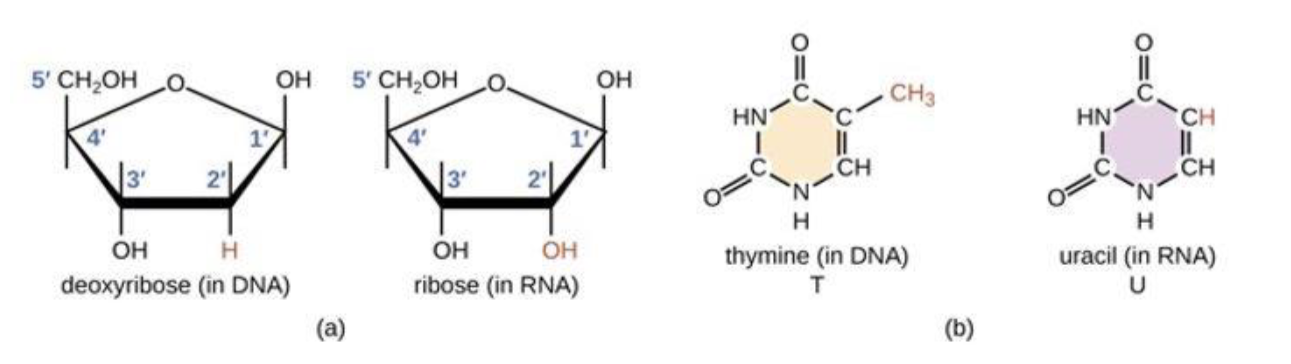
ribonucleotides are joined in exactly the same way as…
deoxyribonucleotides
How are ribonucleotides joined?
the 3’OH of the last nucleotide on the growing chain is joined to the 5’ phosphate on the incoming nucleotide to make a phosphodiester bond

DNA polymerase requires a primer to begin synthesis. Does RNA polymerase?
No. Once RNA polymerases are in the right place to start copying DNA, they just begin making RNA by joining together RNA nucleotides complementary to the DNA template.

A gene (DNA) is double stranded, but how many strands are transcribed into RNA?
only ONE strand
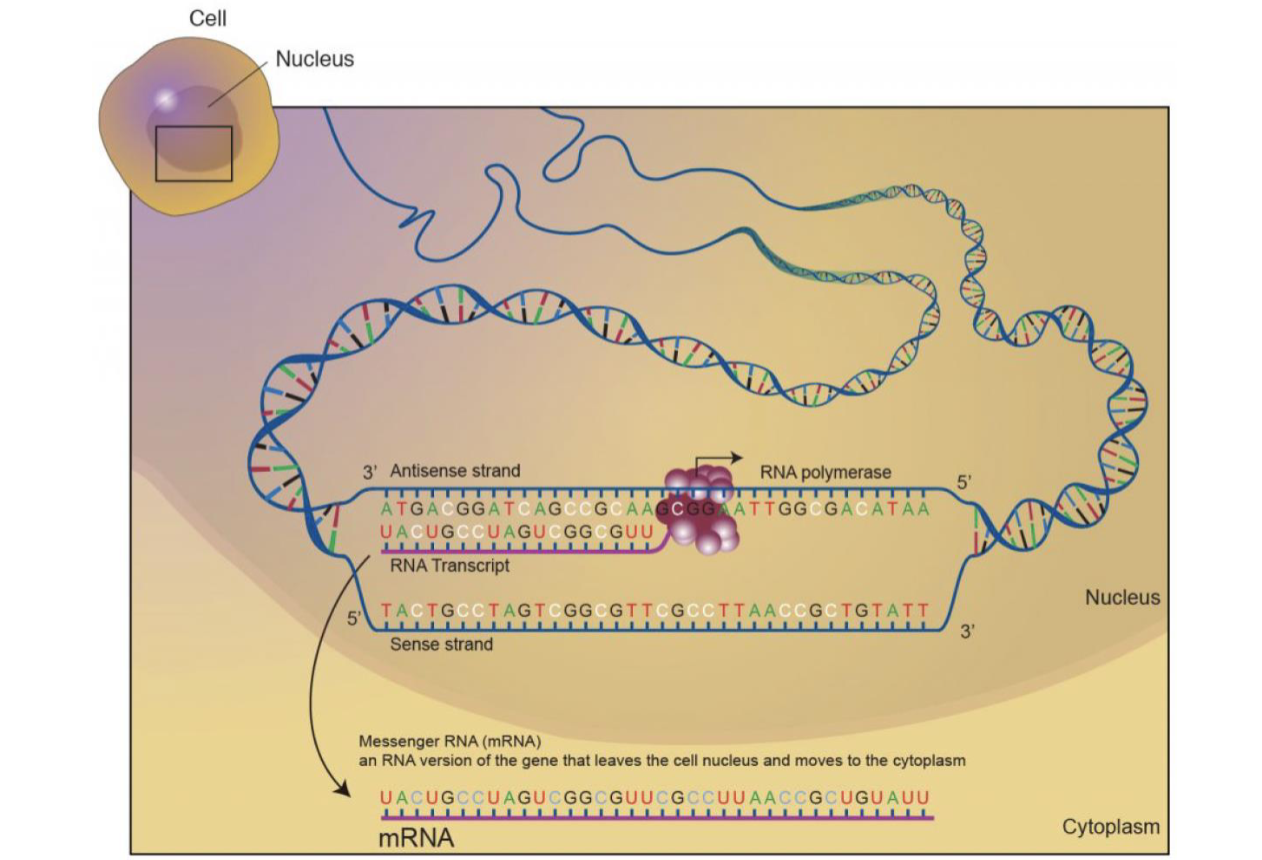
When a gene (DNA) was transcribed into RNA, the 2 strands can be translated into different sequences in the RNA. Why is this?
the 2 strands have different functions

A coding strand is also called
sense (+) strand

Coding strand or sense (+) strand
has the same sequence as the RNA transcript, except that thymine (T) in DNA is replaced by uracil (U) in RNA

A template strand is also called
anti-sense (-) strand or non-coding strand
Which DNA strand does RNA polymerase actually read?
the template strand (or anti-sense (-) strand or non-coding strand)

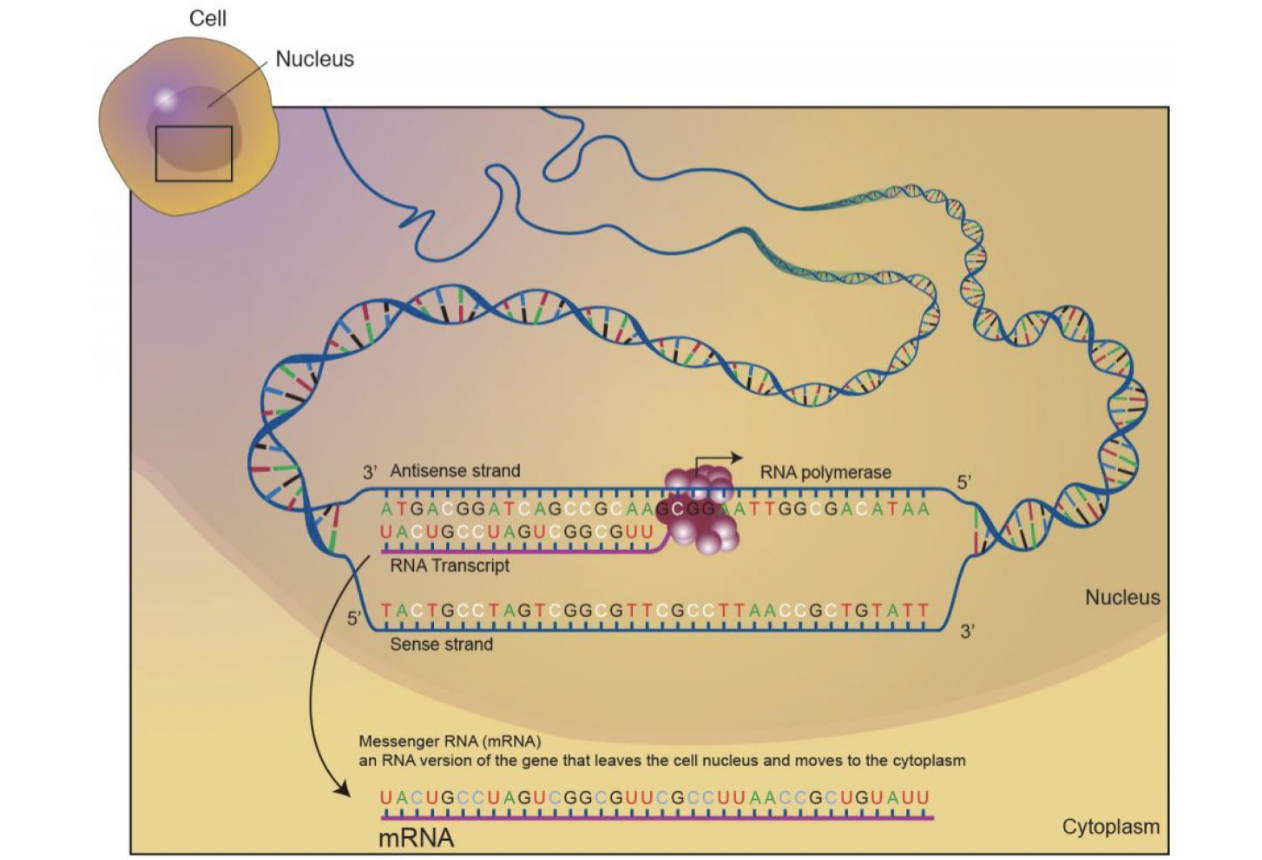
Which strand has the sequence complementary to the RNA transcript?
the template strand (or anti-sense (-) strand or non-coding strand)

RNA is synthesized in what direction?
complementary and antiparallel to the DNA template strand
Either of the 2 polynucleotide strands may contain a gene. This is why…
the determination of the sense and antisense is gene-specific
Coding strand vs template strand
Coding strand has the same sequence as the final RNA product, but the RNA polymerase will not use this strand to produce the RNA. Instead RNA polymerase uses a template strand to produce the RNA molecule.
Unlike DNA replication, where every nucleotide of the parental DNA must eventually be copied, only ______________ portions of the DNA are transcribed into RNA.
selected
The genome contains thousands of genes. Do all these genes need to be expressed?
No, only a subset needs to be expressed at a given time
How to recognize individual genes and transcribe them at the proper time and place?
Specific DNA sequence patterns are recognized by RNA polymerase or other proteins that help determine where transcription should start and end.
transcription unit
the stretch of DNA that encodes a RNA molecule and includes all the sequences necessary for its transcription

What 4 things does the transcription unit contain?
promoter
transcription start site (TSS)
transcribed region
terminator


Promoter
a specific DNA sequence that directs RNA polymerase to the correct site to initiate transcription

Where is promoter located?
upstream (before) of the gene it controls
What are the functions of the promoter?
helps determine which DNA strand will serve as the template strand
establishes direction of transcription
controls whether and how frequently a gene is transcribed
What happens if the RNA polymerase and its helper proteins do not bind at the promoter?
the gene cannot be transcribed and it will, therefore, not be expressed
Is the promoter transcribed into RNA?
NO. It’s purpose is to only guide the RNA polymerase to bind on the gene

Transcription start site (TSS)
the first nucleotide that is transcribed into RNA
What is designated +1?
transcription start site (TSS)


upstream sequence
nucleotides before +1 are assigned negative numbers
How are numbers assigned on a gene?
based on the distance of nucleotide to TSS site

downstream sequence
nucleotides after +1 are assigned positive numbers

Is there a nucleotide numbered 0?
no

transcribed region
the region downstream of the transcription start site that is copied into RNA

terminator
a DNA sequence that signals the end of transcription

The terminator causes RNA polymerase to what?
to stop adding nucleotides and dissociate from the DNA template

Is the terminator transcribed into RNA?
YES. Transcription stops only after the terminator has been copied into RNA.
RNA Polymerase Enzymes (RNAPs)
required to carry out the process of transcription and are found in all cells ranging from bacteria to humans
What are the functions of RNA Polymerase Enzymes (RNAPs)?
recognize promoter regions to start transcription
requires specialized initiation machinery, different in bacteria and eukaryotes
uses template strand, copying RNA complementary to DNA template in 5’ to 3’ direction
uses NTPs (A, C, G, and U) as substrates
stops at terminators, and the newly synthesized RNA is released from RNAP
All RNAPs are…
multi-subunit assemblies and carry out the same reaction
What are the simplest forms of RNA polymerases?
Bacterial RNAPs
Like DNA polymerase, there are
RNA polymerase holoenzymes


RNAP catalytic core
contains 5 major subunits (α2ββ’ω)
2 copies of alpha (α1 and α2), beta (β), beta prime (β’), and omega (ω)
responsible for the actual synthesis of the RNA

sigma factor (σ)
Position of the core enzyme at the correct promoter to initiate transcription.
Helps to find a site where transcription begins, participates in the initiation of RNA synthesis, and then dissociates form the rest of the enzyme.
What is required in the holoenzyme for full function of RNA polymerase?
sigma factor


sigma70 (σ70)
the housekeeping sigma factor that is responsible for transcribing most genes in growing cells
What was the first sigma factor to be identified and how was it named?
sigma70 (σ70). It has a mass of 70kDa.


consensus sequence
Represents the most common nucleotide found at each position among many promoter sequences.
this does not mean that every promoter has the exact consensus sequence
individual promoters can differ from the consensus at one or more positions

-10 sequence (Pribnow box)
A 6 bp region centered about 10 bp upstream of the transcription start site (TSS).
The consensus sequence at this position is TATAAT
if you count back from TSS, the sequence found at roughly -10 in the majority of promoters studied is TATAAT