Remote Sensing (Exam 2)
 Call Kai
 Learn
 Practice Test
 Spaced Repetition
 Match
 Flashcards
 Knowt Play
1/290

There's no tags or description
Looks like no tags are added yet.
291 Terms
What is a supercell?
A supercell is a storm with a long-lived core and a mesocyclone (a rotating updraft).
What is a mesocyclone?
A mesocyclone is the rotating updraft within a supercell.
What severe weather hazards can supercells produce?
Supercells can produce large hail, damaging winds, and tornadoes.
What four ingredients are required for supercells to form?
Supercells require shear, CAPE, lift, and moisture.
What does CAPE stand for?
CAPE stands for convective available potential energy.
What are the main steps in radar interpretation?
Identify storm structure and morphology, identify vertical clues, determine strength, and analyze velocity products.
What storm morphologies should you look for when interpreting radar?
Kidney bean, hook echo, and bow echo shapes.
What vertical clues should you identify in radar interpretation?
Features such as a WER, a BWER, and elevated cores.
Which type of radar product is analyzed to study storm rotation and winds?
Velocity products.
How does a mesocyclone develop?
It develops when environmental and/or locally generated vorticity is tilted.
What two sources of vorticity can contribute to a mesocyclone?
Environmental vorticity and locally generated vorticity.
What process turns horizontal vorticity into the rotation of a mesocyclone?
Tilting, which reorients the vorticity into the vertical.
What is the forward flank downdraft (FFD)?
The FFD is the main region of the downdraft in a supercell, located on the leading or downwind side of the storm.
Where is the heaviest precipitation located in a supercell?
In the forward flank downdraft (FFD) region.
What process in the FFD leads to the development of a cold pool and outflow boundary?
Significant evaporative cooling.
What three processes drive the forward flank downdraft?
Water loading (drag), melting, and evaporation.
What forms as a result of evaporative cooling in the FFD?
A cold pool and an outflow boundary.
Why does the outflow boundary become stationary?
Cool, dense air from the FFD collides with the warm, moist inflow air.
What is the rear flank downdraft (RFD)?
The RFD is sinking air that forms on the trailing/upwind side of the updraft.
What processes form the RFD?
Dynamic and/or thermodynamic processes associated with the mesocyclone and with precipitation being wrapped around the backside of the storm.
Where does the RFD form relative to the updraft?
On the trailing, or upwind, side of the updraft.
What kind of boundary is associated with the RFD?
An outflow boundary that arcs into the updraft region and hook echo.
Which downdraft is on the leading side of a supercell, and which is on the trailing side?
The forward flank downdraft (FFD) is on the leading/downwind side, and the rear flank downdraft (RFD) is on the trailing/upwind side.
What is a hook echo?
A hook echo is a base reflectivity radar signature that resembles a hook or pendant.
What does the reflectivity gradient look like in a hook echo?
It shows a strong reflectivity gradient.
Where is a hook echo typically located on a supercell?
Near the right rear flank of the supercell.
What causes a hook echo to form?
It forms due to the RFD (rear flank downdraft).
Which radar product shows a hook echo?
Base reflectivity.
What two quantities does Doppler radar measure?
Radial velocity and spectrum width
Radial velocity
The weighted mean motion along the radial
Spectrum width
The variability of the radial velocity
At what point are radial velocity and spectrum width computed?
For each gate sampled
What does a large spectrum width indicate?
Greater uncertainty in the radial velocity estimates
Radial velocity is a ___ mean motion along the radial.
Weighted
Spectrum width describes the ___ of radial velocity.
Variability
What is the Doppler effect?
A change in the frequency of a wave relative to an observer who is moving relative to the source of the wave
Why is the radar's location irrelevant to relative motion in Doppler radar?
Radar location is fixed, so relative motion can only occur if the target's location changes
When can relative motion occur in Doppler radar?
Only if the target's location changes
What happens to energy sent at a given frequency when it hits a moving target?
It returns at a different frequency, depending on whether the target is moving toward or away from the radar
Target moving toward the radar
Higher frequency returned (negative values)
Target moving away from the radar
Lower frequency returned (positive values)
A target moving toward the radar returns a ___ frequency, shown as ___ values.
Higher; negative
A target moving away from the radar returns a ___ frequency, shown as ___ values.
Lower; positive
Radar location is ___, so relative motion occurs only if the ___ changes location.
Fixed; target
What is frequency change proportional to in Doppler radar?
Target motion
Does the WSR-88D measure frequency changes?
No
What does the WSR-88D detect instead of frequency changes?
The phases of the returned signal
How does the WSR-88D get information about target motion?
It calculates pulse-to-pulse phase changes
Why can't the radar determine the shift in frequencies directly?
Because of the size of the shift
Phase
A particular angular stage or point of advancement in a wave cycle
Phase (fractional definition)
The fractional part of the angular period through which a wave has advanced
From where is phase measured?
From the phase reference point
Pulse-to-pulse phase change
The change in phase between successive returned pulses, used by the WSR-88D to calculate target motion
Frequency change is ___ to target motion.
Proportional
The WSR-88D detects the ___ of the returned signal and calculates ___ phase changes
Phases; pulse-to-pulse
Phase is measured from the ___ ___ point.
Phase reference
What type of motion does the WSR-88D detect?
Only motion toward and away from the radar
What is the radial velocity of a stationary target?
0 kts
What is the radial velocity of a target moving perpendicular to the radial?
0 kts
Into what two components can a target's velocity be broken down?
Radial (measured) and tangential
Which component of a target's velocity does the WSR-88D measure?
Radial
The WSR-88D only detects motion ___ and ___ the radar.
Toward; away from
Stationary targets or targets moving ___ to the radial have a radial velocity of ___ kts.
Perpendicular; 0
A target's velocity can be broken into ___ (measured) and ___ components.
Radial; tangential
What is the windmill analogy used to explain?
How a radar works
What is another name for unambiguous velocity (Vmax)?
Nyquist velocity
What does Vmax (Nyquist velocity) represent?
The maximum velocity a target can move and still be accurately detected by the radar
Maximum unambiguous velocity (Vmax) corresponds to what pulse-to-pulse phase change?
180°
Phase shift less than 180°: what is the result?
Correct velocity, direction known
Phase shift equal to 180°: what is the result?
Correct velocity, direction unknown
Phase shift greater than 180°: what is the result?
Incorrect velocities, direction known
What does Vmax stand for?
Maximum unambiguous velocity
At what phase shift is direction unknown, even though velocity is correct?
Exactly 180°
At what phase shift are velocities incorrect?
Greater than 180°
How can the radar operator prevent a 180° or greater phase shift?
Increase PRF
What is the equation for maximum unambiguous velocity (Vmax)?
Vmax = (PRF x wavelength) / 4
What does Vmax depend on?
PRF and the radar's wavelength
When does velocity aliasing occur?
When targets move toward or away from the radar at a velocity greater than Vmax
What happens to Vmax and Rmax when PRF increases?
Vmax increases, Rmax decreases
What happens to Vmax and Rmax when PRF decreases?
Vmax decreases, Rmax increases
Increasing PRF has what effect on Vmax?
Increases Vmax
Decreasing PRF has what effect on Vmax?
Decreases Vmax
Increasing PRF has what effect on Rmax?
Decreases Rmax
Decreasing PRF has what effect on Rmax?
Increases Rmax
Zero Isodop
Line of contrast zero doppler velocity
What is the first step in determining wind flow from radial velocity data?
Draw a vector from the radar along a radial that intersects the zero isodop
What is the second step in determining wind flow from radial velocity data?
Draw a resulting vector perpendicular to the original vector

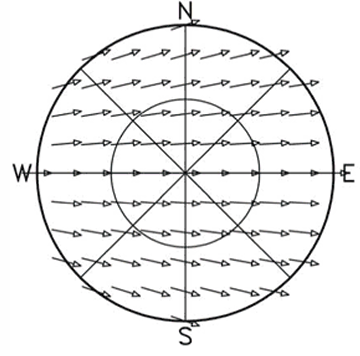
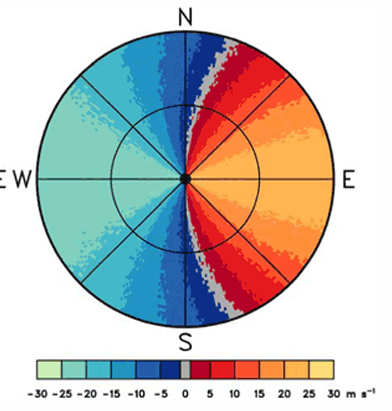
What is the wind direction and speed with height?
Westerly, constant
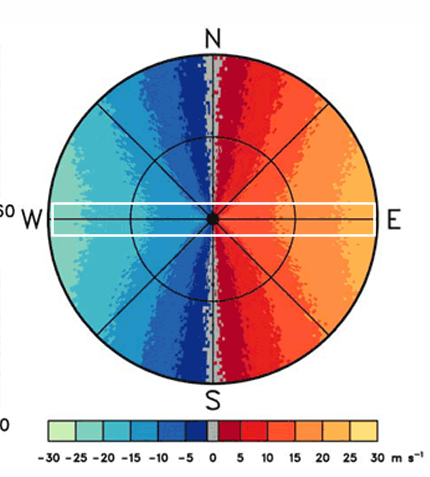
What is the wind direction and speed with height?
Westerly, increasing with height

What is the wind direction and speed with height?
Westerly, increasing then decreasing
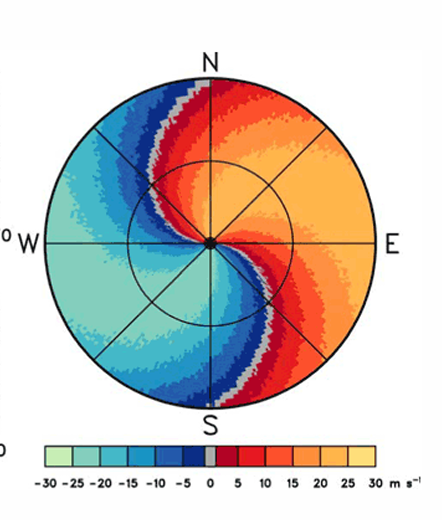
What is the wind direction and speed with height?
Veering, constant

What is the wind direction and speed with height?
Veering, increasing with height

What is the wind direction and speed with height?
Veering, increasing then decreasing

What is the wind direction and speed with height?
Backing, constant
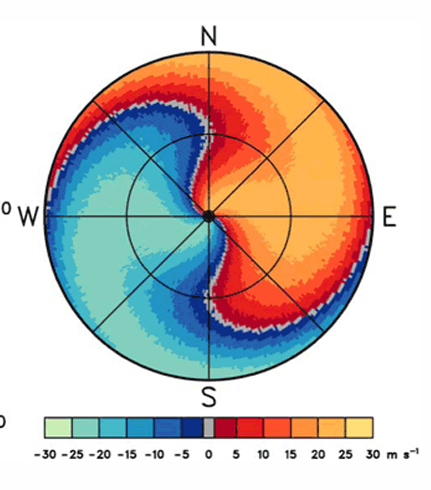
What is the wind direction and speed with height?
Veering then backing, constant

What is the wind direction and speed with height?
Northwesterly (CAA) behind front, Southwesterly (WAA) ahead of front, constant

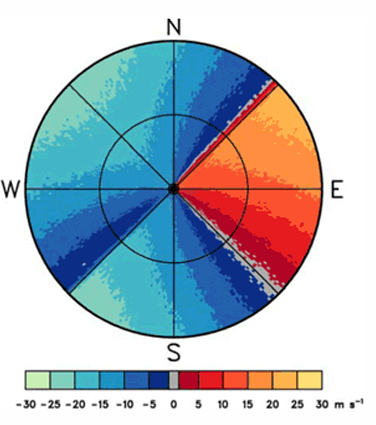
What is the wind direction and speed with height?
Northwesterly (CAA) behind front, Southwesterly (WAA) ahead of front, constant


What is the wind direction and speed with height?
Diverging, constant
What is the wind direction and speed with height?
Converging, constant

What is velocity aliasing?
When targets move toward or away from the radar faster than Vmax, so the velocities appear reversed or incorrect