Exam 3
 Call Kai
 Learn
 Practice Test
 Spaced Repetition
 Match
 Flashcards
 Knowt Play
1/45

There's no tags or description
Looks like no tags are added yet.
46 Terms
Idea of says law vs keynes law
says: supply creates its own demand
keynes: demand creates its own supply
when do says law and keynes law apply best
says: long run
keynes: short run
constraints of says law and keynes law
keynes: In the short run, recessions happen when firms face a lack of demand
says: If only demand mattered, the government could grow the economy just by spending or cutting taxes. Economies have real limits on production.
aggregate supply? when does it slope up?
total amount of GDP firms produce and sell at each price level
when price of output increases, firms produce more to make more profit
vertical line at point: potential GDP (long run)
aggregate demand? why may it slope down?
total spending on domestic goods C+I+G+(X-M)
a higher price level
lowered purchasing power (c falls)
Raises demand for credit and interest rates (I falls)
makes exports pricier than imports (X-M) falls
two things that can cause shifts in aggregate supply
productivity growth
changes in input prices
things that can cause shifts in aggregate demand
changes in C, I, G, (X-M)
if any one increases or decreases, theres a shift
explain shifts in aggregate supply and demand in relation to each other
the slopes meet at equilibrium. if one changes, its dragged along the other
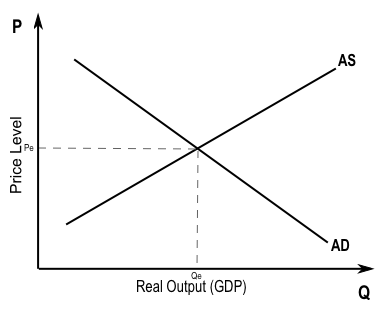
unemployment and AD/AS diagram
low when output is closer to potential GDP
high when output is farther from potential GDP
inflation and AD/AS diagram
inflation tends to increase during or just after booms, and decrease during recessions
a right-shifting AD curve when the economy is near potential GDP can cause inflationary stress
so can shifting SRAS to the left (lowers output and raises prices
basically when AD shifts right when AS is static and when AS shifts left when AD is static
keynesian zone
a point far left on the AD/AS curve, where its more flat
intermediate zone
a point far somewhat at the middle of the AD/AS curve, where its getting steeper
neoclassical zone
a point far right on the AD/AS curve, where its very steep
what did keynes advocate for and why
counter cyclical spending: economy is down, gov spending goes up
start spending to stimulate demand
keynesian perspective
firms only produce output if it’s expected to sell
aggregate demand is not stable and can fluctuate
whats keynesian perspective on recession based on
aggregate demand is not always high enough to force firms to hire workers and reach full employment
economy may only slowly shift in AD because of sticky wages/prices
sticky wages/prices
when wages/prices do not fall in response to a decrease in demand or rise in response to an increase in demand
why are wages sticky
coordination argument: people care about how much others are being paid, so they dont wanna be paid less
2 sets of costs that come with changing prices
uses company resources
customers may be angry
what causes recession and unemployment
sticky wages and prices
drop in demand (excess of labor)
look at expenditure multiplier
phillips curve - how does it relate to AD/AS
illustrates tradeoff between unemployment and inflation
neoclassical has low unemployment and high prices
keynesian has high unemployment and low prices
what does keynesian economics say is the solution to a recession
expansionary fiscal policy
tax cuts/increase in gov spending to stimulate aggregate demand
what does keynesian economics say is the solution to a high neoclassical (high inflation risk)
contractionary fiscal policy
decrease tax cuts and gov spending
neoclassical perspective
the government shouldnt interfere with recessions
the economy would fix itself in the long run
neoclassical vs keynesian
What determines the economy’s size?
Wages and prices
neoclassical
potential gdp
flexible, so it adjusts
Keynesian
AD can affect size in the short run
sticky in the short run
full employment and how to grow potential GDP
zero cyclical employment
increase in physical capital
increase in human capital
increase in technology
how to read neoclassical model
AS curve is a vertical line at potential GDP, and output is determined by supply no matter where the AD is drawn
LRAS shifts right over time as productivity rises
explain how the economy is flexible even when AD shifts right or when AS shifts left
AD shifts right (AS shifts left)
the two are at equilibrium
ad shifts right - unemployment is too low, so employers raise wages to attract
as shifts left
the two are at equilibrium again but at a different price level
both equilibriums are on the vertical line
AS shifts right (AD shifts left)
as too high, shifts right, high unemployment
ad shifts left
same original level of output, but lower price
adaptive vs rational expectation
adaptive: people look at past experience and gradually adapt to changes
rational: people form the most accurate expectation using available info to make quick adjustments
expected inflation
future rate of inflation that consumers and firms consider when decision making
keynesian vs neoclassical perspective
keynesian: gov should adjust AD to help economy
neoclassical: government may be slow to make changes, which may make things worse
describe the long run phillips curve
AD along LRAS changes price level but not output, so unemployment is at a natural rate
at a natural rate, the phillips curve is vertical no matter the price level or inflation
how do neoclassical economists want to fight unemployment or inflation
focus on how the gov can change public policy, not AD, to reduce natural rate of unemployment
AD has not long term effect on unemployment
would want AD to change only as AS shifts to the right
keeps price level the same and inflation low
whats the primary concern of neoclassical economists and what does it depend on
how to grow potential GDP, which depends on long-term productivity growth
3 categories of federal reserve regulation
capital
reserve
types of investments
a minimum net worth as % of assets to protect depositors and creditors
why is it hard to regulate the banks
require assessments of loans
deposit insurance vs lender of last resort — WHat, WHO, and WHY
deposit insurance - makes sure depositors dont lose money even if the bank fails, paid by the FDIC to protect depositors
lender of last resort - the fed provides short-term emergency loansto banks to keep them afloat
what is monetary policy and describe the two types
managing interest rates and credit conditions
Expansionary: increases the supply of money and the quantity of loans, or reduces interest rates
contractionary: reduces the supply of money and the quantity of loans and increases interest rates
the feds primary responsibility
methods of conducting monetary policy
open market operations - creating/destroying money
the FED buying/selling bonds from banks
Buying: gives money to banks to put towards loans
Selling: takes away from bank money that can go towards loans
changing reserve requirements
causes there to be more or less money to be lended
changing the discount rate
alter the interest rate charged by the banks on loans
monetary policy should be ________
countercyclical: moving opposite of the business cycle
at lows, expansionary
at highs, contractionary
federal funds rate
the interest rate at which one bank lends funds to another overnight
How does a central bank “raise” interest rates
they pay interest to banks based on what the banks have in reserve
encourages banks to keep their money so that they can accumulate more interest
HOW do expansionary and contractionary monetary policy effect the AD curve and WHY
Contractionary: discourages borrowing, leading to less consumption and investment, so AD shifts left
Expansionary: interest is lowered, so banks lend more to make money back from that interest, leading to more consumption and investment, so AD shifts right
inflation targeting
the rule that a central bank should focus on keeping inflation low
the fed does not have an inflation targeting rule; its supposed to monitor both unemployment and inflation
zero lower bound
banks cant make nominal interest rates negative
even if interest is lowered to zero, real interest can still be positive, which discourages investment and consumption
real = nominal - inflation