exam 2
 Call Kai
 Learn
 Practice Test
 Spaced Repetition
 Match
 Flashcards
 Knowt Play
1/79

There's no tags or description
Looks like no tags are added yet.
80 Terms
dynamic equilibrium
condition where in the rates of the forward and reverse reactions are equal, does not mean the concentrations of reactants and products are equal
Law of mass action
the relationship between the chemical equation and the concentration of reactants and products
Favors products (Keq)
Keq » 1
favors reactants (Keq)
Keq « 1
Q > K
products will decrease and reactants will increase
Q < K
products will increase and reactants will decrease
2A +B +6C = 3D +2E if [A] increases
shifts to the products, B decreases, D and E increase
2A +B +6C = 3D +2E if [E] increases
shifts to the reactants, D decreases, A and B increase
2A +B +6C = 3D +2E if [E] decreases
shifts to the products, D increases, A and B decrease
2A (g) +B(aq) +6C(s) = 3D(g) +2E (aq) if Vol is increased
will shift to the reactants because there is less mol’s of gas
2A (g) +B(aq) +6C(s) = 3D(g) +2E (aq) if Vol is decreased
will shift to the products because there is more mol’d of gas
2A (g) +B(aq) +6C(s) = 3D(g) +2E (aq) + heat
If temp increases: will shift to the reactants and products will decrease
if temp decreases: will shift to the products and reactants will decrease
heat + 2A (g) +B(aq) +6C(s) = 3D(g) +2E (aq)
If temp increases: will shift to the products and reactants will decrease
if temp decreases: will shift to the reactants and products will decrease
Arrhenius definition of acid
produces H+ in solution
Arrhenius definition of base
produces OH- in solution
brosted lowry definition of acid
H+ donor
brosted lowry definition of base
H+ acceptor
arrhenius theory: acids
produce H+ ions in aqueous solution, tends to form hydronium ion (H3O+)
arrhenius theory: bases
produce OH ions in aqueous solution
bronsted lowry theory: acid
H+ donor
bronsted lowry theory: base
H+ acceptor
amphoteric substances
act as either an acid or base (water)
conjugate pairs
base = conjugate acid
acid = conjugate base
Strong Acids
donate all H+ ions and 100% ionized
hydrochloric acid
HCl
hydrobromic acid
HBr
hydriodic acid
HI
Nitric acid
HNO3
perchloric Acid
HClO4
sulfuric acid
H2SO4
weak acids
donate small fraction of their H+ ions, do not donate H+ to water, less than 1% ionized in water
acid ionization constant Ka
larger the Ka stronger the acid
acidic solutions
acidic < 7
basic solutions
basic > 7
pH measuring
pH > 7 is basic and pH < 7 is acidic
pOH measuring
pOH < 7 is basic and pOH > 7 is acidic
relationship of pH and pOH
pH +pOH =14
stronger the acid
smaller the pKa
stronger the base
smaller the pKb
strong basces
more willing to accept H+
weak bases
accepts a small fraction of H+
anions as weak bases
the stronger the acid the weaker the conjugate base
cations as weak acids
the stronger the base the weaker the conjugate acid
strong base + conjugate base of strong acid
neutral solution
strong base and conjugate base of weak acid
basic solution
salt cation
conjugate acid of a weak base
salt cation is the conjugate acid of a weak base, the anion is the conjugate base of a strong acid
acidic solution
salt cation is highly charged metal ion, the anion is the conjugate base of a strong acid
acidic solution
ionization in polyprotic acids
ionize in steps, each H+ has a separate Ka

Strengths of Binary Acids
increasing electronegativity and acidity going to the right.
decreasing bond strength and increasing acidity going down
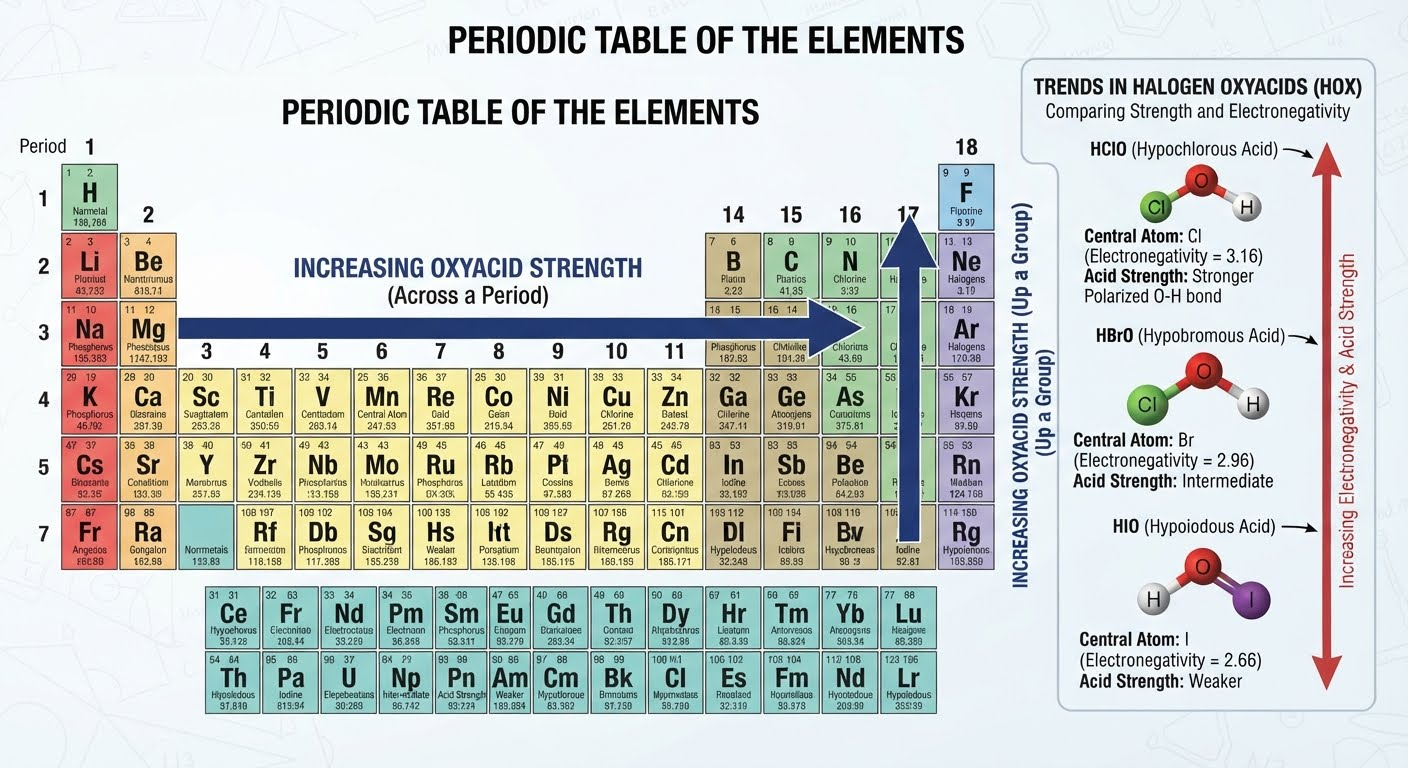
strengths of oxyacids
acidity decreases down a group
acidity increases to the right across a period
Lewis acid, does not require H+
Lone pair acceptor
Lewis base, does not require H+
Lone pair donor
Buffer
Resists changes in pH by neutralizing added acid or added base
Common ion effect
Weak acid solution, anion NaA, conjugate base of the acid, shifts the position of equilibrium to the left
Buffer capacity
Amount of acid or base a buffer can neutralize
Buffer range
pH range in which the buffer can be effective, an effective range is pKa ± 1
Buffer capacity reaches 1
the ability of the buffer to neutralize both added acid and base improves
titration
a solution of unknown concentration is slowly added to a solution of a known concentration until reaction is complete
equivalence point
moles of acid are equal to the moles of base
strong base added to strong acid
down to up
strong base with a strong acid
up to down
weak acid with a strong base
before equivalence point, solution becomes a buffer
beyond equivalence point OH- is in excess
titration of a polyprotic acid
2 equibalance points
solubility product (ksp)
equilibrium constant for the dissociation of a solid salt into its aqueous ions
molar solubility
the number of moles of solute that will dissolve in a liter of solution
Ksp and relative solubility
small Ksp is the most insoluble
precipitation
will occur when the concentrations of the ions exceed the solubility of the ionic compound
Q = ksp
solution is saturated no ppt
Q < Ksp
solution is unsaturated no ppt
Q > Ksp
solution above saturation, salt above saturation will ppt
selective precipitation
a solution containing several different cations can often be separated by addition of a regent that will form an insoluble salt with one of the ions but not the others
qualitative analysis
an analytical scheme that utilizes selective precipitation to identify the ions present in a solution
complex ions
ions that form by combining a cation with several anions or neutral molecules
Ligands
ions or molecules that act as lewis bases, H2O
complex ion equilibria
if a ligand is added to a solution that forms a stronger bond than the current ligand, it will replace the current ligand
complex ion formation reaction
the reaction between an ion and ligands to form a complex ion
formation constant (Kf)
equilibrium constant for the formation reaction
k’s larger than 1 favors products
solubility of amphoteric metal hydroxides
many are insoluble
become more soluble in acidic solution
some also act as acids, becoming more soluble in basic solution
cations that form: Al 3+, Cr 3+, Zn 2+, Pb 2+, and Sn 2+