Fin Theory Flash card
 Call Kai
 Learn
Learn Practice Test
 Spaced Repetition
 Match
Match Flashcards
 Knowt Play
1/24

There's no tags or description
Looks like no tags are added yet.
Name | Mastery | Learn | Test | Matching | Spaced | Call with Kai | Chat |
|---|
No analytics yet
Send a link to your students to track their progress
25 Terms
Why utility function has an upward sloping?
Non-satiable preferences imply that as consumption increases, utility also increases. This means individuals receive added satisfaction from consuming more of a good, reflecting their desire for more.
Why IC cannot cross?
Transivity of preferences ensures each choice leads to a consistent ranking, preventing indifference curves from crossing.
Indifference Curve (IC)
A graphical representation of different combinations of goods that provide the same level of utility to a consumer, illustrating the trade-offs between the goods while maintaining constant satisfaction.
Why Indifference Curve (IC) has a downward sloping?
A downward sloping indifference curve indicates that as a consumer consumes more of one good, they must give up some of another good to maintain the same level of utility. This reflects the principle of diminishing marginal rate of substitution.
Why Indifference Curve (IC) has a convex shape?
A convex indifference curve illustrates that as a consumer substitutes one good for another, the rate at which they are willing to make that trade-off diminishes, reflecting the principle of decreasing marginal utility.
Sharpe’s Ratio

U’(X) > 0 means what in total utility function for risk averters?
It means that the total utility function is increasing with consumption, indicating that risk averters derive positive utility from increases in wealth or more is preferred to less.
U’’(X) > 0 means what in total utility function for risk averters?
It indicates that the total utility function is convex, reflecting diminishing marginal utility of wealth, which is characteristic of risk-averse individuals or risk aversion.
What is Certainty equivalent?
The certainty equivalent is the guaranteed amount of money that an individual considers equally desirable as a risky prospect with uncertain outcomes, reflecting their risk preference.
Portfolio A dominate Portfolio B stochastically if?
Portfolio A has better returns in terms of expected value than Portfolio B for all states of the world, meaning it provides higher utility for risk-averse investors.
Portfolio A dominate Portfolio B with second order stochastic dominance if?
Portfolio A has higher expected utility than Portfolio B for all risk-averse investors, ensuring that the cumulative distribution function of Portfolio A is to the left of that of Portfolio B at all points.
What is the difference between risk and uncertainty?
Risk refers to situations where the probabilities of outcomes are known, while uncertainty refers to situations where these probabilities are unknown. Risk can be measured statistically, whereas uncertainty cannot be quantified easily.
Will a risk averter enter speculative activities?
A risk averter is generally unlikely to enter speculative activities due to their preference for certainty and avoidance of potential losses. Such individuals prioritize investments with predictable outcomes over those with high volatility.
If F dominate G under First Order Stochastic Dominance. Would the investor prefer F to G regardless of risk attitude?
Yes, First Order Stochastic Dominance accounts for risk by comparing the cumulative distribution functions of two portfolios. If one portfolio is always greater than or equal to the other, it indicates that it offers higher expected returns for all levels of risk aversion.
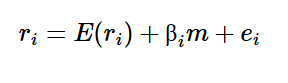
What does e subscript i stand for in single index model?
e subscript i represents the error term or residual for asset i in the single index model, capturing the portion of the asset's return that is not explained by the market return.

What is the single index model’s assumption?
The single index model assumes that the return of an asset can be explained by the return of a single market index and a unique error term, indicating that the asset's return is linearly dependent on market movements.
In Single Index Model, what does Beta refer as?
Beta refers to the sensitivity of an asset's return to changes in the market return, indicating the asset's systematic risk relative to the market.
In Single Index Model, what does alpha refer as?
Alpha refers to the excess return of an asset beyond what is predicted by its beta, representing the asset's performance relative to the market and capturing its unique contribution to return.
SIM allows division of labor and decentralization of?
Macro and security analysis
What is idiosyncratic risk?
Idiosyncratic risk is the risk that is unique to a specific asset or company, not correlated with the overall market movements. It represents the volatility caused by factors affecting only that particular asset.
If alpha of a stock is positive, is the stock over or under priced?
If alpha of a stock is positive, the stock is considered underpriced, indicating it is expected to outperform its benchmark given its risk level.
In Single Index Model, what does high beta typically mean?
High beta indicates higher sensitivity to market movements, suggesting that the asset is expected to experience greater price fluctuations compared to the market.
What does low Beta means for single index model?
Low beta indicates lower sensitivity to market movements, suggesting that the asset is expected to experience smaller price fluctuations compared to the market.
For CAPM, what does Beta refer to?
Beta in CAPM represents the measure of an asset's volatility in relation to the overall market, indicating its systematic risk.