Physics midterm
 Call Kai
 Learn
 Practice Test
 Spaced Repetition
 Match
 Flashcards
 Knowt Play
1/138

There's no tags or description
Looks like no tags are added yet.
139 Terms
A photon is a packet of _______.
Properties of all photons
Energy
No mass
No charge
Travel at speed of light
______ is a mode of energy propagation for photons
Consists of oscillating (time-varying) electric and magnetic fields that move at right angles to each other
Electromagnetic radiation
______ is a unit of energy equal to the amount of kinetic energy gained by a single electron when it's accelerated through an electric potential
An electron volt
1.602x10⁻¹⁹J
Is MV a unit of energy?
How to find average energy?
A 6MV photon beam has a maximum photon energy of ______ MeV and an average photon energy of ______ MeV
No
1/3 of the maximum energy
It refers to the accelerating potential of the linear accelerator
6
2

Ionizing radiation vs Non-ionizing radiation
Give examples
Radiation with wavelength
Ionizing: Is energetic enough to ionize atoms (remove electrons from atomic orbitals), break molecular bonds, and initial biological change
ex: x-rays, gamma rays, UV-C
Non-ionizing: Energy is transformed into heat or mechanical energy. Bonds are not broken, no molecular damage
ex: radio waves, radar, visible light
X-rays vs Gamma rays
X-rays: are produced outside of a nucleus in an x-ray tube (keV) or linear accelerator (MeV) energies
Gamma rays: are produced inside of a nucleus: produced when an unstable nucleus releases excess energy
What is in the nucleus?
Protons and neutrons
Chemical properties are determined by _______.
Electron structure
# of valence electrons
For an atom to be electrostatically neutral, the number of _____ must equal the number of ______.
Electrons
Protons

X =
Z =
N =
A =
X = Chemical symbol for the element
Z = Atomic number (# of protons)
N = Number of neutrons
A = Mass number (# of nucleons = Z + N)
Atoms are classified as different elements based on the number of _______.
Protons
Isotopes
Atoms with the same number of protons but different number of neutrons
Have the same chemical properties
Isotones
Same number of neutrons, different number of protons
Isobars
Same number of nucleons but different number of protons/neutrons
Isomers
Same number of protons and neutrons but differ in their nuclear energy state
Nuclides in a metastable energy state are radioactive and typically emit a _____ to achieve stability
Gamma ray
4 fundamental forces in nature
1. Electromagnetic
-strong but repulsive amongst particles of same charge, aims to disrupt the nucleus
2. Gravitational
-very weak
3. Weak nuclear
-quite weak, relevant for some types of radioactive decay
4. Strong nuclear
-stronger than EM force
-relevant when the distance between nucleons is smaller than nucleus diameter (

Uncharges particles are not attracted to the nucleus when farther away than the nuclear radius. when they get within _________m they experience strong attraction and fall into _______. Is formed as a result of the ______ and provides nuclear binding energy.
If the particle can get close enough and overcome the Coulomb force it will be attracted due to _______.
10^-15m
the potential well
mass defect
the strong nuclear force
All elements with Z
82

Maximum number of electrons that can exist in a given orbit is given by?
2n^2
Does a shell need to be completely filled before electrons begin to fill the next shell?
No
What is binding energy?
Potential energy = -binding energy
Binding energy depends on?
Binding energy increases with increasing _____ and decreasing ______.
Binding energy is the energy to remove an electron
-equal to the energy level of the orbital that the electron is in
The electrostatic attraction between the nucleus and electrons
Increasing Z and decreasing orbital radius
To move an electron to a higher energy level, you must _____ energy
Add
To move an electron to a lower energy level, energy must be ______.
Emitted
To remove an electron from an atom, you must supply energy ______ to the current energy level. (binding energy)
Equal
Ionization vs excitation
Ionization: removal of an electron
Excitation: moving an electron from a lower to a higher orbital
Free radical
An atom carrying an unpaired electron in their outer shell
______ are highly reactive and interact with DNA to cause DNA/biological damage
Hydroxyl radicals (OH)
Artificial radioactivity
Occurs when stable atoms which are not naturally radioactive are bombarded by particles such as protons, neutrons, or alpha particles
What is activity?
# of disintegrations per unit time
Decay constant
Number of radioactive atoms decreases with _____?
Number of atoms decaying per unit time is proportional to the number of atoms present
Time
Half life
Time for the activity of radioactive atoms to decay to half the initial value
Average life
Average lifetime of a radioactive atom before it decays
Specific activity
A high specific activity means you can have ________ from a _____ sample of radioactive material (advantageous for nuclear medicine, brachytherapy, and radiation therapy)
Activity per unit mass of a radionuclide
A large number of disintegrations
Lighter
Elements with Z>? have to be produced artificially
92
Elements with a low Z are _____ and high Z are ______
As the number of nucleons increases, the forces that keep the nucleus together become less effective
Stable
Radioactive
What is an alpha particle
Contains two protons and two neutrons

In alpha decay, the Z of the nucleus is reduced by ______ and the mass number is reduced by ______
2
4
_______ = disinegration energy = energy released during transformation = difference in mass energy between parent and product nuclei
Q
What are the two types of beta particles?
B- = electrons
B+ = positrons
Do electrons/positrons regularly exist inside the nucleus?
No
_____ decay occurs when there is an excess number of neutrons
high n/p ratio = _____ decay
-A neutron in the nucleus turns into a proton and an electron is emitted
-V is a _____?
low n/p ratio = ______ decay
-A proton in the nucleus turns into a neutron and a positron is emitted
-V is a _____?
Beta
B-
B+
V is an anti-neutrino
V is a neutrino
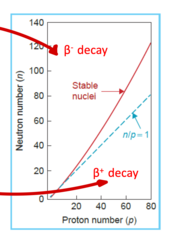
For B+ decay to occur the energy difference between the parent and daughter must be > ?
> 1.02MeV
What is positoron annihilation?
What are the gamma rays energies?
When a positron interacts with an electron to produce two gamma rays
0.511 MeV each
______ occurs in radionuclides with a deficit of neutrons
An orbital electron is captured by the nucleus and a proton is transformed into a neutron
After EC, the nucleus is still in an excited state and the nucleus will emit its excess energy through a _____.
Electron capture
Gamma ray
Electron capture and B+ decay are in competion because they both have a deficit of neutrons. Which is more common?
Beta +
Electron capture usually involves a _____ shell electron since it is closest to the nucleus
K
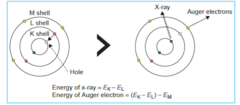
When an electron moves from an outer orbital to an inner orbital a _____ with energy equal to the difference in orbital energies is emitted
Characteristic x-ray
_______ are produced when a characteristic x-ray is produced and absorbed by the atom and the energy is transferred to another orbital electron, which is then ejected from the atom
Are monoenergetic
Auger electrons
Fluorescent yield = _____ = the probability of an electron vacancy resulting in the emission of a characteristic x-ray
w
For high Z (>30) ______ are more probable in electron capture
For low Z (
Characteristic x-rays
Auger electrons
How is internal conversion and electron capture different?
IC: the nucleus does not capture an electron to turn a proton into a neutron
Excess nuclear energy is transferred to an orbital electron which is ejected from the atom and creates an electron vacancy

If Q (nuclear reaction energy) > 0: energy is _____
If Q < 0: energy is _______
Q = difference in mass energy of initial and final particles
Released
Absorbed
Proton bombardment vs Deuteron bombardment vs Neutron bombardment
What is emitted?
P: Gamma ray is emitted
D: Neutron/proton is emitted
N:Radioactive B emitting particles are emitted
What is photodisintegration?
A nuclear reaction produced by interaction of high energy photon with the nucleus
Results in emission of neutrons (y,n reaction)
y,n reactions can cause linac components to become ______
Radioactive
_____ occurs when you bombard high Z nuclei with neutrons. After absorbing the neutron the nucleus splits into nuclei of lower atomic number and neutrons are emitted
Can cause a chain reaction
Product nuclei are called ________.
Fission
Fragments
____ occurs when low mass nuclei combine to form one nucleus
Total mass of the products is less than the reactants meaning energy is released
Fusion
What is a delta ray?
An ejected electron that receives enough energy to produce a track of its own
_______ particles such as electrons protons and alpha particles are known as ______________ provided they jabe sufficient kinetic energy to produce ionization by collision
Energy is lost in a series of small interactions along the ionization track in the medium
Charged
Directly ionizing radiation
_________ particles like neutrons and photons are ___________. They release directly ionizing particles when they interact with matter
_______ moving electrons deposit energy and damages molecules
Uncharged particles
Indirectly ionizing
Photon attenuation has dimensions of ________
Value depends on
Inverse length (1/length)
1. Material
2. Incident photon energy
________ is the thickness of a material that attenuates an incident beam to 1/2 its original intensity
Half value layer
What is the difference between the linear attenuation coefficient and the mass attenuation coefficient?
The mass attenuation coefficient removes the effect of density
N = No e(-u/p)px)
4 main types of interactions of x-rays/gamma rays with matter
1. Coherent scattering
2. Photoelectric effect
3. Compton
4. Pair production

__________ scattering is a collision between a photon and the entire atom
Oscillating electrons emit radiation (same wavelength as incident photon)
No energy is transferred!!!!!
Net result: a change in direction of the photon
Coherent scattering
The probability of coherent scattering increases with increasing ________, and decreasing _______.
Photon energy
Z
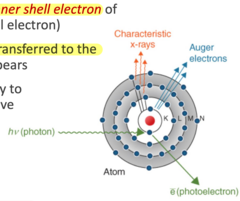
The _______ effect occurs when a photon collides with an inner shell electron of an atom
Entire energy of photon transferred to the electron
Electron uses some energy to overcome binding and leave the atom
The vacant shell has to be filled, the difference in energy between shells appears as a characteristic x-rays or auger electrons
Photoelectric
Net result of the photoelectric effect
_____ electron ejected that can cause damage directly
Low energy characteristic radiation emitted
Fast moving
Probability of photoelectric interaction decreases with
Increasing ______
Decreasing ______
Decreasing _______
Photoelectric attenuation equivalent to ________
photon energy
Z
physical density
Z^3/E^3
The probability of the photoelectric effect is maximum when photon energy is slightly above the ________ energy
Binding
The photoelectric effect is relevant for?
Medical imaging/orthovoltage (low energy)

At the first bump, this is the K-shell binding energy for lead; at 0.088 MeV, the photon now has enough energy, so the attenuation coefficient goes up dramatically

________ occurs when a photon collides with an outer shell electron of an atom
A portion of the energy is transferred to the electron
The electron overcomes its binding energy and is ejected from the atom with kinetic energy
Photon continues with reduced energy, deflected from its original path
Compton scatter
Post-interaction referred to as the _______ photon
Energy of the photon is variable (varies from straight forward to straight backward)
Post-interaction energetic electron referred to as _______ electron
-outer shell electron so binding energy considered negligible, and no characteristic radiation or Auger electrons
Energy and momentum is conserved
Scattered
Compton
Net result of compton scatter
Fast moving electron causes _______ to DNA
Scattered photo can further interact with ________
Probability of interaction decreases with
-Increasing ______
-Decreasing ________
-Decreasing __________
-Compton scatter equivalent to ________
Damage
Matter
Photon energy
Electron density
Physical density
1/E
______ is the principle interaction mechanism for MV photons
Compton scatter
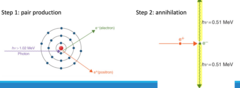
______ occurs when a photon passing near atomic nuclei interacts with the strong field of the nucleus
Photon disappears and is replaced by electron/positron pair
Energy of the photon must be greater than 1.022 MeV
Pair Production
PP
The electron has a mass of ______ and the positron has a rest mass of ______
Incident photon energy in excess of 1.022 MeV threshold is shared as kinetic energy by the outgoing electron and positron particles
0.511 for both
Net result of Pair Production
Fast moving _____- can cause damage
Positron will annihilate and create two photons which will carry energy away
Fast moving ______- can cause damage
Positron
Electron
Probability of pair production interaction decreases with
-Decreasing ______
-Decreasing _______
-Decreasing _______
Photon energy
Z
Physical density
Pair production becomes significant in RT ________.
> 5MeV
Describe the graph of the most probable photon interaction
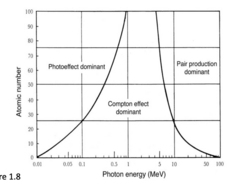
What is direct action radiation? Can photons do direct action?
Fast moving electrons directly break the DNA molecule
No, photons must interact first
What is indirect action of radiation?
The photons interact with atoms -----> creates free radicals -----> diffuse through tissue and causes damage to DNA
What are free radicals? Leads to creation of a?
Molecules with an unpaired electron
Hydroxyl radical
What can happen to DNA when it breaks?
1. Can join back together correctly
2. Fail to rejoin
3. Reassort and rejoin
______% of x-ray damage to DNA is due to OH
_________% of x-ray damage due to direct action
75%
25%
How much radiation in general do non-proliferating cells need to die
Tens of thousands of cGy
LOTS
How much radiation in general do proliferating cells need to die
Can be less than 200 cGy
Lower energy = _____ attenuation
Higher
The energy transferred between charged particles with matter is inversely proportional to?
1. Kinetic energy of incident charged particle
2. Closest distance of approach
What is more common, large energy energy transfers when the interactions are close or small energy transfers when the interactions are distant?
Small energy transfers when the interactions are distant
When electrons interact with each other, since the incident/target masses are similar, how is the direction of travel affected?
Significant change in direction
Interaction of electron with nuclei (bremsstrahlung)
Electron is light and pulled off its original course, its path is ______ leading to _________ accompanied by radiation energy (x-ray)
curved
deceleration
Interactions with nuclei become important in high _____ materials, for _____ incident charged particles (ie. electrons), and as ______ of incident electron increases
Z
Light
Energy
Stopping power
The amount of energy lost by a particle per unit length of travel
In water, interactions between incident electrons and nuclei are equal at around _____ MeV
100
In lead interactions between incident electrons and nuclei are equal at around ______ MeV
10
______- is an ejected atomic electron that has been produced by a charged particle interaction and which has enough energy to produce further ionization
Has lower energy compared to incident charged particle
Interactions with nuclei are not probable, no x-ray production
Delta ray