Animals (Vertebrates)
 Call Kai
 Learn
 Practice Test
 Spaced Repetition
 Match
 Flashcards
 Knowt Play
1/21

Earn XP
Description and Tags
L9-L...
22 Terms
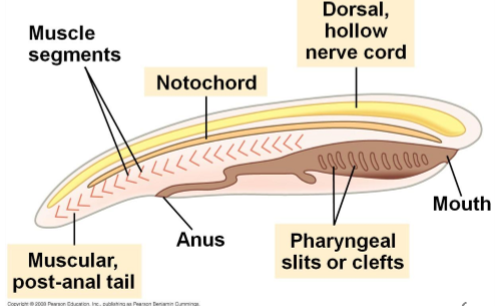
What is the four main features of a Chordate?
Notochord
Dorsal, hollow nerve chord
Pharyngeal slits or clefts
Muscular, post-anal tail
What is the recapitulation theory?
Claiming that an organisms biological development, parallels and summarises its species’ evolutionary development
REJECTED in modern biology
Cephalochordates (Lancelets) (Chordata) overview
30 extant species
fish-like
notochord (entire length and life)
marine
live partially buried in sand
filter small prey in pharyngeal slits
brain but poorly developed
very important for understanding embryonic development
Urochordates (Tunicates) (Chordata) overview
>2000 species
Sea squirts most common
Solitary or colonies
Plankton filter-feeding
Adults sessile (lost notochord)
Tadpole-like larvae reveal chordate traits
Includes many invasive species
Huge damage with biofouling (unwanted buildup of microorganisms, plants, algae, or small animals)
Are more closely related to vertebrates then Cephalochordata
Vertebrates overview
Arose 530 MYA during the Cambrian
Single common ancestor
Great diversity within the group
Vertebrates have backbones (series of vertebrae)
Rigid internal skeleton
2 pairs of appendages
Anterior skull and large brain
Internal organs suspend in large coelom
Advanced circulatory system
Examples of jawless fish (vertebrates) & overview
Myxini
Petromyzontida
And many extinct groups of jawless fish identified through fossil evidence
Shared characteristics with jawless fish and vertebrates:
skull, brain, eyes and sensory organs
2 or more clusters of hox genes
neural crest (important for forming bone cartilage of the skull)
Myxini (vertebrates) overview
Common name hagfish
58 known species
Generally marine
Jawless (rasping tongue-like structure)
Degenerate eye spots (sensory tentacles)
Low pressure circulatory system
Partial cranium
Brain has no cerebrum or cerebellum
Skeleton is made of cartilage
Reduced vertebrae
Petroyzontida (vertebrates) overview
Common name lamprey
represent the oldest living lineage of vertebrates
Jawless
Marine and freshwater
Cartilaginous segment surrounding the notochord (vertebrae)
What are Gnathostomes?
Gnathostomes are vertebrates
They have are jawed fish
Jaw may have evolved from two pairs of skeletal supports (pharyngeal arches)
4 living lineages:
Chondrichthyans
Ray-finned fishes
Lobe-fin fishes
Tetrapods
Placoderm fish (fossil Gnathostome, vertebrates) overview
Heavily armoured
Has a jaw
Evolved sleek body and fins (manoeuvrability)
Once a top predator
Acanthodians (fossil Gnathostome, vertebrates) overview
Good fossil records
Acanthodians (spiny fins)
Boney spines
Large eyes, blunt head, heterocercal tail
Modern Gnathostome (vertebrates) overview
Additional duplication of Hox genes (more options for genetic source of morphological variability)
Enlarged forebrain
Lateral line system (sensitive to vibrations)
Chondrichthyans (Modern Gnathostome, vertebrates) overview
Chondrichthyans = sharks, rays, chimaeras
1000 species
Skeleton composed primarily of cartilage
The largest most diverse groups
Eggs fertilise internally via:
Oviparous
Ovoviviparous
Viviparous
What is Oviparous embryo development?
Egg hatch outside the mothers body
What is Ovoviviparous embryo development?
The embryo develops within the uterus and is nourished by the egg yolk
What is Viviparous embryo development?
The embryo develops within the uterus and is nourished through a yolk sac placenta from the mother’s blood
Ray-finned fishes (Modern Gnathostome, vertebrates) overview
Important for commercial fishing
Have a bony endoskeleton (Osteichthyes)
Aquatic species have:
operculum (gills in a single chamber with1 flap)
swim bladder (fills with gas to help them float)
Flexible fin rays
calcified endoskeleton
scales
Ray-finned fish - external anatomy
Dorsal fins, Caudal fins, Pectoral fins, Pelvic fins, Anal fins

Circulatory system - fish vs mammals
Fish - single circuit circulatory system
Mammals - double circuit
Actinistia (coelacanths) (Lobe-fin fishes, jawed fish, vertebrates) overview
Large fish with fleshy fins
Muscle outside the body, similar to tetrapod load bearing limbs
Some limb bones (pectoral) homologous to tetrapod limb bones
Many fossil records
2 living species
Dipnoi (lungfishes) (Lobe-fin fishes, jawed fish, vertebrates) overview
Monophyletic group
Powerful jaws, crushing teeth
Paired fins, with thick central lobe with bone and muscle
Found in warm stagnant water (very specific habitat)
Lungs are filled by gulping air allowing survival in stagnant water
Aestivation - a state of dormancy or torpor during the summer
Pro and Cons of tetrapod’s becoming terrestrial
Pros:
Air has many advantages for gaining o2
Less energy required for motion on land
Cons:
Gravity
Evolution of new locomotory system required