lecture 3 regulation of prokaryotic transcription
 Call Kai
 Learn
 Practice Test
 Spaced Repetition
 Match
 Flashcards
 Knowt Play
1/13

There's no tags or description
Looks like no tags are added yet.
14 Terms
how do prokaryotes primarily control gene expression, and what’s the difference between constitutive and regulated expression?
prokaryotes primarily control gene expression by regulating transcription.
- constitutive expression: housekeeping genes are expressed routinely, such as genes for glycolytic enzymes and cytoskeletal proteins.
- regulated expression: gene expression can be inducible (turned on or increased by a signal) or repressible (turned off or decreased by a signal).
define operon
a cluster of prokaryotic genes that share a promoter and are regulated and transcribed as one unit, producing a single mrna. the proteins they encode often work together to carry out a common function.
how does substrate induction increase transcription of an operon?
when the substrate is present, transcription increases so the cell makes more proteins to break down the substrate. example: the lac operon.
how does end-product repression decrease transcription of an operon?
when the end product builds up, transcription decreases so the cell makes fewer proteins to synthesize that product. example: the trp operon.
what does the lac operon do, and what does each of its three genes encode?
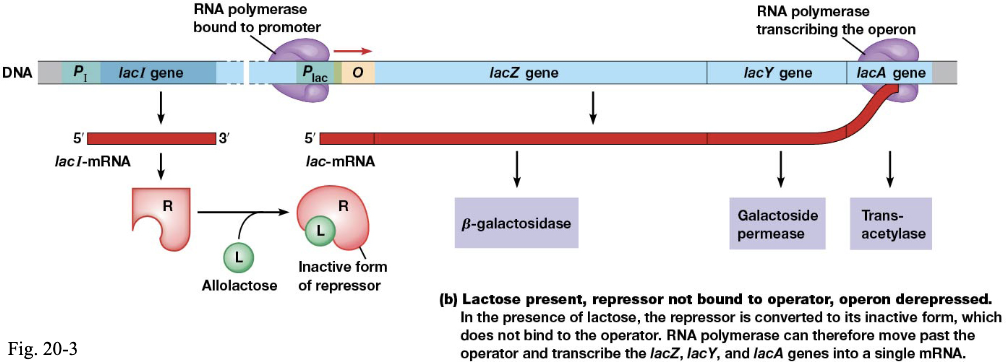
lac-z encodes β-galactosidase, which splits lactose into glucose and galactose.
lac-y encodes galactoside permease, which brings lactose into the cell.
lac-a encodes transacetylase, which acetylates certain galactosides.

how is the lac operon repressed when glucose is present and lactose is absent?
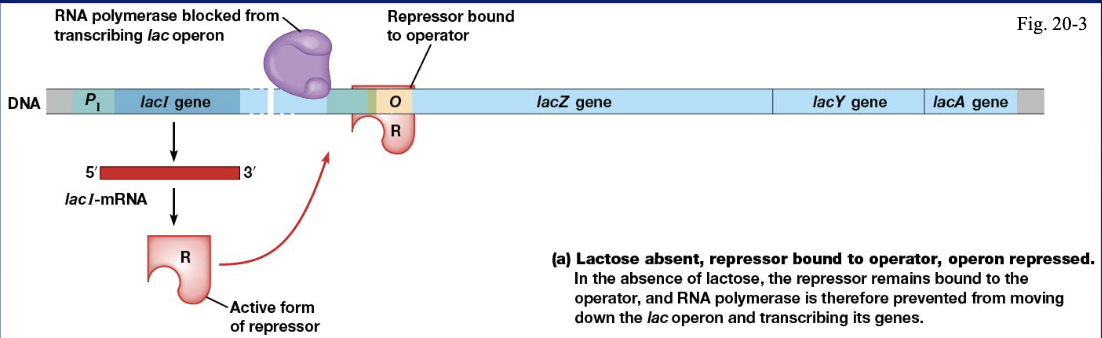
without lactose, the repressor made by the lac i gene binds the operator and blocks transcription of the lac operon.
how does the presence of lactose relieve repression of the lac operon?
some lactose is converted to allolactose, which binds the repressor and causes it to release the operator. rna polymerase can then transcribe the lac genes. this is called substrate derepression. if glucose is still present, transcription remains low.
when lactose is present and the lac repressor has released the operator, what happens to camp levels if glucose is absent?
camp levels rise. glucose indirectly inhibits adenylyl cyclase, the enzyme that makes camp. without glucose, adenylyl cyclase makes more camp.

once camp levels rise, how does that lead to maximal lac operon transcription?
camp binds catabolite activator protein (cap). the cap–camp complex binds near the lac promoter and recruits rna polymerase. with the repressor already off the operator because lactose is present, transcription is maximal.

what does the trp operon help synthesize, how many proteins and enzymatic functions does it encode, and why is its mrna called polycistronic?
the trp operon encodes five proteins with six enzymatic functions that work together to synthesize tryptophan. its five structural genes are transcribed into one polycistronic mrna, meaning a single mrna carries instructions for multiple proteins.

what are the two ways transcription of the trp operon is regulated?
end-product repression — when tryptophan is abundant, it activates the repressor, which binds the operator and blocks transcription initiation.
attenuation of elongation — when tryptophan is abundant, transcription can start but ends early, before rna polymerase reaches the structural genes
what activates the trp repressor when tryptophan levels are high?
tryptophan binds to and activates the repressor protein made by the trpr gene.

once the trp repressor is activated, how does it shut down the trp operon?
the active repressor binds the operator and blocks transcription. this is end-product repression because tryptophan shuts down transcription of the genes used to make it.

when tryptophan is low or absent, the trp repressor stays inactive. what happens at the operator, and how does this affect transcription?
the operator stays unoccupied, so rna polymerase can transcribe the trp operon. this is derepression, and it lets the cell make the enzymes needed to synthesize tryptophan.
