Mod 4 (Ch 5) - Coping with Environmental Variation: Energy
 Call Kai
 Learn
 Practice Test
 Spaced Repetition
 Match
 Flashcards
 Knowt Play
1/39

Earn XP
Description and Tags
included on exam 1, updated for spring 2026
40 Terms
3 things organisms can use energy from
sunlight (used by photosynthesizers)
reactions of inorganic chemicals (used by chemosynthesizers)
consumption of organic compounds (used by herbivores, detrivores, scavengers, parasites, predators)
why do organisms use energy? (regardless of source of energy)
to produce or obtain glucose
ways organisms use glucose
to create ATP via cellular respiration
ATP powers most cellular processes
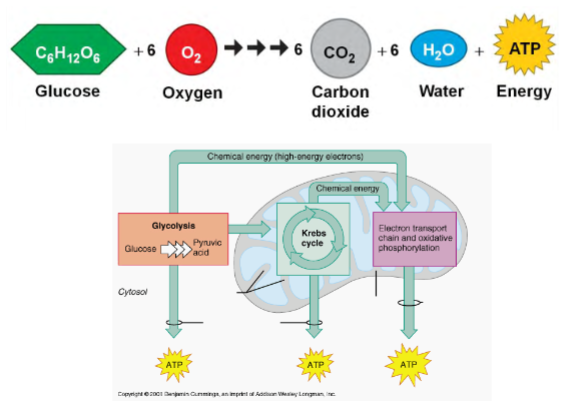
autotroph
an organism that uses radiant or chemical energy to produce carbohydrates
can convert CO2 into organic carbon (carbohydrates)
can be photosynthetic or chemosynthetic
heterotroph
an organism that consumes other organisms to obtain carbohydrates
must obtain carbon by eating live or dead herbivores or heterotrophs
comparison/contrast of the two types of autotroph
both use energy (ATP/NADPH) to convert a carbon compound into food (carbohydrates)
differ in how they produce energy (radiant energy via photosynthesis vs oxidation via chemosynthesis)
both reactions use the Calvin cycle
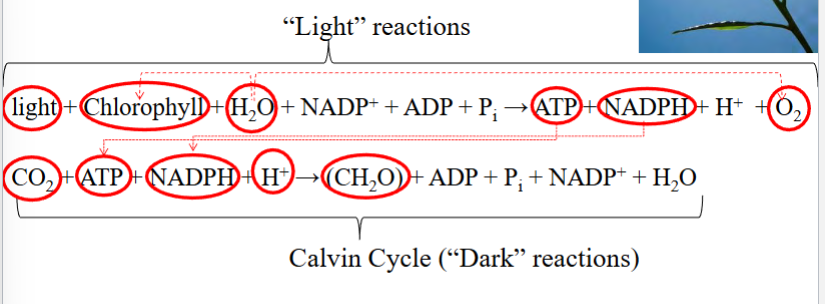
only photosynthesis uses light reactions
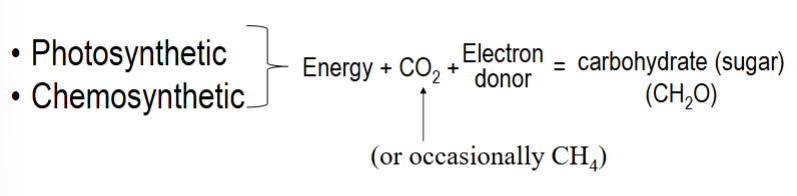
photosynthesis equation
summarized: sunlight + CO2 + H2O → (CH2O)n + O2
really 2 reactions: light reactions + Calvin cycle (dark reactions)
chemosynthesis: summarized equation
CO2 + 4H2S + O2 → CH2O + 4S + 3H2O
(4H2S + O2 is a general oxidation reaction)
in what organisms does chemosynthesis occur?
only in certain bacteria and archaea
usually in bacteria/archaea that do not have access to sunlight, or that have access to lots of sulfur
symbiosis with chemosynthesizers
some animals rely on symbiosis with chemosynthesizers to obtain carbs
e.g. giant tube worms, chemosynthetic bacteria live in their trophosomes
e.g. hydrothermal vent clams, chemosynthetic bacteria livei n their gills
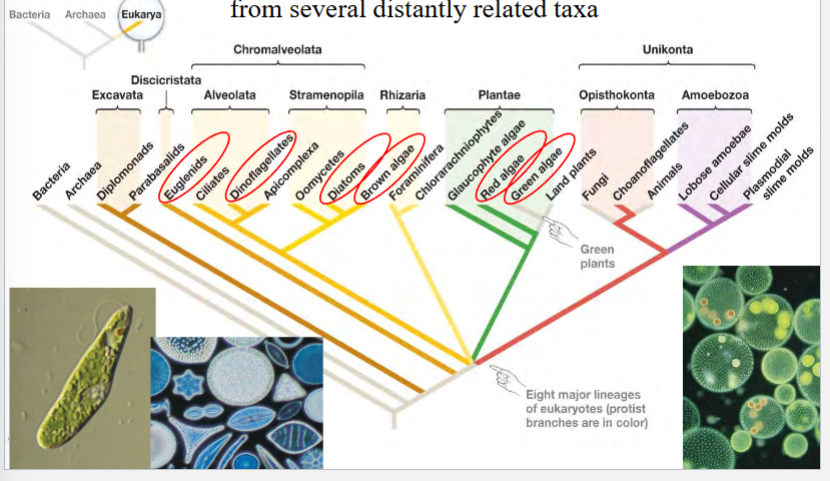
algae
photosynthetic microorganisms
very broad taxonomy, from several distantly related taxa
symbiosis with photosynthesizers
algae live inside another organism
e.g. dinoflagellates live in cnidarians
e.g. all shallow water corals, some anemones, some upside-down jellies have algae living inside them
e.g. dinoflagellates live in some mollusks (giant clams)
e.g. some sponges house cyanobacteria or various algae (dinoflagellates, rhodophytes, chlorophytes, diatoms)
functionally photosynthetic animals
a few animals are functionally photosynthetic without symbiosis
kleptoplasty: the animals consume dinoflagellates and incorporate their chloroplasts
e.g. exhibited in some mollusks (nudibranch sea slugs)
cycles producing and using glucose
photosynthesis creates carbohydrates (glucose)
carbohydrates are used to synthesize ATP and NADPH
carbohydrates are used to create important macromolecules
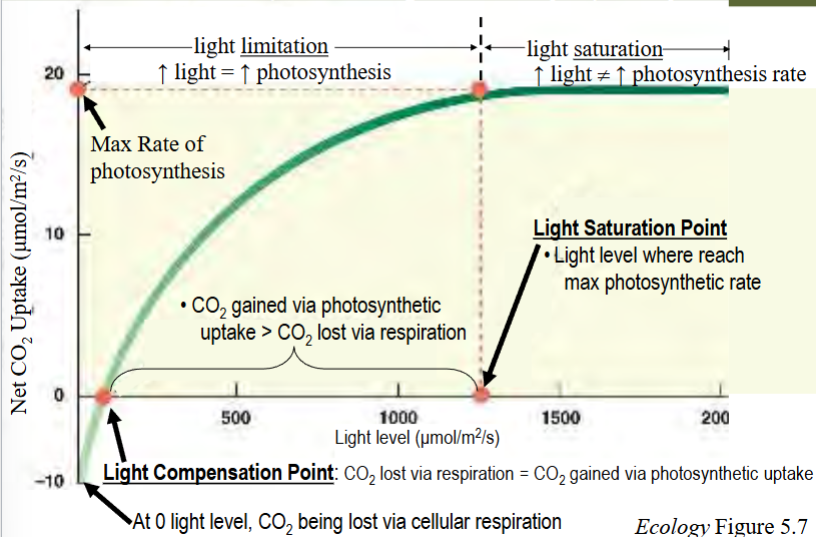
light response curve
a graph curve that summarizes the relationship between light availability and photosynthesis rate
x-axis is light level (further right = more light)
y-axis is CO2 uptake, thus photosynthesis rate (higher up = greater photosynthesis rate)
big idea: as light increases, the rate of photosynthesis increases up until the light saturation point
(know all the areas and parts of the curve of this graph)
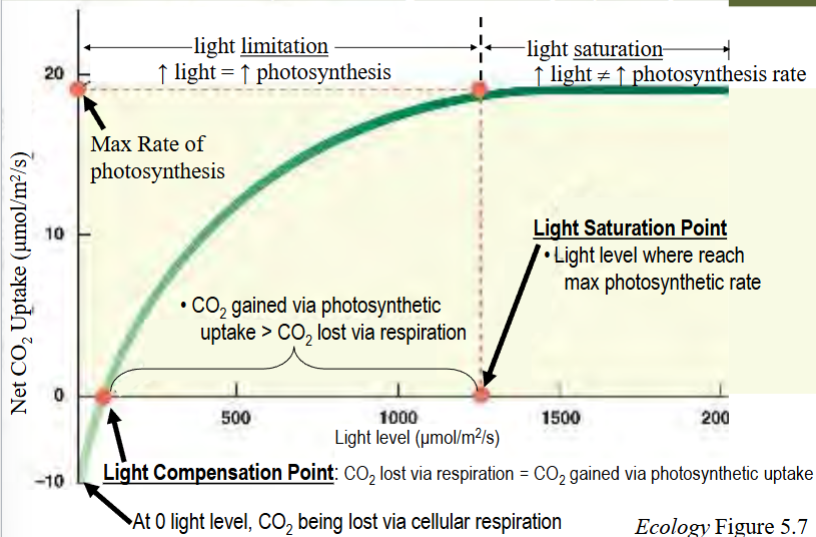
things to know about the light response curve
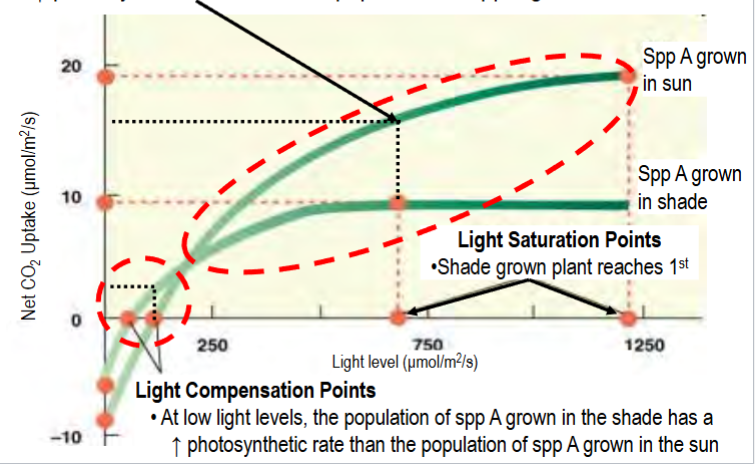
0 light level: CO2 is being lost via cellular respiration
light compensation: CO2 lost via respiration (out) = CO2 gained via photosynthesis (in)
light limitation: the region during which increased light = increased photosynthesis (from light compensation point to light saturation point)
light saturation point: light level where the max photosynthetic rate is reached
light saturation: the region during which increased light =/= increased photosynthesis rate
(be able to recognize all of these on the curve)
results of too much sunlight on a plant
overheating → inefficient metabolic functions
water loss
damage to photosynthetic membranes in chloroplasts
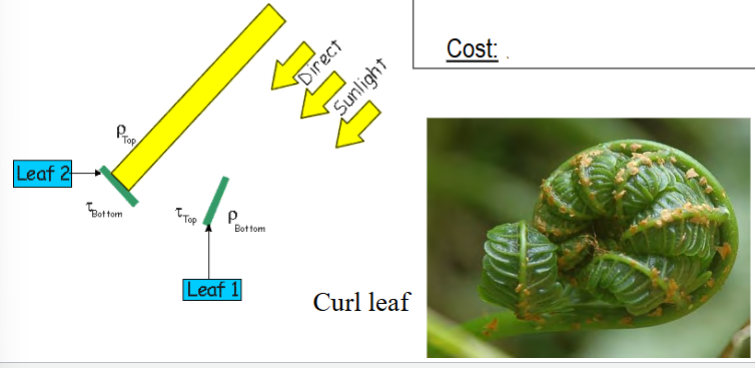
changing leaf orientation
a short-term (acute) morphological response to help regulate light input
can be done over hours to days
e.g. rotating leaf face, curling up
benefit: less overheating, less desiccation
cost: less photosynthesis
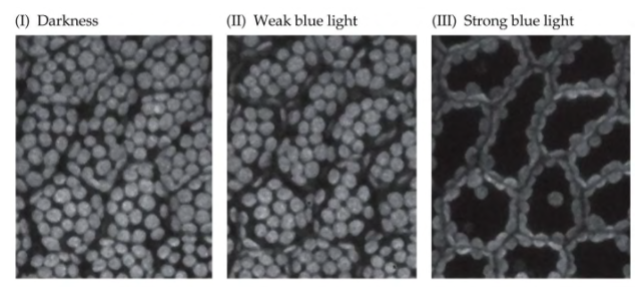
alteration of location of chloroplasts
a short-term (acute) morphological response to help regulate light input
done to increase or decrease shading of other chloroplasts (some chloroplasts hide under others)
done over hours or days
benefit: less tissue damage
cost: less photosynthesis
increasing/decreasing the number of chloroplasts
a long-term morphological response (acclimatization) to help regulate light input
benefit of more chloroplasts: increased photosynthesis = saturation at higher light levels
cost of more chloroplasts: more energy to make chloroplasts
benefit of fewer chloroplasts: less energy used to make chloroplasts
cost of fewer chloroplasts: decreased photosynthesis = saturation at lower light levels
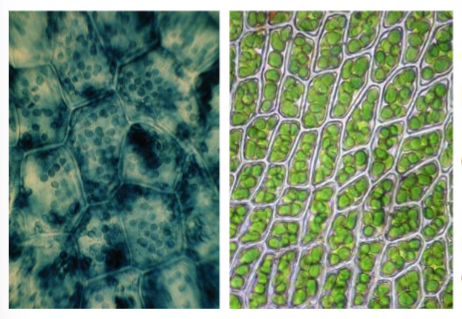
question: which have more chloroplasts, sun- or shade-grown plants?
sun-grown plants
because a shade-grown plant would not need those extra chloroplasts if they’re not being used
chloroplast level will generally match light level
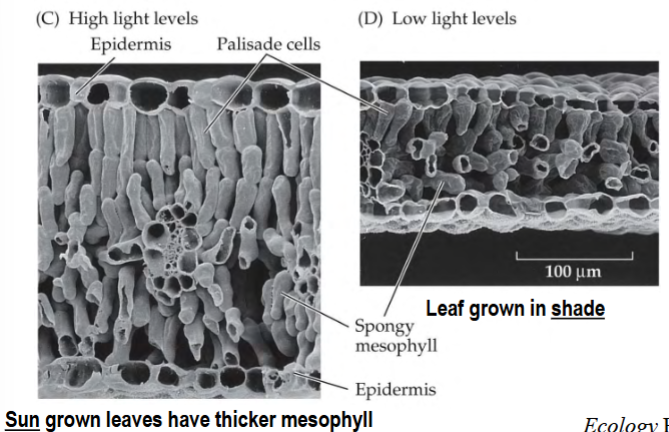
changing leaf thickness
a long-term morphological response (acclimatization) to help regulate light input
done to reduce light penetration → protect delicate membranes inside
sun-grown plants have thicker leaf mesophylls than shade-grown leaves
acclimatization on a light response curve
acclimatization shifts the light saturation point → maximizes photosynthetic efficiency
sun-grown plants will have higher photosynthetic rates at higher light levels than shade-grown plants
shade-grown plants will have higher photosynthetic rates at lower light levels than sun-grown plants
C3 photosynthesis
the mot common type of photosynthesis
named because the first molecule has 3 carbons
many enzymes involved (know Rubisco, the first enzyme)
enzyme
a protein which helps cause a specific chemical reaction to occur, or increases the rate of the reaction
for photosynthesis, know rubisco (the first enzyme in photosynthesis)
some enzymes are specific adaptations found only in species that need them in specific environments
Rubisco
the enzyme that catalyzes the first reaction of the Calvin cycle in C3 photosynthesis
found in all plants and used in all types of photosynthesis
can catalyze 2 competing reactions in a plant: photosynthesis and photorespiration ( depending on if RuBP combines with CO2 or O2)
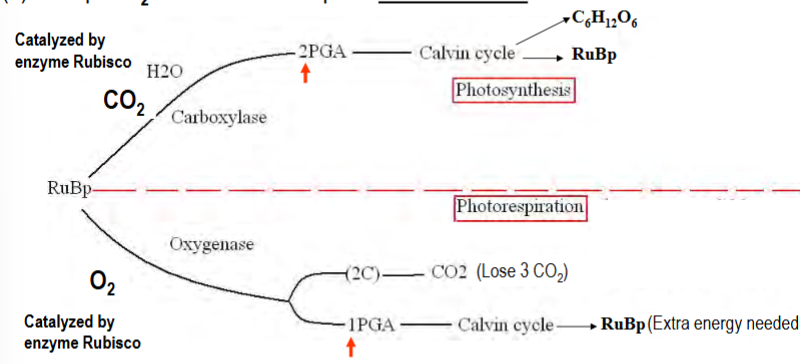
photorespiration
the competing reaction against photosynthesis in a plant
catalyzed by Rubisco
no carbohydrate is produced
results in loss of CO2 to a plant
requires extra energy (ATP) to reform Rubisco
usually unfavorable, but it still happens
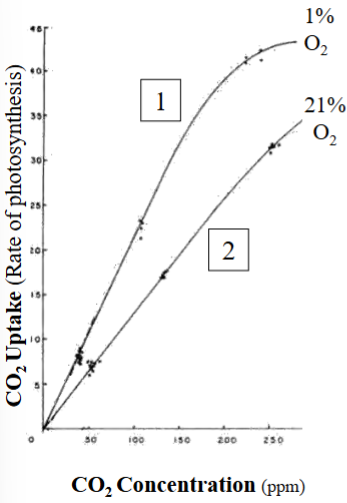
effect of [O2] on photosynthesis rate
at low % O2 (e.g. 1% O2): higher [CO2] → higher CO2 uptake → higher rate of photosynthesis
at higher % O2 (e.g. 21% O2): higher [CO2] → higher CO2 uptake, still, but at a lower rate than at low % O2 → more respiration occurring
more photosynthesis = less respiration (increased plant efficiency)
less photosynthesis = more respiration (decreased plant efficiency)
photorespiration rate change with temperature
at high temperatures, plants close stomata to reduce H2O loss → photosynthesis decreases → photorespiration increases
why does photorespiration still exist?
with exposure to high-intensity light, photorespiration helps dissipate excess energy without damage to photosynthetic membranes, for longer amounts of time (in comparison to photosynthesis)
see slide 35 for experiment details
needed alongside photosynthesis to protect from damage
C4 and CAM photosynthesis
other types of photosynthesis
evolved to improve efficiency under certain environmental conditions
C4 photosynthesis
a type of photosynthesis adapted to reduce photorespiration and reduce water loss in hot environments
spatial separation of where CO2 uptake and processing in the Calvin cycle occurs
uptake always occurs at the leaf surface
processing in Calvin cycle happens in bundle sheath cells, further down in a different cell
seen in lots of grasses, plants in hotter climates
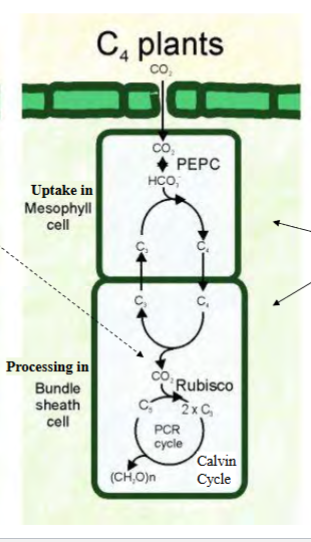
reduction of photorespiration in C4 photosynthesis
Rubisco only occurs in lower tissues, away from surface O2 and CO2
PEPCase is in cells near surface (in mesophyll), only reacts with CO2 to form a 4-C molecule (does not react with O2)
4-C molecule is pumped to bundle sheath cells (more inner) where Rubisco occurs → converted to CO2 to enter Calvin cycle
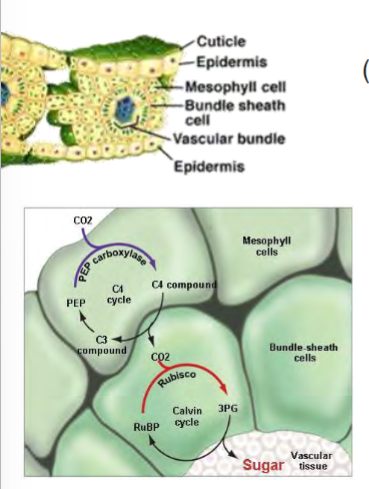
reduction of water loss in C4 photosynthesis
stomata partly close when it’s hot or dry → CO2 intake is decreased
PEPcase can uptake CO2 at a lower concentration compared to Rubisco
photosynthesis can continue despite partly closed stomata and low [CO2]
CAM photosynthesis
a type of photosynthesis adapted to reduce H2O loss in dry environments
temporal separation of when CO2 uptake and processing in Calvin cycle occurs
CO2 uptake and processing in Calvin cycle occur in the same cell
(CAM = cassulacean acid metabolism)
usually occurs in plants in dry environments, are usually succulents or epiphytes (e.g. Spanish moss, bromeliad, pineapple)
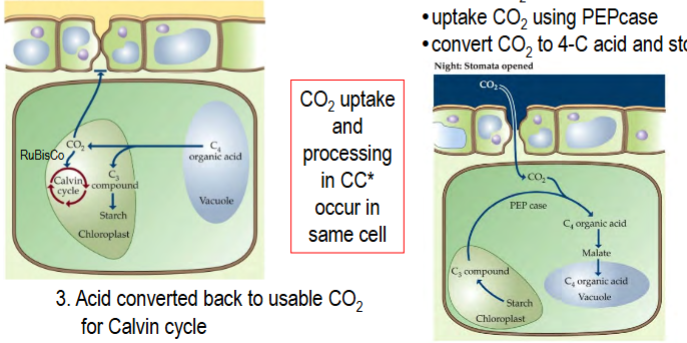
reduction of water loss with CAM photosynthesis (process of CAM)
stomata close during the day (with warm temps and low humidity, so high H2O loss)
stomata open at night (with lower temps and higher humidity, so low H2O loss)
when stomata are open, CO2 uptake happens using PEPcase, converted to a 4-C acid and stored
acid is converted back to usable CO2 the next day using photosynthesis, for the Calvin cycle
why is pineapple sour?
pineapple is a CAM bromeliad
sour because it has acid stored in it
obligate CAM photosynthesis
applies to most CAM plants
they must use CAM, and can only use CAM
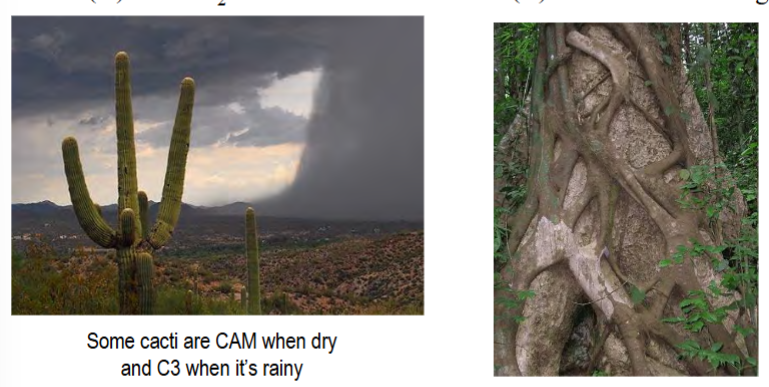
facultative CAM plants
can use CAM, but can switch to C3 when water is abundant or in different life stages
e.g. some cacti use CAM when it’s dry, C3 when it’s rainy
e.g. strangler figs are epiphytes (CAM) when young, switch to C3 when they’re older and they root in the ground
drawbacks to C4 and CAM photosynthesis
additional steps and extra enzyme production require more energy
energy may be saved if plants can cool themselves/prevent water loss without the need for C4 or CAM
in most places, it’s not hot or dry all the time; might be better to use C3 and conserve energy