Big Ahh Chem Exam 3 Flashcard Pack
 Call Kai
 Learn
 Practice Test
 Spaced Repetition
 Match
 Flashcards
 Knowt Play
1/27

Earn XP
Description and Tags
Che 105 UK
28 Terms
Increases left to right on periodic table
Electronegativity, Electron Affinity, Ionization Energy, Effective Nuclear Charge (Zeff)
Most electronegative element?
Fluorine, F
Decreased left to right on periodic table
Atomic Radius
Increases moving down groups on the periodic table
Atomic Radius
Decreases moving down groups on the periodic table
Electronegativity, Electron Affinity, Ionization Energy, Effective Nuclear Charge (Zeff)
4 types of quantum numbers
Principal (n), Angular momentum (l), Magnetic (ml), spin (ms)
What value can the principal quantum number (n) have?
Any positive integer
What value can the Angular Momentum quantum number (l) have?
Range from 0 to n-1
What value can the Magnetic quantum number (ml) have?
Range from -l to +l
What value can the Spin quantum number (ms) have?
-1/2 or +1/2
What types of subshells are there?
S, P, D, F
How many orbitals does the S subshell posess?
1, holds two electrons
How many orbitals does the P subshell posess?
3, holds 6 electrons
How many orbitals does the D subshell posess?
5, holds ten electrons
How many orbitals does the F subshell posess?
7, holds fourteen electrons
Try to memorize the order of subshells

Remember the shape of the S orbital.

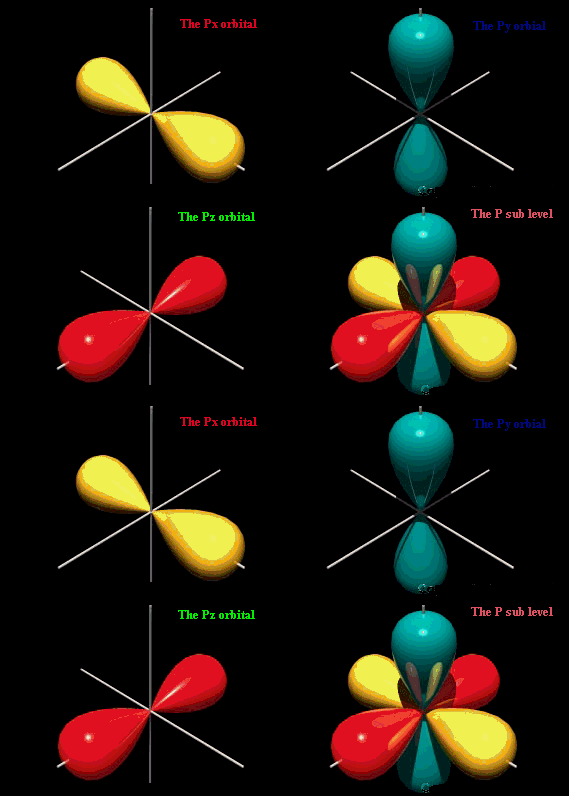
Remember the shape of P orbitals.
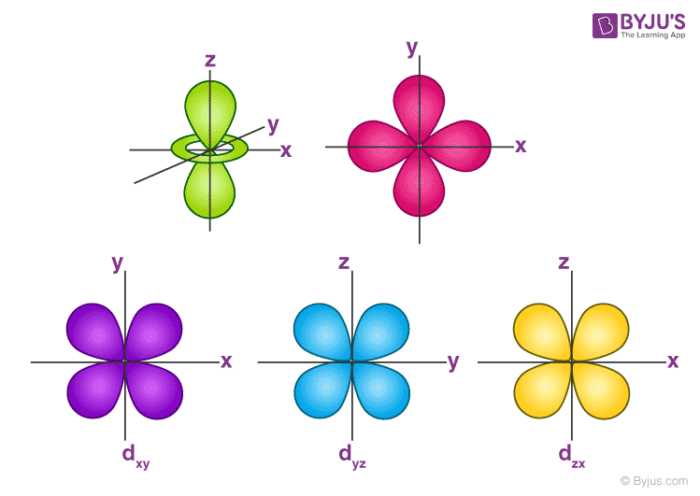
Remember the shape of D orbitals.
Remember the shape of F orbitals.

What is the magnetic state of Aluminum, Plutonium, Uranium, etc?
Paramagnetic
What is the magnetic state of Helium, Carbon, Silver, etc?
Diamagnetic
What is the meaning of Paramagnetic
Substance with unpaired electrons, attracted to magnetic field
What is the meaning of Diamagnetic
Substance with no unpaired electrons, weakly repelled from the magnetic field
Group 1A elements become more _____________ as you move up the group.
Electronegative
Ionic Bond
Polar
Metallic Bond
Nonpolar
Covalent Bond
Can be polar/nonpolar depending on equality of electrons