BCHE Exam 2
 Call Kai
 Learn
 Practice Test
 Spaced Repetition
 Match
 Flashcards
 Knowt Play
1/207

There's no tags or description
Looks like no tags are added yet.
208 Terms
central dogma
In 1958, Francis Crick enunciated this
scheme outlined the residue-by0residue transfer of biological information
DNA → RNA → Protein
RNA transcription location
occurs in same place where DNA is in the cell
Prokaryotes: cytoplasm
Eukaryotes: nucleus
RNA transcription
catalyzed by the enzyme RNA polymerase
(RNA)n residues + ribonucleoside triphosphate → (RNA)n+1 residues + Ppi
synthesis is from 5’-3’ direction
synthesis is driven forward by the hydrolysis of pyrophsophate
no helicase is needed because RNA polymerase can unwind DNA
RNA polymerase requirements
template (single/double stranded DNA)
Active precursors (ATP, GTP, UTP, CTP) are required
Divalent metal ion (either Mg2+ or Mn2+)
transcription steps
binding of RNA polymerase holoenzyme at promoter sites and initiation of polymerization
chain elongation
chain termination
RNA transcription step 1
Binding of RNA polymerase and initiation
RNA polymerase, with the help of transcription factors, bind to a specific sequence within the gene (promoter) and pries the 2 strands apart
promoter
DNA sequences that initiates the transcription of a gene by RNA polymerase
2 consensus elements
Pribnow Complex
TTGACA sequence
divalent metal ion
RNA polymerase requirement
either Mg2+ or Mn2+
switches roles in synthesis and degradation
one ion remains tightly bound to the enzyme, whereas the other comes in with the nucleoside triphosphate and leave with pyrophosphate
sigma subunit
allows RNA polymerase to initiate RNA synthesis from specific bacterial promoters
recognizes promoter sequence on DNA
alpha subunit
Subunit of RNA polymerase
for assembly and for activation of enzyme
beta subunit
Subunit of RNA polymerase
binds DNA
beta prime subunit
Subunit of RNA polymerase
binds NTP’s and interacts with sigma subunit
omega subunit
Subunit of RNA polymerase
helps in maintaining the plasticity of the active site of RNA polymerase
RNA polymerase
holoenzyme = core enzyme + sigma factors
unwinds the 12 pairs of DNA (locations +2 and -10) relative to transcription start sites
Does not need a primer, it starts mRNA synthesis at start codon and moves downstream along the gene
zips DNA back up as it goes, keeping only 10-20 bases exposed at a time
consensus sequence
can be defined as the bases appearing with the highest frequency at each position when a series of sequences with a common function are compared
aligns the “-10 regions” of 100 genes
includes the most common bases at each position
the more closely a promoter matches this, the better the polymerase binds and the more transcription occurs for that promoter
elongation
step 2 of RNA transcription
one of the strands will be template (antisense) and a sense strand
RNA polymerase starts at start codon and moves downstream along the gene
once RNA polymerase reaches end of gene, termination occurs
once RNA polymerase binds to promoter, RNA polymerase unwinds the DNA to create a transcription bubble (12-15 nucleotides long)
rate is 20-50 nucleotides per second
2A: aminoacyl tRN awill be loaded onto the A site
carries anticodon and carries a GTP and EF “tu” (prok) or IA in (euk)
2B: peptide bond forms between 2 amino acids
peptidyl transferase forms bond (located within ribosomal subunit)
2C: ribosome advances 3 nucleotides towards teh 3’OH end of mRNA (Translocation)
energy consuming process; prok: EFG and euk: eEF2 with GDP
following the unloaded tRNA on P-site is moved to E site ( A site is empty and ready for new aminoacyl-tRNA
RNA polymerase binding sites
binding sites for NTP’s
initiation site
binds purine nucleotides (ATP and GTP)
elongation site
accepts all 4 subunits
termination
3rd step in RNA transcription
once an oligonucleotide of 10 residues long has been formed, the sigma subunit dissociates from RNA polymerase, signaling the completion of initiation
Results in: the formation of a phosphodiester bond ceases, the RNA-DNA hybrid disscoiates, unwound region of DNA rewinds, and RNA polymerase relases the DNA
stop codons appear on A site of the ribosome
Prokaryotes
RF1: recognizes UAG and UAA
RF2: recognizes UGA
Eukaryotes: RF recognizes all stop codons
as soon as stop codon appears on A site, the RF is recruited to the A site and hydrolyses the bond which links the peptide chain and tRNA and releases the nascent protein
releasing the RF after is done by RF3
complex dissociates and can be reused for synthesizing another peptide chain
palindromic regions
signals RNA polymerase to STOP transcription
GC rich regions followed by AT regions
hairpin structure
RNA-DNA hybrid helix produced after hairpin is unstable because of rU-dA base pairs
the pause of transcription permits the weakly bound nascent RNA to dissociate from DNA template
DNA template rejoins and re-forms DNA duplex
rho factor mechanism
less common mechanism for termination
advances in the 5’-3’ direction until it reaches transcription bubble
rho factor recognizes and bits to C-rich region in RNA complex
rho factor
ATP-dependent molecule that catalyzes the unwinding of RNa:DNA hybrid helixes
participates in another mechanism (less common) for RNA transcription
rifampicin
type of antibiotic
inhibits initiation by binding to the polymerase and blocking the exit of nascent RNA
actinomycin
type of antibiotic
intercalates between the bases of the DNA double helix, preventing the DNA from being used as a template
eukaryotic transcription
much more complex than prokaryotic
cells contain membrane bound organelles that allow for spatially and temporally separated steps
influenced by:
nuclear membrane
complex transcription regulation
RNA processing
can continue after death (usually developmental genes; occurs due to genes transcribing at different times after death) ; usually lasts only 30 minutes
compartmentalization
allows the control of many different function with greater efficiency within the same cell by concentrating the required components in a confined space and segregating them from the rest of the cell
nuclear membrane
separates the site of RNA synthesis from protein synthesis—-the spatial and temporal separation allows for regulated gene expression
messenger RNA
5% of total RNA
template for protein synthesis or translation
transfer RNA
carry amino acids in the activated form of the ribosomes for peptide bond formation
15% of total RNA
ribosomal RNA
major component of ribosomes (80%)
Prokaryotes:
23S
16S
5S
Eukaryotes
28S
18S
5.8S
RNA polymerase 1
location: nucleolus
cell transcripts: 18S, 5.8S, 28S rRNA
a-amanitin effect: insensitive
in eukaryotes
Promoters
rlnr + UPE
RNA polymerase 2
location: nucleoplasm
cell transcripts: mRNA precursor and snRNA
a-amanitin effect: strongly inhibited
in eukaryotes
most specific type of RNA polymerase
Promoters
enhancer element + rlrnr + consensus sequence (TATA) [-30 to -100] OR downstream promotor element (DPE) [+28 to +32]
RNA Polymerase 3
location: nucleoplasm
cell transcripts: tRNA and 55rRNA
a-amanitin effect: inhibited by high concentrations
in eukaryotes
Promoters
Type 1 in 5S rRNA with short conserved (A and C block)
Type 2 in tRNA with A and B block
a-amantin
acyclic octapeptide
produced by mushroom Amanita phalladides
“destroying angel” mushroom
highly specific to study and manipulate gene expression by selectively inhibiting RNA polymerase 2
strongly inhibits mRNA (no mRNA precursors → no protein gene expression)
RNA polymerase 1 is resistant
RNA polymerase 2 is very insensitive
RNA polymerase 3 is less sensitive
rlnr
promotor sequence for rDNA that is located in the ribosomal initiator element
help in RNA polymerase 1 and 2
UPE
upper promotor element
150-200 base pairs from the start site
RNA polymerase 2 promoters
major elements
TATA box- [-30 and -100] upstream of initiation site
Initiator element (lnr)- [ -3 and +5bp] and often paired with the TATA box
Downstream core promoter element (DPE)- [+28 and +35bp], works in cooperation wiht lrn when TATA box is absent
CAAT box and GC box- [-40 and -150]. GC box is common in genees that are conitnuously expressed
general transcription factors
GTF
help RNA polymerases find the promoter and initiate RNA synthesis
required to form basal transcription complex (interact with promoters)
basal transcription complex steps
binding the TATA box sequence by a transcription factor called the tATA-binding protein or TBP
when bound, the DNA bends at this points and takes on the structure suitable for binding additional transcription factors and RNA polymerase
binding a general TF called TFIIH
works as a helicase and kinase (adds phosphates to the C-terminal domain of the RNA polymerase)
5’ end cap
before mRNA transcript gets moved, the end gets a cap containing modified guanosine nucleotide
guanlyl transferase helps to added GTP to the 5’end of the transcript to form 5’-5’ triphosphate linkage
once guanine is attached the methyl transferase enzyme attaches the methyl group to the guanine nucleotide (5’end cap)
functions
protection from some nucleases
enhanced translation
enhanced transport from nucleus
essential step in mRNA maturation
splicing
occurs only in eukaryotes
the editing of a newly made RNA transcript to remove non-coding sections and join protein-coding sections together
introns
noncoding regions that interrupt the coding information (exons)
alternative splicing
a regulated gene expression process that allows a single gene to code for multiple unique protein variants by selectively including or excluding specific segments (exons) of pre-mRNA
splice sites
introns beginning with GU and ends with AG
consensus sequence at 5’end- AGUAAGU
consensus sequence at 3’end- 10 pyrimidine (U or C) followed by any base and then by C and AG
internal site located between 20-50 nucleotide upstream of the 3’splice site; branch site
splicing mechanism
cleavage of phosphodiester bond- between exon 1 and exon 5 of intron
attacking group is 2’OH of adenylate on branch site
2’-5’ phosphodiester bond is formed between A residue and 5’ phosphate and generates free 3’OH and exon 1- transesterification 1
lariat intermediate
3’OH of exon 1 attacks phosphodiester bond between intron and exon 2- transesterification 2
exon 1 and 2 join and lariat form of intron is released
polyadneyaltion of primary transcript
cleavage stimulation factor
cuts the mRNa to create a new, specific 3’ end
cleavage and polyadenylation specificity factor
with poly A tail; add 100-200 adenine containing nucleotides to the new 3’end
poly A tail
helps maintain the stability of mRNA molecules
help move mRNa out of the nucleus
protects the mRNa from exonuclease digestion
catalytic RNA
RNA molecules that can catalyze chemical reactions
can splice itself under certain conditions
requires an added guanine nucleoside
ex: rRNA precursor from tetrahymena splices itself in the presence of a guanosine cofactor
translation
process of reading the information in mRNA to create a protein
translating the language of nucleotide sequences to amino acid sequence
Euk: occurs in cytoplasm
Prok: occurs in cytoplasm
genetic code
the sequence of nucleotide bases in a gene, which specifies the sequence of amino acids in a protein
3 nucleotide base group (triplet) codes for an amino acid
codons are always read from from 5’ to 3’
first base (5’) second base, third base (3’)
3 stop codons (code has meaning); most amino acids are encoded by more than one codon, 61 codons code for only 1 amino acid
codon
a sequence of 3 nucleotides in mRNA that specifies a particular
translation steps
initiation
elongation
termination
translation initiation
transitional complex forms and tRNA brings first amino acid in polypeptide chain to bind to start codon on mRNA
key components
mRNA with codons that will be translated
Ribosomes
Prok : 70S (30S and 50S)
Euk: 80S (60S and 40S)
tRNA- carries amino acid binding site and anticodon
prok-fMet (key signal to identify
GTP required for teh assembly (for energy)
a set of soluble proteins- initation factors labeled as IF for prokaryotes ; eIF (euk)

translation elongation
tRNA brings amino acids one by one to add to polypeptide chain
components:
initiation complex (mRNA: Ribosomal subunits- 30S and 50S (70S Prok); 60 and 40S (80S euk); tRNA (amino acid binding site and anticodon)
aminoacyl tRNA-tRNA carrying amino acids (amino acids are activated: amino acid attached to tRNA
guanosine triphosphate (GTP): required for assembly
a set of soluble proteins: elongation factors and release factors (termination)

translation termination
release factor recognizes stop codon, translational complex dissociates, and completed polypeptide is released

aminoacyl site
A site on a ribosome
acceptor site or attachment site for incoming amioacyl-tRNA

peptidyl site
site on ribosome
P site
occupied by peptidyl-tRNA; tRNA growing polypeptide chain

Exit site
site on a ribosome
E site
unloaded/deacylated tRNA—occupies prior to exiting ribosome
mRNA recognition and alignment
for mrNa to be translated accurately, its sequence of codons must be brought into proper position on small ribosomal subunit
Prok: Shin Dalgarno sequence—Marks the start of each coding sequence, letting the small ribosomal subunit find the right start codon at each gene
Euk- eIF-4 binds the 5’cap of mRNA and helps correctly bind the 40S
tRNA
single chain containing 73-93 ribonucleotides
L-shaped molecule
contain unusual bases- methylated or dimethylated derivatives of A, U, C, or G
½ of nucleotides are base paired to form double helices except 5 groups of bases
5’ end is phosphorylated- 5’ residue is pG
3’ CCA group has amino acid attachment site (activated amino acid is attached to hydroxyl group)
Anticodon loop, making accessible the 3 bases that constitute the anticodon
initiation complex in prokaryotes
set of initiation factors bound to tRNA
prok (IF-2-GTP)
euk: (eIF-2-GTP)
formation of complex: small ribosomal subunit, mRNA , initiator tRNA (forms pre-initiation complex)
initiator tRNA carries GTP and undergoes hydrolysis to release GDP and inorganic phosphate
the energy released from the hydrolysis of GTP is utilized to attach large ribosomal subunit to the pre-initiation complex to form the complete initiation complex
activation for protein synthesis
adenylation
transfer of aminoacyl group of aminoacyl AMP to tRNA
adenylation
aminoacyl-tRNA syntheses enzyme transfers AMP group onto the carboxyl group to form aminoacyl AMP molecule
amino acid + ATP → (aminoacyl-tRNA synthase)aminoacyl-AMP +PPi
step 2 transfer
in activation of protein synthesis
AMP from aminoacyl-AMP is released forming aminoacyl-tRNA
transfer at the 3’Oh group of ribose → creates aminoacyl-tRNA
2 ATP molecules are consumed in the synthesis
tRNA carrying its cognate amino acid is “charged”
Aminoacyl-AMP + tRNa → aminoacyl-tRNA + AMP
aminoacyl-tRNA synthetase
at least 1 is available for each amino acid (20 enzymes)
activate amino acids- highly discriminating amino acid activation sites
can proofread with additional functional sites to bind and correct its mistakes
divided into 2 classes
class 1
class 2
class 1
type of aminoacyl-tRNA synthetase
attaches the carboxyl of their target amino acid to the 2’OH of the termianl adenosine
class 2
type of aminoacyl-tRNA synthetase
attaches the carboxyl of their amino acid to the 3’OH of adenosine
formation of initation complex
small ribosomal subunit is needed, which is attached to IF, mRNA , and initiation tRNA → forms pre-initation complex
initiator initial tRNA carries GTP and undergoes hydrolysis to release GDP and inorganic phosphate
IF is releaed
energy released from GTP hydrolysis is utilized to attach the large ribosomal subunit to form
euk: tRNa carrying MET attaches to small ribosmal subunit
together, they bind 5’ end of mRMNA by recognizing the 5’GTP (then walk along mRNMa until start codon)
prok: shine Dalgaro sequence marks start of coding sequene (fMET)
streptomycin
type of antibiotic (prok)
binds 30S ribosomal subunit
inhibits formation of initation complex
tetracycline
type of antibiotic (prok)
30S ribosomal subunit
inhibits the loading of aminoacyl-tRNA on A site
puromycin
type of antibiotic (euk and prok)
resembles tRNA incorporated during peptide chain elongation
inhibits formation of peptide chain
chloramphenicol
type of antibiotic (prok)
inhibits enzyme peptidyl transferase
no peptide bond formation
clindamycin and erythromycin
type of antibiotic (prok)
50S ribosomal subunit
inhibits translocation of ribosome toward 3’end of mRNA
diptheria toxin
type of antibiotic (euk)
binds to eEF
inhibits translocation of ribosome toward 3’end of mRNA
gene regulation
process by which cells control the expression of genes, including when, where, and how much a gene is expressed
prokaryotic gene regulation
needed to efficiently adapt to environmental conditions
allows them to conserve energy by only producing proteins needed a particular time [maximizes survival]
operon
group of genes that are transcribed together into a single mRNA molecule
functioning unit of DNA consisting of DNA containing a cluster of genes under the control of a single promotor

operon components
promoter
operator
structural genes

operon promoter
a nucleotide sequence that enables a gene to be transcribed
is recognized by RNA polymerase, which then initiates transcription
operator
a segment of DNA between the promotor and genes to which a repressor binds
structural genes
the genes that are co-regulated by the operon
repressor protein
physically obstructs the RNA polymerase from transcribing genes
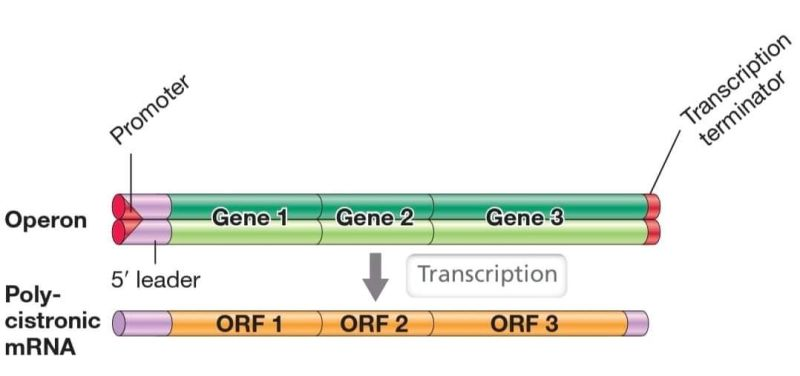
polycistronic mRNA
“many” DNA segments that codes for a polypeptide
the promoter that directs synthesis of 1 mRNA that can be translated to more than 1 polypeptide
single RNA transcript that encodes multiple polypeptides
pattern of organization allows all genes in operon to be regulated through transcription into the single polycistronic RNA encoding all metabolic pathways
b-galactosidase
has bifunctional activity
hydrolyzes lactose to galactose and glucose
catalyzes the intramolecular isomerization of lactose to alloctose (lac operon inducer) consisting of galactose and glucose-b1-6 glycolytic linkage
lactose availability induces the synthesis of this by activating the transcription of lac operon

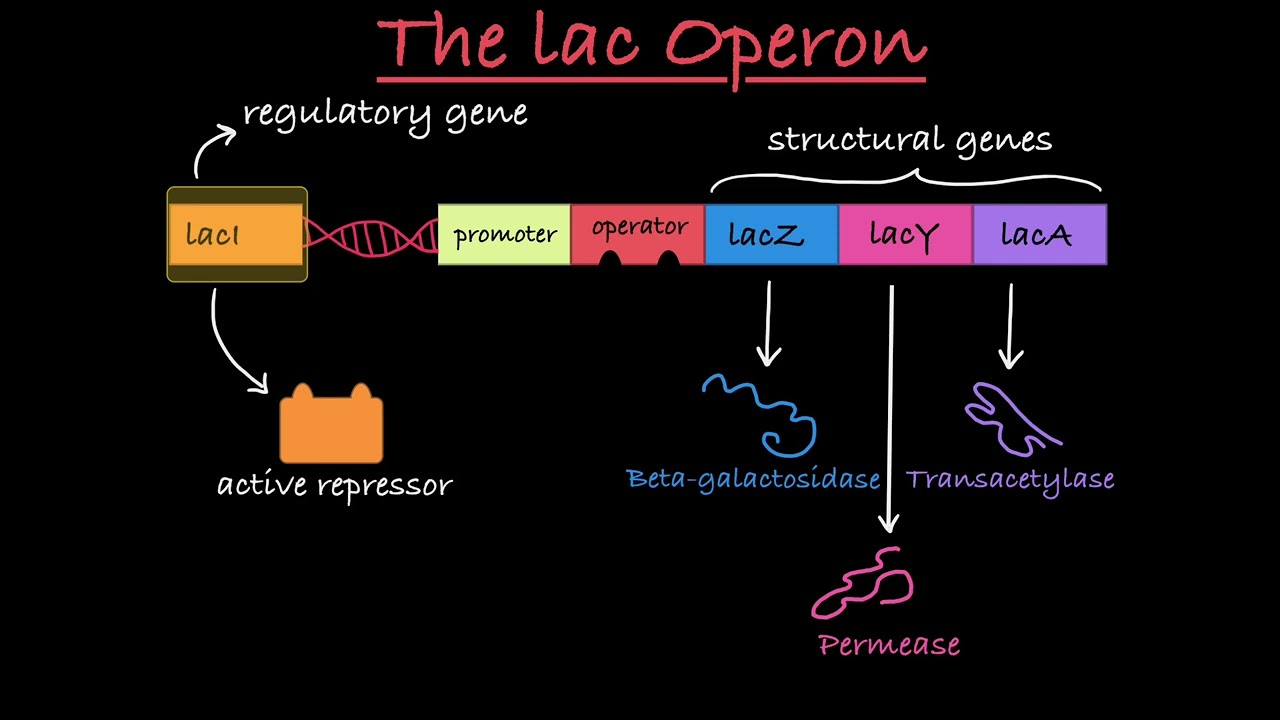
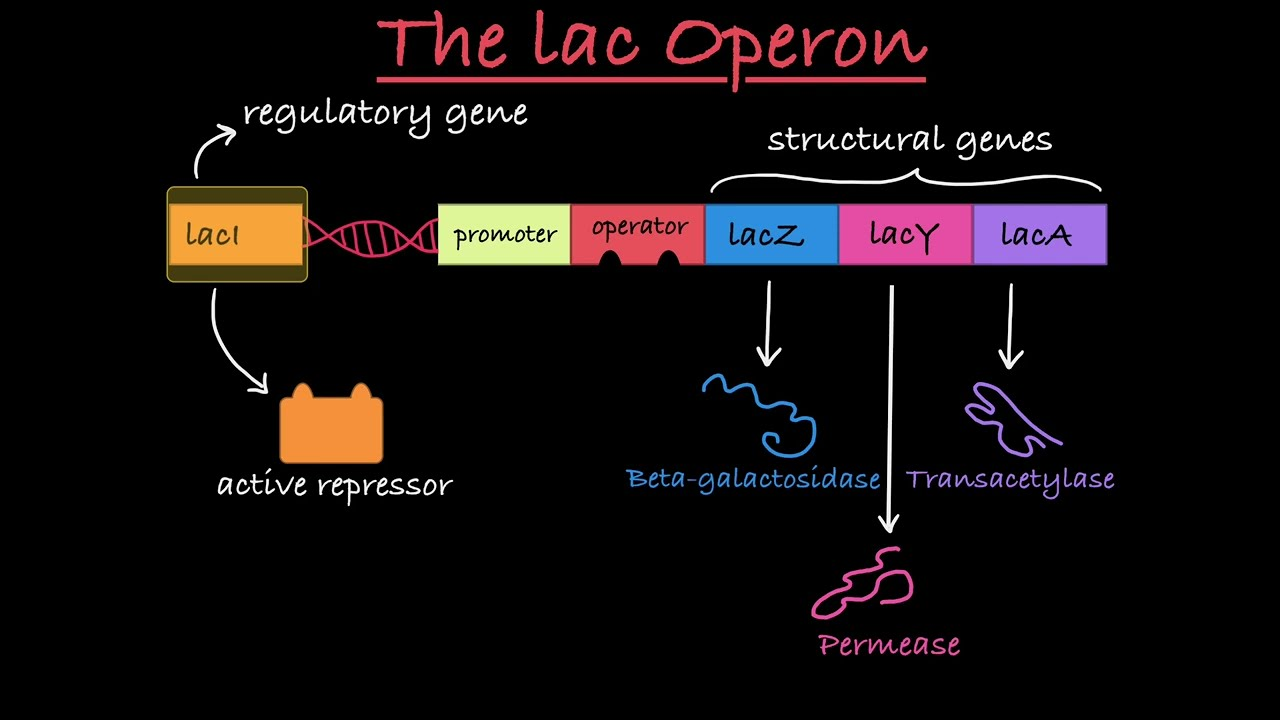
regulator gene
(i)
component of lac operon
produces repressor to bind to operator

lac operon promoter
helps bind RNA polymerase and transcribe all 3 genes

lacZ
gene on lac operon
encodes for B-galactosidase
function: splitting lactose into readily usable glucose and galactose
lacY
gene on lac operon
encodes for: permease
function: transmembrane “pump” that allows cells to import lactose

lacA
gene on lac operon
encodes for transacetylase
function: transfers an acetyl group from acetyl-CoA to galactosides, lactosides, glucosides; uptake of lactose
absence of allolactose
lac operon model without inducer
repressor binds to operator region and prevents RNA polymerase from transcribing the operon
partially covers promoter
when lactose is not available, the lac repressor binds tightly to operator, preventing transcription by RNA polymerase
presence of allolactose
lac operon model with inducer
lac repressor loses its ability to bind to DNA
it floats off operator, clearing the way for RNA polymerase to transcribe operon
presence of lactose turns on transcription by removing lac repressor
glucose
if this is present in the environment, bacteria will try to take it (easiest form of energy)
take it over lactose
no glucose, high lactose
low glucose leads to cAMP production
cAMP attaches to CAP, allowing it to bind DNA
CAP helps RNA polymerase bind to the promoter
high levels of transcription
high glucose, high lactose
when glucose is high, no cAMP is produce
CAP cannot bind DNA without cAMP
Low levels of transcription
CAP
catabolite activator protein
binds to region of DNA right before promoter and helps RNA polymerase attach to promoter
driving increased levels of transcription
lac operon
under second layer of control and cannot be turned on by lactose if sufficient glucose is present
glucose is better energy source than lactose
type of catabolite repression
exerted through 2nd messenger (AMP and positive regulator protein (CRP))
Inducible Operon- turns ON in presence of lactose
tryptophan
bacteria need amino acids to survive and build proteins
if this amino acid is not present, they will make their own by using enzymes encoded by 5 genes
acts as a co-repressor—binding to trp repressor and inhibiting transcription when abundant
if it is available, bacteria will take it up and build proteins
trp operon
encodes a leader peptide sequence (trpL) and 5 polypeptides, trpE and trpA
the 5 polypeptides comprise of 3 enzymes and catalyze the formation of tryptophan from chorismate
goal: to synthesize tryptophan
repressible operon- turns OFF in response to tryptophan
negatively controlled by level of its product; tryptophan