motor development & cognition in infancy
 Call Kai
 Learn
 Practice Test
 Spaced Repetition
 Match
 Flashcards
 Knowt Play
1/16

There's no tags or description
Looks like no tags are added yet.
17 Terms
motor development stages

motor development
early motor movement is impaired by poor muscle strength
and by under-developed motor coordination
locomotion begins to emerge by the mid-point of the first year
changes in motor development have major consequences for cognition - particularly notable for crawling
acquiring the ability to move unaided bring concurrent improvements in memory (Herbert et al., 2007)
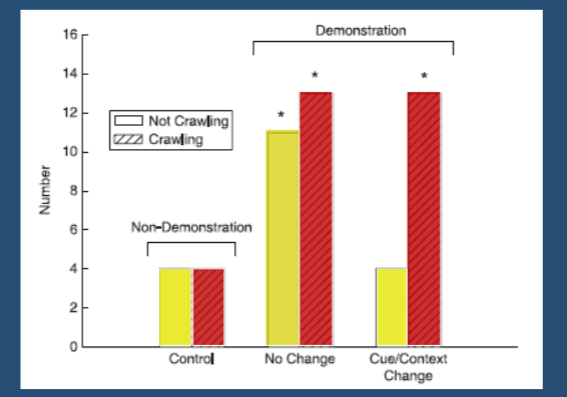
motor development and memory - Herbert, Gross & Hayne, 2007
9 month olds were tested on an infant memory task
half the children were able to crawl at time of testing and half were not
crawling = the ability to traverse at least one meter using arms and/or knees
infants were shown how to play with a novel toy
toy had a specific novel action associated with it
results
both crawling and non-crawling infants could remember the target action
only crawling infants were able to retrieve that memory in a new context
this difference between crawlers and non-crawlers can’t be due to age since the two groups were the same age
= increased memory flexibility
crawling → walking
age of onset of crawling = 8 months generally but varies form 5-11
change from crawling to walking requires muscle development, different patterns of limb coordination and balance control
why walk > crawl?
covers space quicker
gives access to more distant objects
allows different interaction with others
affords better visual input
walking study
Kretch, Franchak & Adolph, 2014
perception vs cognition
perception = how we see, hear or directly experience the world
cognition refers to how we form, use and act upon internal thoughts and states - ‘mental representations’
studying cognition in infants involves understanding the content of their mental representations of the world
object permanence
the ability to understand that even if an object can no longer be seen, it still continues to exist
Piaget - prior to 9 months, infants made no response to an object after it was hidden
around 9 months - infants are able to search for objects that are out of view - suggests the can act on basis of though, rather than just perception
A not B task
infants around 9 months persist in reaching to the old location, even though they have seen where the object is
the object is hidden while they are watching - no deception
by around 12 months, infants reach correctly to the new location
violation of expectation tasks
children shown an event repeatedly until they habituate
then shown one of two variations of the same event
if they look at one event for longer, it suggests they’re surprised by it i.e. violated their expectation
studying object permanence using the violation of expectation paradigm leads to surprising findings
Baillargeon (1986)
presented series of events to 6 and 8 month olds
looked longer at impossible event than the possible event
suggests that infants have object permanence because they seem to know the block continues to exist even when out of sight
replicated with 4 month olds - block hidden when truck passes it - to be surprised by this, you have to know that the block still exists
infants seem to regard to possible and impossible events as importantly different
explaining discrepant findings
appears that children have knowledge of world from early in infancy
but that they only become gradually able to act on that knowledge
cog.dev. in the first year of life involves building inks between their knowledge and their actions
infant cognition: number
there are two ways in which infants demonstrate understanding of number
precise understanding of very small numbers
approximate understanding of larger numbers
counting in infants
classic use of VofE task was to test what infants understand about number
4 and 5 month olds were shown an event where objects were moved behind a screen, and the screen was the removed
the event was either possible or impossible
results
4 and 5 month olds looked longer at the impossible event (Wynn 1992)
its not that they look longer when there ends up being two things or one thing
or when something appears or disappears
their expectation appears sensitive to number
infants looked longer at a ‘1+1=3’ impossible event rather than at a ‘1+1=2’ event - suggests that they have a more precise sense of number than just ‘there should be more than one
approximate number system
infants also possess system for estimating large quantities
a primitive mental system of non-verbal representation of number
allows broad comparisons of quantity
does not allow for the representation of specific numbers, only of ratio quantities (Feigenson, Libertus & Halberda, 2013)
seen across a range of species, as well as in young infants
in humans, acuity of ANS improves with age
- 6 months: 8 vs 16
- 10 months: 6 vs 10
- adult: 7 vs 8
