Infectious Diseases Week 8
 Call Kai
 Learn
Learn Practice Test
 Spaced Repetition
 Match
Match Flashcards
 Knowt Play
1/185

There's no tags or description
Looks like no tags are added yet.
Name | Mastery | Learn | Test | Matching | Spaced | Call with Kai | Chat |
|---|
No analytics yet
Send a link to your students to track their progress
186 Terms
What family do coronaviruses belong to
Family Coronaviridae
When were coronaviruses first identified
In the 1950s
What are the viral properties of coronaviruses
Enveloped
SSRNA (+)
~31 kb – among the largest known RNA viruses
How long did it take to identify the host receptor for SARS-CoV
10 years
How long did it take to identify the host receptor for MERS-CoV
1 year
How long did it take to identify the host receptor for SARS-CoV-2
2 months


how many coronavirus strains can infect humans and cause mild to severe disease
7
when and where was SARS-CoV identified
March 2003 in Guandong province, China
How many cases and deaths did SARS-CoV cause
8,096 cases and 774 deaths (9.6% case fatality rate)
When was SARS-CoV contained
July 2003
How was SARS-CoV contained
Through regular containment measures – e.g., travel restrictions, quarantine, self-isolation
Is there a vaccine or antiviral available for SARS-CoV
No vaccine or antiviral available
What are the reservoirs for SARS-CoV
bats and civets
How many SARS-related coronaviruses have been discovered in bats
50+ SARS-related coronaviruses
What does MERS stand for
Middle East respiratory syndrome coronavirus
When and where did MERS-CoV emerge
In the Middle East in 2012-2013
How many people did MERS-CoV infect
Approximately 2.6K infections in 27 countries (943 deaths)
Where did MERS-CoV spread
Within the Middle East, with a small number of cases in Europe and the UK due to travel. South Korean outbreak in 2015
What does MERS-CoV cause
Acute respiratory infection/respiratory distress
Is there a vaccine or antiviral treatment for MERS-CoV
No vaccine or antiviral treatment developed
What are the reservoirs for MERS-CoV
Dromedary camels and bats
What receptor does MERS-CoV bind to
CD26 (also known as DPP4 receptors)
Does MERS-CoV bind to ACE2
No. MERS-CoV does not bind ACE2 (which is the SARS-CoV receptor)
What does the MERS-CoV RBD domain require
The specific receptor CD26/DPP4
When and where was SARS-CoV-2 (COVID) identified
End of 2019 Wuhan China
what was SARS-CoV-2 originally designated
2019-nCoV
How many cases were there worldwide by 2024
>776M cases worldwide (12M in Australia)
Does SARS-CoV-2 spread outside of the lung
Yes. It appears to spread outside of the lung – e.g., ocular transmission
What other clinical symptoms can SARS-CoV-2 cause
Blood clots, stroke, diabetes, cardiac injury, liver damage, kidney failure, skin rashes
Are there vaccines and antiviral treatments for SARS-CoV-2
Yes. Vaccine and antiviral treatment developed
What is the reservoir for SARS-CoV-2
Currently unknown, but bats and pangolins are thought to be involved
What is the spike protein of SARS-CoV-2 coated in
Sugar molecules, or glycans
What do the glycans do
Disguise the spike protein from the immune system
How many points can the spike protein hinge at on the stalk
Three points – giving it flexibility
What are the regions of the spike protein
Receptor-binding domain
S1 subunit
S2 subunit
stalk (with hip, knee, and ankle regions)
glycan coating

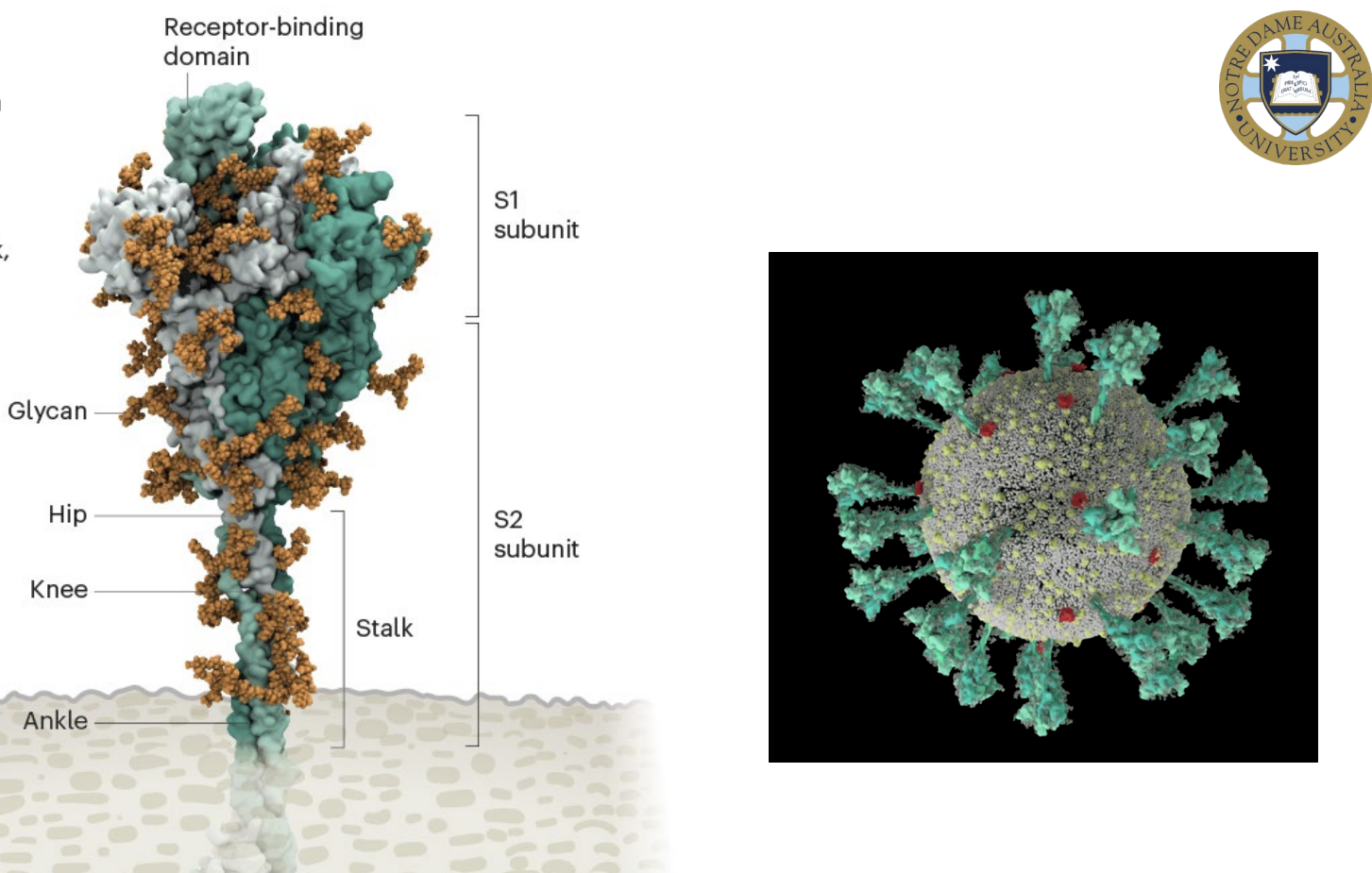
What does the SARS-CoV-2 spike protein bind to on the host cell
ACE2 (angiotensin-converting enzyme 2)
What enzyme cleaves the spike protein
TMPRSS2 (host molecule)
What does TMPRSS2 cleavage expose
Parts of the spike that fuse the viral membrane with that of the host
What happens after the spike protein is cut
The spike glycoprotein folds back onto itself, like a zipper, forcing the viral and cell membranes to fuse
What hydrophobic amino acids are exposed
Hydrophobic amino acids in the spike that rapidly embed themselves into the nearest membrane – that of the host cell


What happens in Stage 2 of SARS-CoV-2 life cycle: Inside the cell
Viral RNA is translated into non-structural proteins (NSPs) that quickly suppress the translation of host messenger RNAs in favour of those belonging to the virus
What happens in Stage 3: Remodelling the cell
The virus transforms the cell's ER into bubble-like structures called double-membrane vesicles (DMVs). These might provide a safe haven for more viral RNA to be replicated and translated
What happens in Stage 4: Exit
Once the newly made molecules assemble into a complete virus particle, it leaves the cell through an organelle called the Golgi apparatus, or perhaps through lysosomes
What happens in Stage 5: The last slice
A host enzyme named furin makes a crucial cut at a site of five amino acids on the spike protein. This prepares the virus to strike another cell
Do variants have a higher proportion of snipped spike proteins
Yes. Variants have a higher proportion of snipped spike proteins, helping them to infect cells more efficiently
What do SARS-CoV-2 infected cells create
Large multinucleated respiratory cells (syncytia) filled with up to 20 nuclei
What was generated to identify the host receptor for SARS
Pseudoviruses
What vector was used
Vesicular stomatitis virus (VSV) vector
What are 293T cells
Epithelial-like cells isolated from the kidney of a patient
What does the pseudovirus system encode
The spike protein, and the virion proteins to form a mature virus except the env genes
Why can't mature virions be formed
The absence of Env gene expression means that mature virions cannot be formed
What was shown to be the natural reservoir for SARS
Chinese horseshoe bats
How long after the epidemic was the receptor for SARS discovered
10 years
What does the SARS viral spike protein bind to
Angiotensin-converting enzyme 2 (ACE2)
Where is ACE2 expressed
On endothelial cells of the lower respiratory tract
What does SARS use for S protein priming
the cellular serine protease TMPRSS2
What did the immunofluorescence assay show
Human, civet, and bat ACE2 all support SARS-CoV infection, while control cells with no receptor show no virus
What percentage amino acid identity do SARS-CoV and SARS-CoV-2 share
Approximately 76%
What receptor do both SARS-CoV and SARS-CoV-2 use
ACE2
What protease primes the spike protein for both viruses
TMPRSS2
What is the neutralisation efficiency by SARS convalescent sera for SARS-CoV vs SARS-CoV-2
High for SARS-CoV
Moderate for SARS-CoV-2
What is the cross-reactivity between SARS-CoV and SARS-CoV-2
weak
What is VSV and what does it mean that it is pantropic
Vesicular stomatitis virus – a pantropic virus can infect a wide range of cell types.
Do SARS and SARS-CoV-2 spike proteins facilitate similar patterns of viral uptake in human cell lines
yes – similar patterns in human cell lines but not so much in animal cell lines
What does this suggest about the virus
The virus must have a preference for the human receptor – adapted for human transmission
What cells were used to test receptor specificity for SARS CoV-2
BHK21 cells
What did BHK21 cells lack
A suitable receptor for SARS or SARS-CoV-2
What happened when BHK21 cells were transfected with human or bat ACE2
SARS and SARS-CoV-2 were taken up
What receptor does MERS bind to
hDPP4 (CD26)
Can MERS bind to ACE2 or APN
no
What receptor does 229E-S use
hAPN
Can 229E-S use hACE2 for viral infection
no
What happened when anti-hACE2 antibody was added
SARS and SARS-CoV-2 were inhibited in a dose-dependent manner
What did the native SARS-CoV-2 virus experiment confirm
That SARS-CoV-2 uses hACE2 as its receptor
Why is knowing the receptor important
It guides development of antiviral therapeutics:
(i) Design drugs that target receptor entry
(ii) Vaccine targets
What is the incubation period
The interval between exposure to an infectious agent and the appearance of the first symptoms of the disease
What is the prodromal period
The time when the pathogen has yet to cause disease and onset of first symptoms (fatigue, malaise, mild fever)
What is the illness period
The acute period when disease symptoms are at their peak
What is the decline period
Once symptoms begin to subside
What is the convalescence period
The last period of disease progression where the individual regains strength and returns to normal health
What is incidence
Measures the number of new cases of a specific disease that develop in a population in a specified time period
What is prevalence
Measures the proportion of a population who have a specific disease in a given time period, regardless of when the disease first developed
What symptoms are shared between flu and COVID-19
Fever, cough, fatigue – early symptoms are shared among a number of respiratory infections
What are the complications of flu
Less likely to occur because of immunity built up over time
What are the complications of COVID-19
Severe respiratory complications may come on extremely quickly; gastrointestinal symptoms, clotting → stroke, diabetes, inflammatory skin lesions
What did the SARS-CoV-2 virus cause
A respiratory infection that led to significant acute respiratory distress
What happened in the lungs of infected patients
Fluid accumulated within the lungs, making it difficult to breathe due to reduced oxygen exchange
Has acute respiratory distress been noted for other respiratory viruses
Yes – including influenza A
What is required to control viral infections
Innate and adaptive immune system
What cells arrive at the site of infection
Macrophages and neutrophils arrive and recruit lymphocytes
What do CD8+ T-cells do
Kill viral-infected cells
What do CD4+ T-cells do
Provide help for B-cells → antibody production
What are alveoli
Air sacs where oxygen transfers from the lungs into the bloodstream
What do cytokine molecules stimulate
The movement of cells towards sites of inflammation, infection, and trauma
What is thought to be over-activated in response to SARS-CoV-2 infection
The immune system
What does this over-activation lead to
Massive release of proinflammatory cytokines = cytokine storm
Can a cytokine storm be observed in other conditions
Yes – in some cases of autoimmunity