Chemistry 1 and 2 Quest
0.0(0)
Studied by 10 people Call Kai
 Learn
 Practice Test
 Spaced Repetition
 Match
 Flashcards
 Knowt Play
Card Sorting
1/35

Earn XP
Description and Tags
36 Terms
1
New cards
What is an isotope?
An atom that has the same number of protons but different number of neutrons (also referred to as flavours)
2
New cards
What is average atomic mass? How do you calculate it?
An average of all the isotopes for that element using isotopic abundance
3
New cards
What is isotopic abundance? How is it used to calculate the average atomic mass?
Is the percent of each naturally occurring isotope of that element, then we take that percentage add them all up and divide it by the total number of elements to find the average atomic mass
4
New cards
How do you write an isotope in isotopic notation? Give me an example using variables and then write the isotopic notation for Titanium-48, Uranium-238, Carbon-12 and Iron (II) - 57
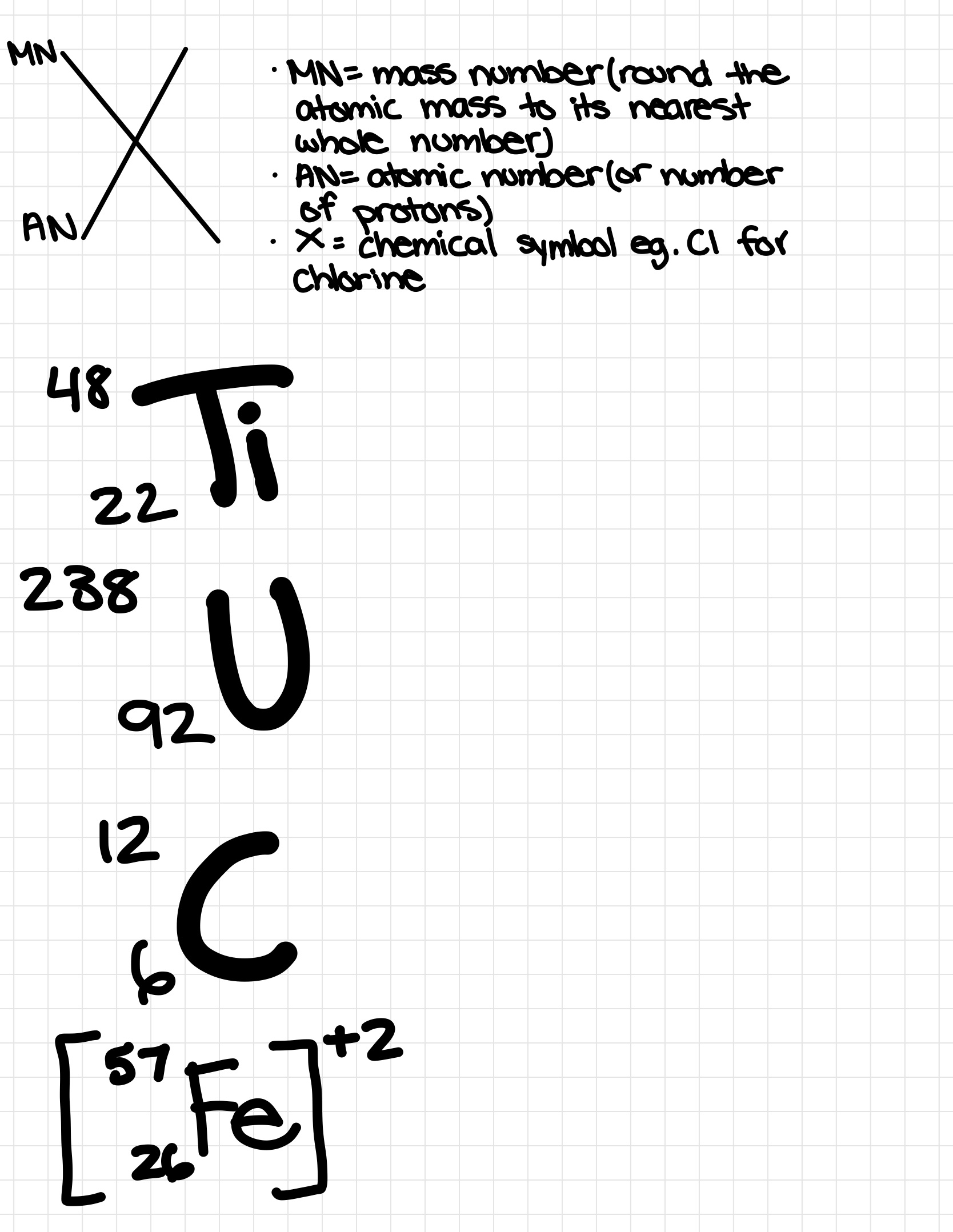
5
New cards
What are some characteristics of metals? Where are they located on the periodic table?
* They are solid, shiny, good conductors of electricity and heat, they are ductile, malleable and they tend to lose electrons easily
* They are located to the left of the staircase
* They are located to the left of the staircase
6
New cards
What are some characteristics of nonmetals? Where are they found on the periodic table?
* They are brittle, not malleable or ductile, poor conductors of electricity and heat, tend to gain electrons, most are liquids or gases
* They are located to the right of the staircase
* They are located to the right of the staircase
7
New cards
What are some characteristics of metalloids? Where are they found on the periodic table?
* Their properties cross between metals and nonmetals, some partially conduct eleectricity
* They border the staircase
* They border the staircase
8
New cards
What are transition metals? Where are they found on the periodic table?
* They have variable charges and differ in colour
* They are found in the middle of the periodic table (the depressed area)
* They are found in the middle of the periodic table (the depressed area)
9
New cards
What are alkali metals? Where are they found on the periodic table?
* They are shiny, soft, and reactive with water
* They are found in group 1 of the periodic table
* As you go down the group the reactivity decreases
* They are found in group 1 of the periodic table
* As you go down the group the reactivity decreases
10
New cards
What are alkali earth metals? Where are they found on the periodic table?
* They tend to be solid, lustrous, and silver-white in colour
* They are located in group 2
* They are less reactive than alkali metals
* They are located in group 2
* They are less reactive than alkali metals
11
New cards
What are halogens? Where are they located on the periodic table?
* They are nonmetals, usually found in a gaseous state but become more solid as the atomic size increases (as you go down the group)
* They are usually very reactive going up the group
* They are found in group 17
* They are usually very reactive going up the group
* They are found in group 17
12
New cards
What are noble gases? Where are they found in the periodic table?
* They are non reactive elements (most stable)
* They are gases at room temperature
* They will glow when exposed to an electric curent
* Located in group 18
* They are gases at room temperature
* They will glow when exposed to an electric curent
* Located in group 18
13
New cards
What is effective nuclear charge? Explain its trend with reference to the periodic table
* Is the amount of positivity that an electron in the atoms orbit may experience, it will want to pull the electron closer to the nucleus
* More protons will result in a higher effective nuclear charge
* Generally: going up a group the effective nuclear charge increases and going right across a period the effective nuclear charge increases
* More protons will result in a higher effective nuclear charge
* Generally: going up a group the effective nuclear charge increases and going right across a period the effective nuclear charge increases
14
New cards
What is atomic radius? Explain its trend with reference to the periodic table
* Is the distance from the atoms nucleus to the outermost orbital shell
* Across a period the effective nuclear charge increases while the amount of orbital shells remains the same, a higher effective nuclear charge causes more attraction to the electrons, pulling the electrons closer to the nucleus resulting in a smaller radius
* Down a group, the number of orbital shells increase, so there is a greater distance between the nucleus and outermost shell resulting in a larger atomic radius
* Generally: going left across a period the atomic radius increase and going down a group the atomic radius increases
15
New cards
What is ionization energy? Explain its trend with reference to the periodic table.
* is the energy required to remove the outermost electron from a neutral atom
* Across a period the effective nuclear charge increases as the amount of orbital shells remain the same, this pulls the electrons closer to the nucleus, creating a stronger attraction making it more difficult to remove
* Down a group, the number of valence electrons increase and the distance between the nucleus and outermost electron increases, resulting in a weaker attraction making it easier to remove
* Generally: ionization energy increases going right across a period and going up a group it also increases
16
New cards
What is electronegativity? Explain its trend with reference to the periodic table?
* Is the measure of the ability of an atom in a bond to attract electrons to itself
* Towards the left of the periodic table, we have metals, their valence shells are less than half full so they tell to lose electrons easily thus having a low electronegativity
* Towards the right of the periodic table, we have nonmetals, their valence shells are more than half full, so theses atoms tend to gain electrons thus having a high electronegativity
* Down a group the number of orbital shells increases. The increased distance weakens the attraction so an atom cannot attract electrons as strongly
* Generally: going right across a group the electronegativity increases and going up a group the electronegativity increases
17
New cards
How can you identify whether a bond is ionic, polar covalent or nonpolar covalent?
* you can calculate the electronegativity difference
* If the electronegativity is greater than 1.7 the bond is mostly ionic (you will still need to verify that it is between a metal and a nonmetal, if not it is polar covalent)
* If the electronegativity is less than 0.4 the bond is non polar covalent
* If the electronegativity is equal to or between 0.4 and 1.7 the bond is polar covalent
18
New cards
Why is the lewis structure for water drawn in a bent shape?
Water is a polar covalent bond but due to the lone pairs on oxygen it repels the other shared electrons
19
New cards
What are intramolecular forces?
The force that holds atoms together WITHIN a molecule
20
New cards
What are intermolecular forces?
The interactions between molecules
21
New cards
What is a metallic intramolecular force?
* when positive metal ions are fixed with electrons flowing freely between them
* Usually occurs in pure metals or alloys such as iron
* These are extremely strong bonds (level 1)
* Usually occurs in pure metals or alloys such as iron
* These are extremely strong bonds (level 1)
22
New cards
What is an ionic intramolecular force?
* when metal cations and non metal anions are bound together through electrostatic forces
* These are fairly strong (level 2)
* Ie. NaCl
* These are fairly strong (level 2)
* Ie. NaCl
23
New cards
What are polar covalent bonds (intramolecular)?
* when a partially charged cation and partially charge anion bond causing an uneven sharing of electrons
* Ie. HCl and water
* These are fairly weak (level 3)
* Ie. HCl and water
* These are fairly weak (level 3)
24
New cards
What is a non polar covalent bond (intramolecular force)?
* bonding between two non metals evenly sharing electrons
* They are very weak (level 4)
* ie. HOFBrINCl
* They are very weak (level 4)
* ie. HOFBrINCl
25
New cards
What is a dipole-dipole interaction?
* when the positive end of a polar covalent molecule is attracted to the negative end of another molecule
* Ie. HCl
* This is medium strength (level 2)
* Ie. HCl
* This is medium strength (level 2)
26
New cards
What is hydrogen bonding?
* a form of dipole-dipole interaction that must have a hydrogen bonding with either fluorine, oxygen or nitrogen, this creates an unusually strong dipole-dipole force
* Ie. water, HF
* extremely strong bond (level 1)
* Ie. water, HF
* extremely strong bond (level 1)
27
New cards
What is london dispersion forces?
* this occurs in all types of molecules (ionic and covalent), this is when temporary dipoles/polarity form due to the temporary movement of electrons
* This is very weak (level 3)
* This is very weak (level 3)
28
New cards
What are ionic compounds melting/boiling points?
We need lots of energy to overcome strong intramolecular forces like electrostatic ones, this results in a high boiling or melting temperature
29
New cards
What are ionic compounds solubility in water?
* in order to be soluble in water, a compound must have a charge or polarity
* Ionic compounds are soluble in water because the polar water molecule will be attracted to the positively/negatively charged ions in ionic compounds
* Ionic compounds are soluble in water because the polar water molecule will be attracted to the positively/negatively charged ions in ionic compounds
30
New cards
What are ionic compounds electrical conductivity?
* Electrical conductivity in ionic compounds depends on the state:
* Solid: not conductive, because there are no freely moving ions or charges as the ions are held rigidly in a lattice
* Liquid: conductive, since the ions can move freely and independently of one another
* Aqueous: conductive, since the ions can move freely and independently of one another
* Solid: not conductive, because there are no freely moving ions or charges as the ions are held rigidly in a lattice
* Liquid: conductive, since the ions can move freely and independently of one another
* Aqueous: conductive, since the ions can move freely and independently of one another
31
New cards
What are polar covalent compound boiling/melting point?
Since less energy is used to break apart dipole-dipole forces found between polar covalent molecule they have an intermediate melting/boiling point (lower than ionic but higher than nonpolar molecules)
Ie. water boils at 0 degrees and 100 degrees
Ie. water boils at 0 degrees and 100 degrees
32
New cards
What are polar covalent compounds solubility in water?
* Because of the polar nature of these molecular compounds they are soluble in water, a good rule of thumb is “like dissolves like” (polar liquids dissolve polar compounds)
* Polar compounds have charges/dipoles and so does water, so the positive ions in water will be attracted to the negative ions in a polar compound an vice versa
\
* Polar compounds have charges/dipoles and so does water, so the positive ions in water will be attracted to the negative ions in a polar compound an vice versa
\
33
New cards
What are polar covalent bonds electrical conductivity?
Since there are no free ions or electrons to conduct a charge in polar molecular compounds they are not electrically conductive
Ie. distilled/pure water is NOT conductive
Ie. distilled/pure water is NOT conductive
34
New cards
What are nonpolar covalent compound melting/boiling point?
Since the intermolecular bonding forces between nonpolar molecular compounds are rather low the melting points will also be low
35
New cards
What are nonpolar covalent compounds solubility in water?
Since nonpolar covalent molecules share electrons equally they do not have much polarity (if so it is very little and temporary) and as a result they are not soluble in water
Note! Chlorine bleach is actually 5% NaClO dissolved in water
Note! Chlorine bleach is actually 5% NaClO dissolved in water
36
New cards
What are nonpolar covalent bonds electrical conductivity?
Since there are no free charges (electrons or ions) that move independently of on another in nonpolar molecular compounds they are no electrically conductive