BE 3415 || Exam 3
 Call Kai
 Learn
 Practice Test
 Spaced Repetition
 Match
 Flashcards
 Knowt Play
1/39

There's no tags or description
Looks like no tags are added yet.
40 Terms
Enzyme
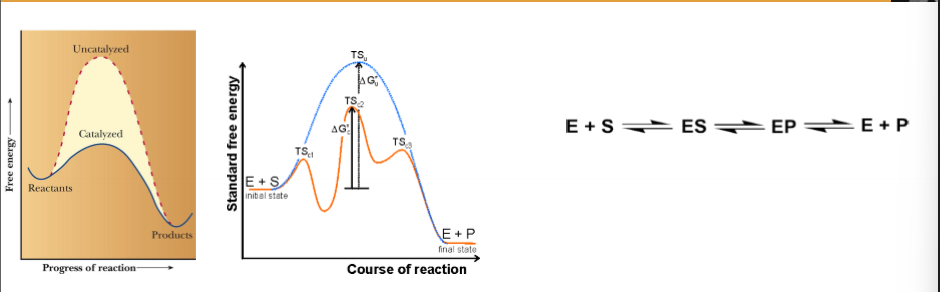
Catalyst that increases the rate of a reaction
Substrate
S: the reactant
Active Site
the small portion of the enzyme surface where the substrate(s) becomes bound via noncovalent bonds
What are the two models that’ve been developed to describe the enzyme-substrate complex?
Lock-and-key model: substrate binds to that portion of the enzyme with a complementary shape.
Induced fit model: binding of the substrate induces a change in the conformation of the enzyme that results in a complementary fit
Kinetics
The study of reaction rates, or the changes in the concentrations of reactants and products with time.
Reaction Rate
change in concentration of a reactant or product over time.
Rate of a Reaction depends on…
Physical states and surface areas of reactants
Temperature
Solvent and catalyst properties
Reactant concentrations

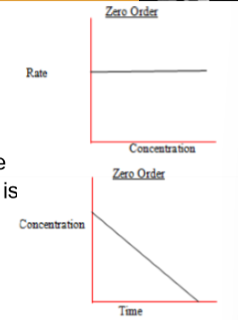
Zero-Order Reactions
Reaction is independent of concentration
Common in reactions that are catalyzed by an attachment to a reactive surface
only a small fraction of the reactant molecules is in a location in which they are able to react. This fraction is continually replenished from the larger pool.

First-Order Reactions
Reaction is directly proportional to the concentration of one of the reactants
Can have more than one reactant but other reactants would have to be zero order


Second-Order Reactions
Reaction rate is proportional to the product of two reactants (two molecules of same or different reactant)
Either two first order of different reactants or one second order reactant

Temperature dependance of catalysis
Increases rates for chemical reactions until denaturation (protein unfolding) occurs, which will result in a decrease.

Michaelis-Menten Model
Km describes
the constant derived from other rate constants
a measure of how well the enzyme recognize the substrate
estimate of the dissociation constant of E from S
Small Km means tight binding while high means weak binding
You can also use this equation to solve for the concentration of the enzyme-substrate complex

Vmax
the theoretical max velocity
Constant
to reach this value, it would require ALL of the enzyme molecules are simultaneously bound with the substrate
approaches asymptotically as substrate is increased

Enzyme Inhibition
Reversible Inhibitor: binds to an enzyme to inhibit, but can be released
competitive inhibitor: binds to the active/catalytic site and blocks access to it by substrate
noncompetitive inhibitor: binds to anywhere but the active site, inhibiting by changing the conformation of the enzyme
Irreversible Inhibitor: an inhibitor that can’t be reversed
usually involves formation or breaking of the covalent bonds to or on the enzyme

Feeback Inhibition
Formation of product that inhibits its own production through the allosteric feedback inhibition
Helps to sustain a steady or oscillating level of product depending on the kinetics and lifetimes in the pathway

Allosteric Enzymes
often serve as switches
biological activity is affected by other substances binding to it, changing the enzyme’s activity the conformation of its structure
something that modifies the behavior of an allosteric enzyme may be either an allosteric inhibitor or activator.
Non-Allosteric Behavior
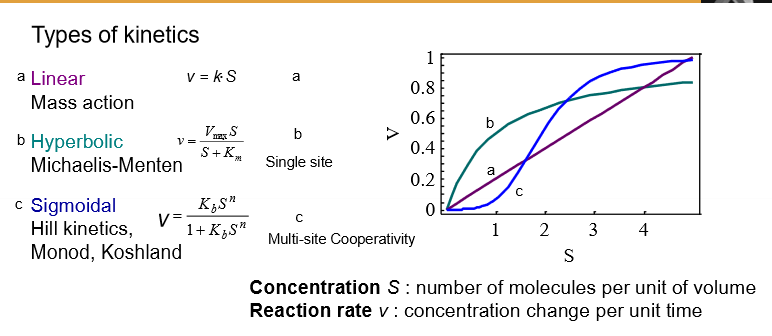
point at which the rate of reaction does not change
enzyme is saturated
maximum rate of reaction is reached

Allosteric Behavior
Sigmoidal shape of rate vs. concentration
Maximum velocity can be reached, but by a different mechanism

Concerted Model
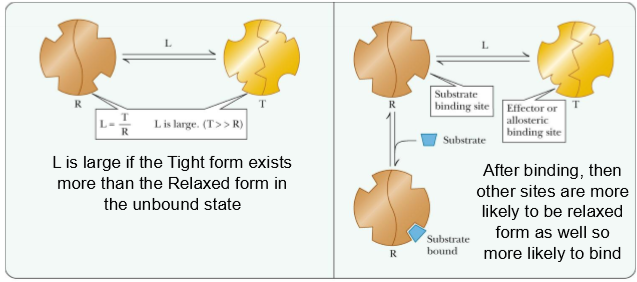
Allosteric Enzymes have two conformations
R (relaxed): binds substrate well; the active form
T (tight or taut): substrate easily released; the inactive form
the presence of substrate shifts the equilibrium from T to R
KR = [R][S]/[RS] & KT = [T][S]/[TS]
If R form binds more strongly to substrate, then KR < KT
Constant c = KR/KT
Sequential Model of Cooperative Binding
the binding of substrate induces a sequential conformational change from the T to R form

Classification of Enzymatic Reactions
Zymogens
Inactive precursor of an enzyme where cleavage of one or more covalent bonds transforms it into an active enzyme
Ex: Chymotrypsinogen
stored in pancreas
when secreted into small intestine, the digestive enzyme trypsin cleaves a 15-unti polypeptide from the original peptide to give pi-chymotrypsin

Enzyme Specificity
Absolute Specificity: catalyzes reaction of one unique substrate to form a specific product.
Relative Specificity: catalyzes the reaction of similarly structured substrates to give structurally similar products.
Stereospecificity: catalyzes a reaction where one stereoisomer is reacted or formed.
requires the binding sites on the enzymes to be asymmetric
Dimers
In DNA binding proteins, the homodimer properties mean it will recognize the same sequence at two different locations
Results in the DNA recognition site being an inverted repeat

Restriction Enzymes: Endonucleases
restrict possibility of attack from foreign DNA
Type II restriction enzymes: cleave DNA chains at selected sites
No ATP required
Recognition sites in dsDNA usually have “palindrome-like” sequence symmetry
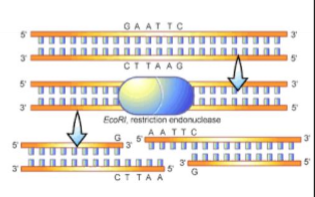
Sticky end vs Blunt end by cutting restriction enzymes
Cleavage can leave staggered “sticky” ends or can produce flat “blunt” ends

Types of restriction sites and frequency
Blunt Ends: Frequency of occurrence of restriction sites
Sticky Ends: If assume random DNA sequence has equal amounts of each base (A,T, G, C)
5’ Overhang: 6 base cutter / 4 base cutter
3’ Overhang: The longer the recognition site is the better the specificity
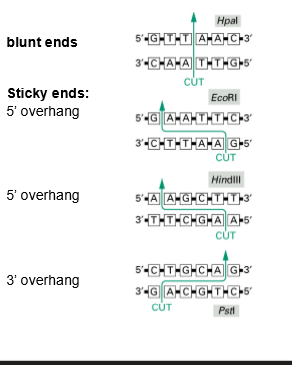
Cloning
Making many copies of a gene

Why are Plasmids useful to cloning
Plasmids are naturally occurring non-chromosomal DNA
Can cleaved by restriction enzymes, leaving sticky or blunt ends

Antibodies
Different Forms of Antibiotics:
Inhibit protein synthesis:
Kanamycin
Tetracycline
Streptomycin
Chloramphenicol
Erythromycin
Inhibit cell wall synthesis:
Ampicillin
Induce DNA breaks:
Bleomycin

Cloning Vectors
Plasmids that can be modified to carry new genes
Examples:
Replicator (Origin of replication)
A selectable marker (Antibiotic resistance gene)
A cloning site

Chimeric Plasmids
Recombinant plasmids that are hybrid DNA, molecules consisting of plasmid DNA sequences plus inserted DNA elements
Associated with Non-Directional Cloning

Directional Cloning
Constructing foreign DNA insert with same set of restriction enzymes
The resulting insert DNA and vector can only be combined in one direction
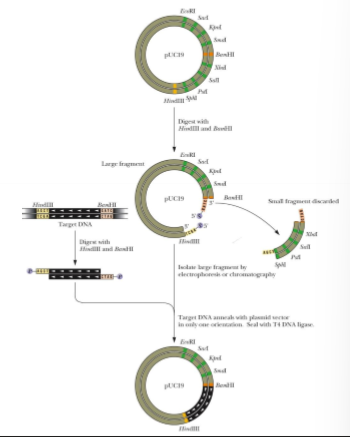
Ligation Reaction

Multiple Cloning Region
Area of the vector that contains many common restriction enzyme sites
Provides a choice of restriction enzyme sites to use when you cut your DNA of interest and put it in the plasmid

Blue-White Screening
X-Gal (turns blue when beta glycosidic bond is cleaved)
Intact lacZ (without an insert) makes a blue color when expressed if X-Gal is present

The plasmid (backbone + biobrick)
Puts parts together one-by-one
Unreliable and time consuming but rather easy
Overhanging the X and S are compatible, when ligated together, they form a new site that can’t be cut from either enzyme (scar)

Polymerase Chain Reaction
A method to copy a given DNA sequence many times over without bacteria
Any chosen DNA can be amplified if the sequence on either end is known
Amplification occurs via oligonucleotide primers
oligonucleotide primers serve as primers for DNA polymerase and the denatured strands of the large DNA sequence of interest serves as the template.

PCR Animation
Small sample of DNA can serve as template for DNA polymerase
Designing complementary primers
Heating and Cooling Elements: Heating to make template a ssDNA and cooling to let primers bind then increase temperature to start the Taq enzyme

Problems with primers
Harpin Structure: If the 3’ side binds to 5’ side forms, the 3’ end will be blocked and the primer won’t work
Primer dimers: Problem if the binding is formed at the 3’ ends
Primer too long: too high of a melting temperature
Primer too short: won’t stick to template because not enough to form a complementarity
