Lab Quiz 2 - Intro to Spectrophotometry
 Call Kai
 Learn
 Practice Test
 Spaced Repetition
 Match
 Flashcards
 Knowt Play
1/69

There's no tags or description
Looks like no tags are added yet.
70 Terms
Light
a form of energy
electromagnetic radiation
photons of energy emitted
Light can be described as (2):
absorbed, transmitted, or reflected/scattered
Light that strikes a molecule can be:
colorimetric assays
What type of assays/tests measure absorbed light?
**hint: glucose, protein, cholesterol all can be measured as a color
wavelength (nanometers)
What unit of measure is used to measure light?
~400 to ~700nm
wavelength of Visible light
200nm to 400nm
wavelength of UV light
**hint: UV light has a shorter wavelength than visible light
760nm to 3000nm
wavelength of Infrared light
**hint: Infrared light has a longer wavelength than visible light
white light
mixture of all the colors of light
black light
the absence of all colors of light
prism or diffraction grating device
The human eye can see all of the colors if the white light is directed onto what (2)?
violet, blue, green, yellow, orange, red
shortest to longest wavelengths:
lower
Longer wavelengths have _____ energy
higher
Shorter wavelengths have _____ energy
optical density
The most useful measure of light absorption is the absorbance (A), which is commonly called what?
Spectrophotometer
an instrument that measures the intensity of a portion of the spectrum of light
- most commonly used method in automated clinical chem lab
2 main principles of all spectrophotometric methods
1. Substances absorb light at specific wavelengths, therefore the wavelength absorption pattern can be the basis for ID of an analyte
2. The amount of light absorbed is proportional to the amount substance that is present
absoptivity
the amount of absorbance specific for a certain substance
absorbed; transmitted
As the concentration of a solution increases, more light is __________ by the solution and less light is __________
transmittance
the amount of light not retained, but passed through a test solution
Beer's Law
explains the relationship between absorbance, at a given wavelength and concentration
A = abc
A = abc
What is the equation for Beer's Law?
absorbance
A = abc
What does A represent in Beer's Law
absorptivity constant for the substance
A = abc
What does a represent in Beer's Law
length of light path through a substance
A = abc
What does b represent in Beer's Law
concentration of the substance
A = abc
What does c represent in Beer's Law
absorptivity (a) & length of light path (b)
What are the 2 constants in Beer's Law
absorbance (A) is directly proportional to the concentration of the substance (c)
Since absorptivity (a) & length of light path (b) are constants, what is the relationship between absorbance (A) & the concentration of the substance (c)?
A1/C1 = A2/C2
Since absorptivity (a) & length of light path (b) are constants, and absorbance (A) is directly proportional to the concentration of the substance (c), what equation can we use to find the concentration of an unknown substance?
linearity
the extent to which a range over a measurement, such as absorbance, is directly proportional to the concentration
relationship of 2 variables produce a straight line when plotted on a graph
absorbance vs concentration is a linear function
How does linearity relate to the absorbance or transmittance of a substance?

light source/lamp
monochromator
sample holder
photodetector
readout device/meter
power source
The 6 components of a spectrophotometer:
Light source/Lamp
Purpose: Provides wavelengths of light in the visible spectrum or UV range
incandescent tungsten lamp or tungsten-iodide lamp
What type of light source/lamp is used or visible light?
hydrogen deuterium or mercury-arc lamp
What type of light source/lamp is used for UV light?
tunable laser beams
Newer spectrophotometers use what as their light source?
periodic lamp inspections
use lens paper to hold & position lamp during replacement
Maintenance of light source/lamp:
Monochromator
Purpose: Used to eliminate unwanted wavelengths of light & allow the desired light to reach the sample
can be: Filter, Prism, or Diffraction grating

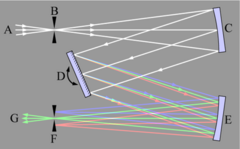
entrance slip
dispersion device
diffraction grating
exit slip
Monochromators are made up of what 4 things?

entrance slip
What is B?
hint: focuses the light where it can be dispersed with a minimum of stray light
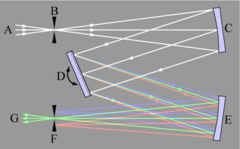
dispersion device
What is C & E?
hint: mirrors
diffraction grating
What is D?
hint: light is passed in order to produce a spectrum

exit slit
What is F?
hint: isolates the selected narrow band of wavelengths

bandpass or bandwidth
The range of wavelengths exiting the slit
Indicates the purity of light passing though the sample
higher resolution, lower intensity
What does a smaller bandpass/bandwidth mean in terms of resolution & intensity?
lower resolution, higher intensity
What does a larger bandpass/bandwidth mean in terms of resolution & intensity?
Sample Holder
Purpose: Holds cuvette containing the test solution
Cuvettes can be round or square, and either glass, plastic or quartz

square
Light passes better through what shaped cuvette?

quartz
What type of cuvette is used for a colorless solution?
scratches will interfere and cause light to scatter
What is a disadvantage of glass & plastic cuvettes?
Photodetector
Purpose: Converts the electromagnetic radiation (light) into an electrical signal that is sent to the readout device as an electric current
When light strikes the light-sensitive material in the light detector, molecules are excited and release a stream (current) of electrons
Photocell, Phototube, Photodiode, Photomultiplier tube
What are the 4 types of photodetectors?
Photomultiplier tube
Preferred type of photodetector:
due to a rapid response & more sensitive
true
T or F:
There is a direct relationship between the intensity of the electromagnetic radiation (light) and the electrical signal produced
Readout device/Meter
Purpose: Presents changes in electrical energy numerically and gives the operator a numerical value that represents the amount of %T or A
The computerized device may be linked to the LIS or HIS/EMR for fast delivery of the info to the provider

Power Source
Purpose: Must supply continuous and stable energy to the components
batteries
offer the advantage of direct current & portability, especially in field testing
eliminates interfering susbtances
What is the purpose of blanking an instrument?
set the limits of the instrument from no light transmitted to all light transmitted
What does zeroing and blanking an instrument do?
water blank
Type of blank that cancels out any color found in water
reagent blank
Type of blank that cancels out any color from the reagents
Calibration
a check of an instrument to ensure continued accuracy throughout the reportable range of the test results for the test system
Calibrators
a material of known value use to calibrate, or adjust a measurement procedure, or to compare the results obtained with the response of a test specimen and/or sample
assigned values
commercially prepared calibrators have __________ values for each analyte that have been determined by a reference lab
Standard
reference material whose concentration is determined by assay with a reference method
aka Calibrator
controls
Manufactured using the same base matrix as the substance being tested
stabilized and processed to maintain the native components which may be susceptible to degradation
ranges are established by repeat testing, and then distributed to labs
calibrators
Manufactured to contain a specific amount of a pure analyte and adding it to the appropriate solvent for analysis, so they contain a known amount of analyte
a more accurate calculation is based on the measurement of several standards of different concentration vs one standard
reagent lot number is changed
extensive maintenance performed on instrument
routinely, based on manufacturer's guidelines
Calibration curves must be re-calculated when:
Calibration Verification
Process in which the calibration of the instrument is checked on a periodic basis
6 months
after a major preventative maintenance or repair
whenever recommended by the manufacturer
Time interval/when to perform calibration verification: