HLTH220 - Module 7 (Middle adulthood)
 Call Kai
 Learn
 Practice Test
 Spaced Repetition
 Match
 Flashcards
 Knowt Play
1/39

There's no tags or description
Looks like no tags are added yet.
40 Terms
What is it like to be middle aged?
(Mixed with young adulthood) = 40-59 years
Age-related physical problems emerge (minor but annoying)
Sensory systems decline
For example:
Eyesight: problems with ability to see fine print
Hearing: Age related changes in the eardrum cause loss in hearing acuity.
What are primary body composition changes?
1) General increase in body fat (mid-upper torso in M, lower torso in W).
Indulgences can cause bigger changes
2) Gradual loss of muscle, bones become more porous + Loss in bone density/strength.
3) Subtle decreases in memory and other cognitive abilities.
However, physical exercise can offset all three—aerobic for body fat, and resistance for muscle tone loss and bone strength.
Good rationale for promoting PA in middle age (but emphasized)
We normally promote for children and late life
What are significant body composition changes in WOMEN?
Women
Menopause begins in this phase of life (cessation of ovulation)
Usually occurs at age 52; but can be as early as 38, or as late as 58.
Emphasis for having children earlier
For some this is met with rejoicing; for others a profound sense of loss.
Prior to menopause, there is a decline in estrogen, resulting in shortened and more irregular monthly cycles.
Menopause itself is accompanied by some uncomfortable sensations:
1) Hot flashes
2) Cognitive changes
3) Loss in skin elasticity
4) Disrupted sleep
5) Sexual arousal difficulties, dryness (vaginal dryness)
6) Depressive symptoms (sometimes problematic)
7) Emotional → irritability, rage (regardless of usual disposition)
Symptoms may occur before menopause (irregular cycle)
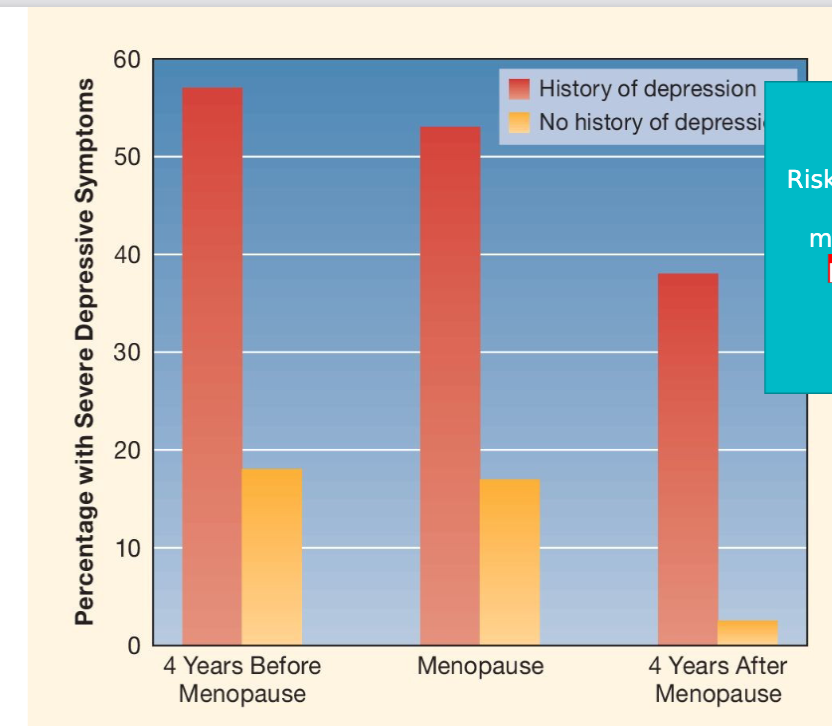
Whats the association between severe depressive symptoms and menopause?
History of depression = increased risk of depressive symptoms in menopause
Increase 4 years before, during, and after
Describe the brief history of menopause? What are the methods of treatment?
All women go through menopause + suffer bad symptoms
To assist with dealing with symptoms of menopause, modern medicine has been quick to offer radical and highly invasive options (previously recommended for ALL women in menopause, but now on a more selective basis):
Overmedicalization
Treatment methods
1) Estrogen replacement theory
2) HRT (estrogen + progestin)
3) Complete hysterectomy (removal of reproductive system)
What is the empirical basis of being concerned for invasive menopause treatment + what happened after invasive treatments stopped? What were the social dimensions? What was the switch-up that happened recently?
Adverse risk of invasive menopause treatment
RCT and prospective studies forced the end of uniform HRT and ERT due to increased cancer risk and heart disease risk.
Ex. RCT trial with HRT terminated early due to evidence of increased risk of adverse incidents among participants
The cancer risk was specifically about the relatively more advanced and treatment resistant variants among particularly combined treatment group
What happened after uniform invasive treatments were stopped?
The Womens Health Initiative (WHI) study became the motivation for the FDA (US) to place a strong warning label on all estrogen boxes.
Prescription rates went from 27% in 1989 to 5% in 2020. [physicians wanted to avoid liability for excess risk] (JAMA Health Forum, 2024).
Social dimensions of the issue
All of the interventions, regardless of outcome, were highly invasive and radically change women’s bodies.
One of the outcomes of this was some reflection on sex differences in how the medical establishment approaches women’s health issues.
Can you think of similarly radical interventions that are universally recommended for middle aged men? (for symptoms that are minor or completely absent?)
However
Re-analysis by Manson et al (2017; 2024) of the data showed that most of the risk associated with HRT was actually among people who are starting it really late (in their 60’s)
Abnormally old age (10 yrs) of women in RCT (fraility)- younger women actually had decreased risk (appropriate age)
Now it is recognized that there is not significant excess risk of adverse outcomes for those women who start HRT in the normal age range for menopause (i.e., 40s and 50s).
Now, in Canada the situation is quite different regarding HRT for menopause symptoms
Consequences of this?
In 2026, FDA dropped warning labels for estrogen (Health Canada has not so far)
However, therapies to protect bone health + cognition are recommended for early menopause (in Canada)
What are the leading causes of mortality in midlife (middle adulthood)
1) Cancer
2) Heart disease
3) Unintentional injury (shifted down from adolescence/YA; higher sensation seeking)
Gender differences → men suffer more deaths than women
What’s the significance of heart disease/CVD in midlife?
CVD is responsible for 25% of middle-aged death”
“Silent killers”:
High blood pressure, cholesterol
Atherosclerosis
Symptoms:
Heart attack (blockage)
Arrhythmia (irregular heartbeat)
Angina pectoris (chest pain)
Chart: Ischemic Heart Disease amplifies in 50-60 age range then increases
Describe trends for cancer in middle adulthood (prevalence, incidence, mortality, gender diffs, age standardized incidence). What types of cancer mortality are decreasing recently?
Prevalence Chart:
All types of cancer increase during young adulthood → 20s to 40s
Doubles when middle adulthood begins (40s to 60s) → doubles again after 55
Overall, keeps increasing but 80-84 most prevalent
Incidence Chart
Number of new cancer diagnoses low in YA (30s-40)
Increase in middle adulthood (40s-50s, doubles in 50s-60s)
Deaths
Low mortality rate in YA (30s-40)
Increases in middle adulthood
Gender differences
Men more affected by cancer (esp later in life)
Do cancer treatments work, regardless of age? Yes cuz incidence is decreasing
Age standardized incidence is generally trending slightly downward for both common cancers (top panel) and less common (bottom panel), in Canada compared to 1990s.
(Ignore) Some are a bit more chaotic looking because of changes in screening (e.g., prostate)
Downward trend in COVID (low diagnoses)
Cancer mortality, on the other hand, has seen some significant reductions (especially for lung, colorectal and prostate).
Less for pancreatic cancer.
Some real gender differences (solid lines vs dotted lines) within disease category
High cancer cases/deaths in men reduced

How about cancer rates in young adults to middle-aged adults specifically?
Rates of cancer (AAPC* %) for young adults were increased in 75% of countries examined (2003-2017), although wide confidence intervals (likely due to low absolute numbers) made only some of these significant.
All ages showed increase, including older adults.
BUT—increases in colorectal cancers in young adults were greater than the increases among older adults. Particularly true in Canada. + kidney and endometrial
How about cancer survival?
YA diagnosis (15-40)
Highest survival → benefit most from cancer txt advancement
Midlife diagnosis (40-59)
High (but lower than YA) survival
Higher ages
Decreasing survival
+ Cancer stage matters for everything
Survival rates, including for colorectal, appear to be good if they are caught early for breast and colorectal; less so for lung, but still early detection matters.
What are primary cancer causes at midlife?
Primary cancer causes at midlife:
Biological aging
Lifestyle factors (e.g., smoking, alcohol, inactivity, diet)
Environmental exposures (e.g., asbestos, benzene)
Chronic infections (HPV; but watch for SARS-CoV-2!)
Endocrine factors (estrogen exposure; androgens)
Chronic stress
Genetics
What is osteoporsis’ significance in midlife? What are the causes? What are ways to prevent osteoporosis?
Osteoporosis:
Severe bone loss, fragile bones; creates proneness to fractures and breaks.
Causes:
Normal aging:
With age, bones more porous, lose bone mass
Decline in estrogen due to menopause speeds loss
Heredity, body build
Lifestyle: diet, physical activity, smoking, alcohol use
How to prevent osteoporosis
Diet (vit D, calcium, avoid caffeine/sodium)
Weight-bearing exercise
Resistance training
Bone strengthening meds
Early prevention
Why is exercise important in midlife
Exercise in midlife
Physiological and psychological benefits
Stress management
Reduces disease risk
Only 18% engage in recommended activity levels
Barriers to beginning, obstacles to continuing
Time, energy, health, convenience, work, access to facilities
Self-efficacy promotes exercise
Interventions needed to reach low SES adults
How can we improve psychological health (coping)? Problem focused vs emotion focused
Problem focussed [address the source]
Construe problem in a way that makes it amenable to change
Identify several possible approaches to manage it
Implement and trouble shoot as many as necessary
Emotion-Focussed [minimize the impact]
Engage in activities that distract from emotional states that are aversive (e.g., meditation, relaxation, hobbies)
Manage distress directly (e.g., use of adaptive self-talk)
Given that life, including midlife, includes situations that are both changeable and not, having both types of coping responses available is important.
Switch flexibly between the two, because of changing circumstances, and differential effectiveness
Mental flexibility is better in midlife (a facet of executive functioning)
More experience
What are some midlife benefits?
1) At midlife, people are more realistic in their categorization of life events as changeable or not (stressors are modifiable)
2) Coping is often more successful as a result of this, compared to young adulthood (mental flexibility)
3) Due to history of experience, they are also more able to anticipate stressful events and prepare.
What is the silver lining of adversity? (Mental health/Life satisfaction VS exposure to lifetime adversity)
High childhood adversity = Worse mental health outcomes in later life
Life satisfaction has high curve with some exposure to lifetime adversity
Mental contrasting → makes it clear that things are better now

How about the brain at midlife? What is crystallized vs fluid intelligence?
Crystallized intelligence (cumulated knowledge overtime - factual/skill)
Skills that depend on:
Accumulated knowledge
Experience
Good judgment
Mastery of social conventions
Valued by person’s culture
Vocabulary, verbal comprehension, general information, logical reasoning
= Peaks in midlife (than YA), declines in eighties
Fluid intelligence (quick access to information/real time working info)
Depends on basic information-processing skills:
Detecting relationships among visual stimuli
Speed of analyzing information
Working memory
Spatial visualization, digit span, letter–number sequencing, symbol search
= Progressive falloff beginning in mid-twenties
Crystallized intelligence better in later life, fluid intelligence better earlier in life
What does the Seattle longitudinal graph say about trends in mental abilities
Gains:
Mental abilities in young adulthood (20s-40s)
Losses:
Mental abilities after YA/during midlife (50s-60s)

What about structural brain changes during midlife?
There are real changes in the brain in middle adulthood
Processing speed slowing
Neural conduction in the CNS is slowed by degradation of myelination
What are some preserved abilities in midlife?
1) Practical problem solving
Using experience and context to solve problems
2) Expression of creativity:
More deliberate
More thoughtful
Less spontaneous
More outward focus (less egocentrism)
Altruistic goals in creation
What’s the main example of neurodegenerative disorders that take hold in middle adulthood? (celebs)
For some, early neurodegenerative disorders that take hold.
Early onset dementia: John Mann (singer for Spirit of the West) passed away after a 5 year battle. He was 52 when diagnosed.
Other examples:
Frontotemporal dementia: Bruce Willis (actor)
Dementoia: Robin Williams (actor), Lewy Body
What are some supports for mid-life students?
Learning new things are crucial at midlife
1) Personal relationships help, w faculty & fellow students (esp other mid life students)
2) Flexible hours for classes, particularly evenings
3) Flexible assignment & tut schedules (more possible w online tech)
4) Video participation options on an as needed basis.
5) Financial aid
What about online education at midlife?
Increasingly, online education is revolutionizing training and education among already employed older adults.
Along with COVID-19, norms around online education are changing for all age groups, including mid-life individuals who are already employed.
Micro-skills training, upgrading, and even degree attainment are possible and highly accessible for those in mid-life.
Interim summary
1) Mid life is a time of change, much of it quite good!
2) Improvements evident in cognitive abilities, particularly those that don’t rely on speed (and benefit from deliberation)
3) Also many psychosocial improvements.
4) Some major disease challenges begin to emerge, including cancer and CVD
5) Coping styles that are many and flexible are of benefit
6) Creativity can benefit from aging, in some specific ways.
7) Late life development of cognitive abilities is possible and increasingly popular
8) Special supports can help older adults to be successful
What is midlife crisis? Are midlife crises common? Who are more likely to experience midlife crisis?
Midlife crisis
Personal, relational and / or professional upheaval.
Characterized by behaviors and decisions that are not matched to developmental stage and appear to be grasping for youth.
According to the MIDUS study, a large study of 7,000 mid lifers... this is a relatively rare phenomenon, affecting at most 25% of mid life adults (and probably less).
The above often occurs in response to missed developmental opportunities in early adulthood.
Alternatively, a midlife crisis may also be a reaction to major life events (divorce, loss of loved one, career loss).
Is midlife crisis common?
The majority (more than 50%) do not report significant upheaval during this time.
It is more likely among those who experienced:
Inability to pursue own explorations due to marriage, cultural norms, etc
What is midlife characterized by? (MIDUS study)
MIDUS study (Midlife Development in the United States)
Midlife is characterized by:
1) Personal satisfaction and an emerging sense of fulfilment and autonomy (i.e., insulation from anxiety about what others think).
2) Secure sense of identity
3) Confidence in one’s direction in life
4) Emphasis shifting to others.
5) Long-term pro-social goals
6) Increasing life satisfaction
What are predictors of good adjustment at midlife?
Predictors of good adjustment at midlife:
1) Positive health behaviors (eating, exercise, substance use)
2) Sense of control
3) Positive social relationships outside marriage
4) Good relationship with spouse or life partner
5) Mastery of multiple roles
What are outcomes of midlife despair?
1) Suicidality
2) Sleep problems
3) Substance use
4) Pain

How about the association between adolescent psychopathology and midlife despair?
Association between adolescent psychopathology and midlife despair
The greater the number of mental disorders in each category at adolescence predicts the likelihood of each of the components of “despair” at midlife
More adolescent mental disorders = higher midlife despair outcomes (suicidiality, sleep, substance abuse, pain)
Supports the idea of midlife crisis as being partially a continuation of longer patterns of emotional upheaval that may arise earlier in life (and continue to be evident intermittently through the lifespan, for example at midlife)
What about personality changes at midlife- do they change much? What are the big five personality traits?
Big five (OCEAN)
Openness (slight decrease) → open to diff perspectives/ideas
Conscientiousness (increase) → organized/responsibility
Extroversion
Agreeableness (slight increase)
Neuroticism → ability to experience high activation emotions
Generally speaking, these don’t change
However, these do change somewhat:
Values
Other orientation (less validation needed)
Time orientation (ahead vs. backward) → focus on present
The above are more beliefs and attitudes than behaviors per se
How about generational dynamics?
The prior slide talks about changes WITHIN person, as compared to themselves earlier in life.
However, there are also MAJOR generational differences that apply BETWEEN people within a generation, and BETWEEN generations.
Its important to not conflate these WITHIN person & BETWEEN person effects
For example, you might consider young adults to be much more prosocial than older generations currently. This is a generational effect, however, and does not refer to changes within person from an earlier time period.
Describe relationships in midlife. What is a launch phase, and its characteristics? What is a launch phase affected by?
Relationships in midlife
More relationships that are close during this time
They span from older to younger
Relations w offspring who r now adults or becoming them.
More VARIABILITY in age that parents have children, the age of children when adults are a mid-life varies a lot—some have kids who are grown adults, others have kids who are still quite young (adolescents or even toddlers).
“Launch” phase
Among those who had children in the early 20s → adult children begin to separate.
This occurs at midlife in such cases, and as characterized by:
Decline in parental authority
Continued contact, affection, support to children
Adjusting to in-laws (as children become married)
Kin keeper role, especially for mothers
Affected by:
Investment in non-parental relationships and roles, especially work
Children’s characteristics
Cultural variations in social clock for children’s departure (come home even after marriage)
How about becoming grandparents?
Becoming grandparents in midlife
Typically starts in early 50s second half of midlife); can spend 1/3 of life as a grandparent
Significant milestone for most
Valued means of fulfilling personal and societal needs
Grandparent–grandchild relationships:
Influenced by age, sex, proximity, SES, ethnicity, culture, relations with daughter- or son-in-law
Vital context for sharing between generations
How can being a grandparent be a big positive change?
(Don’t have to do most difficult stuff)
Grandparents get to indulge without disciplining
They expand the range of their valued role
They gain new relationships with grandchildren
Sense of own purpose in the family
How about caring for your own parent? (significant change in midlife)
A challenge that also arrives in mid adulthood is the need to care for one’s own parents in many cases.
These findings are getting a bit out of date, but do show that women have a disproportionate amount of responsibility in this respect (as of this 2011 sample).
More recent data suggest that the responsibility gap between these groups is closing.
Chart:
Nonworking adults care more for aging parents
More women than men partake in caregiving

Describe friendships at midlife
At younger adult ages, women’s friendships were noted to be more intimate than men’s on average. This trend continues in middle adulthood.
Beyond this, both men and women have fewer friendships than earlier life, but also make more efforts to maintain the ones that they do have.
Social systems don’t support friend connections as automatically as they do in early life (for example, early adolescence and early adulthood share common educational contexts for friendships—people see each other everyday; not so when people go out into the world, mix with new people, and have fewer shared leisure activities that are built-in to their everyday lives.
The function of friends is more one of fun than emotional support, which is somewhat in contrast to earlier life
Friends become more “activity partners” than social support
What about vocations at midlife?
Job + aging process = stressful
Generally white collar workers become increasingly satisfied with their jobs at midlife.
The above is partially a function of perceived mastery over the work, and also an ability to solve work related challenges effectively when they do come up.
The case is more mixed with blue collar workers, who may be more attuned to the negative impact of physical limitations / injuries (in the context of jobs that very much depend on intact physical functioning).
Work life does present a double edged sword, however, where some are very adversely affected by the phenomenon of burnout. –this is particularly likely to happen where there is high person contact, in a physically and emotionally demanding job context.
E.g., nursing, PCW, social workers, physicians, psychologists.
What are consequences of burnout?
Consequences of burnout
Impaired attention and memory
Severe depression
On-the-job injuries
Physical illness
Poor job performance
Absenteeism and turnover
Summarize midlife
1) Midlife is a time of upheaval for some (25% or less), but for the majority, it is a time of satisfaction and comfort with the self in various spheres of life, coupled with an outward orientation.
2) Friendships and relationships with family of origin remain important; both take a back seat to the current family unit however.
3) For women, friendships continue to be more intimate than for men.
4) There are several risks in the vocational domain, the most significant is burnout. This occurs more in person facing occupations, and those that include high levels of emotionality and relatively modest control