BIO LAB midterm
 Call Kai
 Learn
Learn Practice Test
 Spaced Repetition
 Match
Match Flashcards
 Knowt Play
1/73

There's no tags or description
Looks like no tags are added yet.
Name | Mastery | Learn | Test | Matching | Spaced | Call with Kai | Chat |
|---|
No analytics yet
Send a link to your students to track their progress
74 Terms
What units would you use to express the molecular mass of AgC2H3O2?
g/mol
Which of the following is most accurate at measuring small volumes such as uL (microliters)?
Micropipette
A p-value of > 0.05 means the difference between groups is statistically significant.
False
What is the molecular weight of sucrose (C12H22O11)? Your answer must expressed to the tenths place (i.e 100.0) with in grams per mol (just type the number, not the units)
342
Molarity (M) is expressed as:
mol/L
When using a serological pipette or graduated cylinder, which of the following is the correct way to read the measured volume?
At the bottom of the meniscus at eye level
How many grams of NaCl are needed to prepare 60 mL of a 19% solution? Your answer should be written to the tenths place (i.e. 48.6)
11.4
The molecular weight of aspartame will be used to calculate the molarity (M) of diet soda during lab.
True
Using scientific notation, convert 1 uL (microliter) to the appropriate volume in L (liters).
1.0 x 10⁻⁶ L
We will be using bacteria as a model for human skin to test the effectiveness of sunscreens against UV light
True
How many Petri dishes will you use for each group/treatment to obtain reliable results (not including the viability control)?
3
The error bars we created in the bar/column graph (using Excel during chapter 3 lab) represent which of the following?
Standard Deviation
Deductive reasoning is described as developing general conclusions from specific instances (specific to general).
False
How many grams of glucose do you need to prepare 50 mL of 15% glucose solution? Give your answer to the tenths place.
7.5
In Biology, and most sciences, statistical analysis allows for a ___% margin of error (a result must hold true at least 95% of the time to be considered real).
5
Which of the following molecules was used to calculate the M (molarity) of diet soda during ch 3 lab?
Aspartame
How many grams of sucrose (C12H22O11) do you need to prepare 100mL of 0.2 M sucrose solution? Give your answer to the tenths place.
6.8
Which part of each plate will used as an experimental side?
The part not covered with foil
A scientific hypothesis needs to be testable and falsifiable.
True
If the total magnification of your specimen is 100X and you are using a 10X eyepiece, what is the magnification of your objective?
10X
If you are using a 10X eyepiece and the 40X objective lens to view a specimen, what is the total magnification?
400X

What is 1 on the diagram?
Eye piece (binoculars)

What is 2 on the diagram?
Revolving nosepiece

What is 3 on the diagram?
Objective lens

What is 4 on the diagram?
Specimen Stage
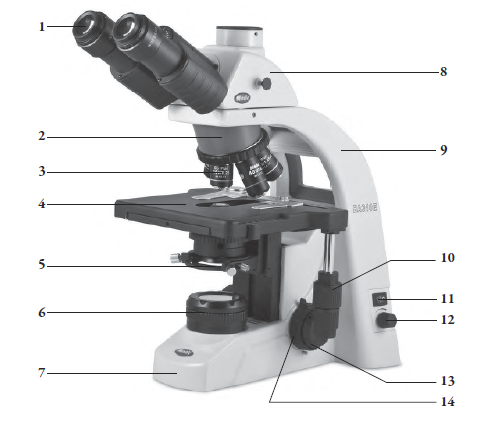
What is 5 on the diagram?
Condenser with iris diaphragm

What is 6 on the diagram?
Light source

What is 7 on the diagram?
Base
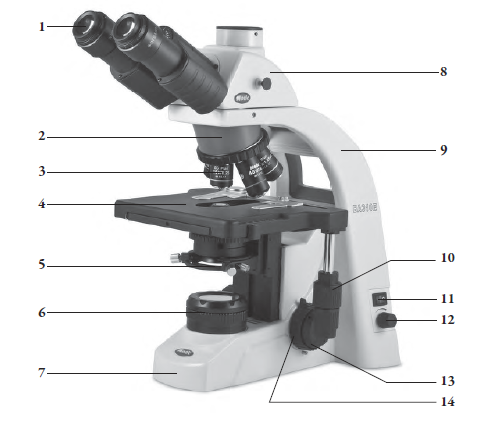
What is 8 on the diagram?
Observation tube

What is 9 on the diagram?
Stand (arm)
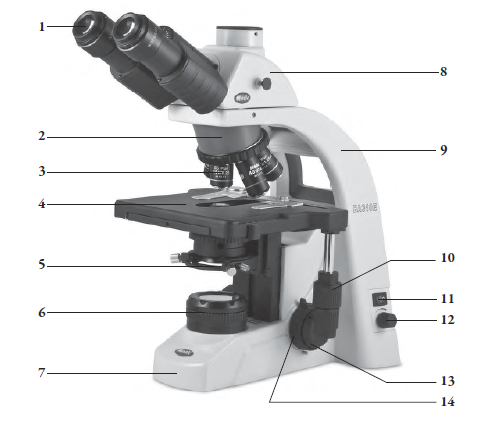
What is 10 on the diagram?
Mechanical stage

What is 11 on the diagram?
Power switch

What is 12 on the diagram?
Light intensity control

What is 13 on the diagram?
Fine adjustment (focus) knob

What is 14 on the diagram?
coarse adjustment (focus) knob
What shouldn’t you do when viewing a specimen using the 100X objective lens
Adjust stage using coarse focus knob
Which of the following materials should you use to clean the lenses on a microscope?
Kleenex
What specimen/sample will you not be examining during chapter 4 lab?
Diet soda
Which liquid will be used to make a wetmount of both specimens/samples (Elodea leaf and check cells) during chapter 4 lab?
Water
You should use the coarse adjustment (focus) knob when viewing specimens/samples with a higher objective lens (e. g. 100X).
False
Which objective lens(es) in chapter 4 lab was/were used with oil?
100X objective lens
As you increase the power of your objective lens (e.g. from 10X to 40X), your working distance (between the stage and objective increases.
False
If you measured a 1.7 mm diameter (of the field of view) using a 10X objective lens, what would be the calculated diameter using a 40X objective lens?
425,000 nm
Which structure(s) should you be able to see in the Elodea leaf specimen?
chloroplast, cytoplasm, cell wall
Which of the following is a white blood cell (leukocyte) that may have been seen in your blood smear slide?
neutrophils
The Leukemia blood sample had on average more white blood cells per field compared to a normal blood sample.
True
When using a serological pipette or graduated cylinder, which of the following is the correct way to read the measured volume?
At the bottom of the meniscus at eye level
Which of the following will not be done in Excel for lab 3?
Line graph
A p-value of > 0.05 means the difference between groups is statistically significant.
False
Which tasty beverage are we going to use this week in lab 3?
Soda pop
What is the molecular weight of aspartame (C14H18N2O5)?
294.3 g/mol
The molecular weight of sucrose will be use to calculate the molarity (M) of diet soda during lab 3.
False
What is the molecular weight of sucrose?
342.3 g/mol
What is the molecular weight of aspartame?
294.3 g/mol
Regular soda had less sweetener than diet soda
False
The error bars we created in the bar/column graph (using Excel during chapter 3 lab) represent which of the following?
Standard deviation
The calculated amount of g (grams) sweetener/mL should have been statistically different between diet and regular soda
True
Which of the following molecules was used to calculate the M (molarity) of diet soda during chapter 3 lab?
Aspartame
What is the basic unit of mass for the metric system?
Kilogram (kg)
Which of the following items/calculations will you not be using in lab for chapter 2?
Microsoft Excel for graphing
Which of the following would not make a 1 M solution of NaCl (58.5 g/mol = NaCl molecular mass)?
58.50 g NaCl dissolved in 0.5 L of solution
What is the concentration of OH- ([OH-]) for a solution at pH 6.0?
10^-8 M
How many uL (microliters) in 580 mL?
580,000
What is the molecular mass of AgC2H3O2?
166.9 g/mol
How many grams of NaCl are needed to prepare 200 mL of a 3.10 M solution?
36.3 g
How many grams of NaCl are needed to prepare 60 mL of a 19% solution?
11.4 g
How do you prepare 340 mL of a 4 M solution from a 20 M stock solution (i.e. how much stock solution do you need)?
0.068 L
How much water is needed to prepare 340 mL of a 4 M solution from a 20 M stock solution?
272 mL
what is a hypothesis
testable prediction about the relationship between two varibles
what is a purpose
what you’re trying to discover

what is the equation for working and stock problems
C1V1 = C2V2

what is the equation for % solution
g solute/ 100mL sol’n

what is the equation for molarity for “how much” or “what amount”
MoS = V x M x MM

what is the equation for molarity
M = MoS/ V x MM