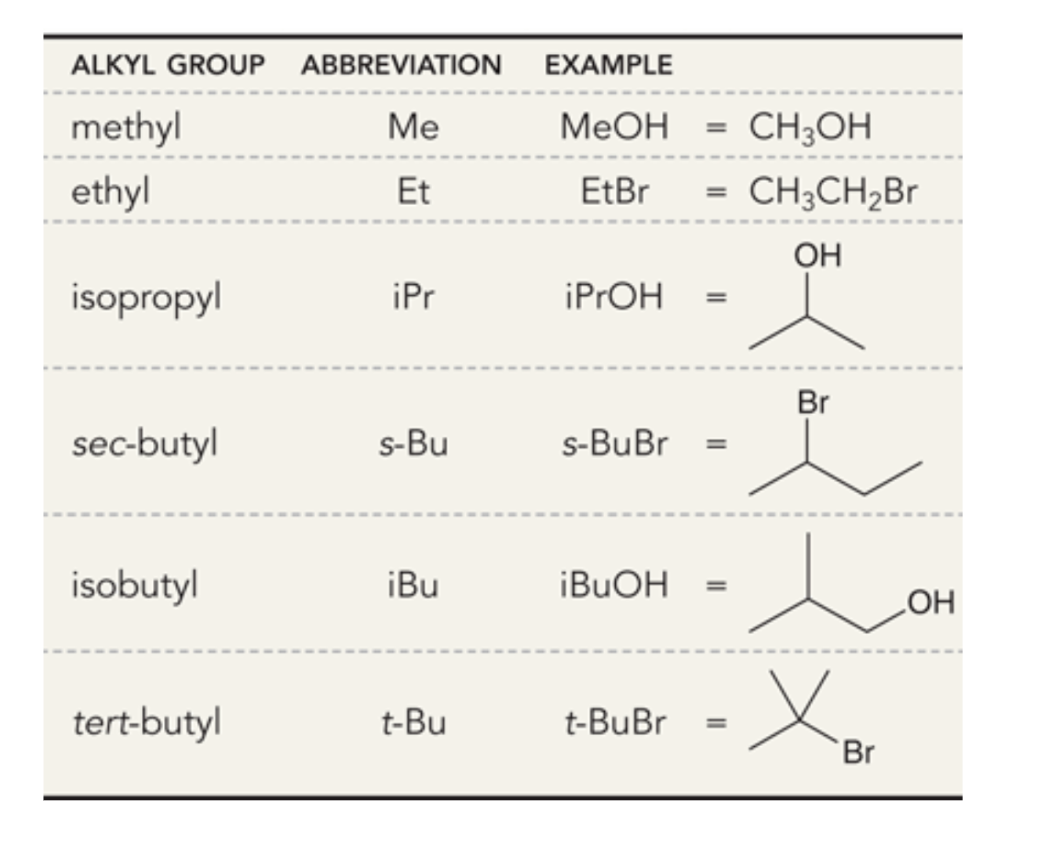
other prefixes+names of compounds
 Call Kai
 Learn
 Practice Test
 Spaced Repetition
 Match
 Flashcards
 Knowt Play
1/10

There's no tags or description
Looks like no tags are added yet.
11 Terms
sec
2
tert
3
iso
branch, end of branch
Alphabetical order
For complex substituent names, count cyclo-, iso-, and neo- when alphabetizing; do not count sec- or tert-.
isopropyl
Branched alkyl group with 3 C
1-methylethyl

sec-butyl
Branched alkyl group with 4 C
carbon on PC connected to 2 other C.
attachment carbon connected to 2 C → sec = secondary = 2°
1-methylpropyl

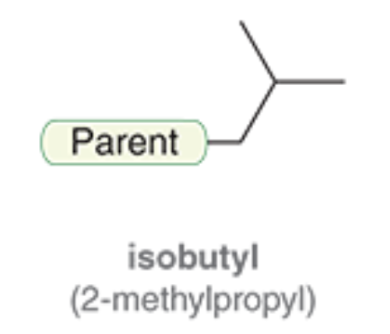
isobutyl
Branched alkyl group with 4 C
branches on 2nd C from PC.
attachment through CH₂, branch on C2 → iso = branch near the end
2-methylpropyl
tert-butyl
Branched alkyl group with 4 C
attachment carbon connected to 3 C → tert = tertiary = 3°
carbon on PC connected to 3 other C.
1,1-dimethylethyl

isopentyl
Branched alkyl group with 5 C
3-methylbutyl

neopentyl
Branched alkyl group with 5 C
2,2-dimethylpropyl

Examples of some with other functional groups
An alkyl group doesn't have to be attached to a parent chain (PC) in order to be called an alkyl group.
Some of these examples, the alkyl is not connected to carbon from PC.
An alkyl group is formed by removing one H from an alkane, leaving one available bond for attachment (why substituents are called alkyls, 1 H is removed to connect to PC’s carbon).
Methane: CH₄ → remove one H → methyl: CH₃–
Ethane: CH₃CH₃ → remove one H → ethyl: CH₃CH₂–