Flashcards Phylogenies & History of Life
 Call Kai
 Learn
 Practice Test
 Spaced Repetition
 Match
 Flashcards
 Knowt Play
1/50

There's no tags or description
Looks like no tags are added yet.
51 Terms
Phylogenetic trees
Tools for studying history
- How phylogenies are usually summarized
- Shows ancestor-descendant relationships among populations or species

Phylogeny
Evolutionary history of a group of organisms

Branch
Represents a population through time
Node/fork
Point where two branches diverge
- Ancestral species split into two or more descendant species
Tip/Terminal Node
Endpoint of a branch
- Represents a group (species or larger taxon) that is living today or ended in extinction
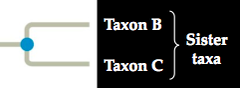
Sister Taxa
Groups that share an immediate common ancestor
Taxa
Groups of organisms classified due to shared characteristics
- Any named group of organisms at any level of a classification system

Outgroup
Species that is less closely related to the group being studied
- Closely related to taxa but not directly
Terms describing traits
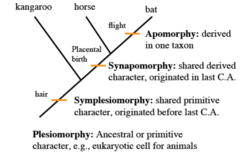
Synapomorphy
Autapomorphy
Symplesiomorphy
Synapomorphy
New traits inherited from a common ancestor and are not shared with other groups
- Originated in last common ancestor
- Allow biologists to recognize monophyletic groups or clades

Autapomorphy
New traits that are only in one lineage

Symplesiomorphy
Shared ancestral traits that are also shared with other organisms outside of the group
-Originated before last common ancestor
Parsimony
Simplest solution is most likely right
- Least amount of steps
Analogous Structures/ Homoplasy
Similar structures in organisms without shared ancestry
- Was the trait present in the last shared ancestor of the group?
Homology
Similarity due to shared ancestry
- Ex: Tetrapod body plans in bats, Fur in mammals
Cladistic
Classifying organisms by grouping them into clades
- Ancestor plus all if its descendants
- Focuses on synapomorphies (shared derived characters of the species under a study)
Ancestral trait
Characteristic that existed in an ancestor
Derived trait
Modified form of the ancestral trait, found in descendant
Homoplasy (analogous trait)
Occurs when traits are similar for reasons other than common ancestry
- Ex: powered flight in bats and birds, spots on salamanders and cheetahs
Convergent evolution
Occurs when natural selection favors similar solutions to the problems posed by a similar way of life
- causes homoplasy
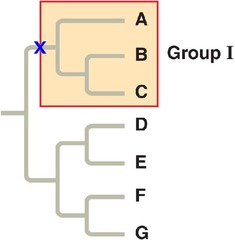
Monophyly
Evolutionary grouping that represents the true history of the species in the group
Paraphyletic
Includes common ancestor and some, but not all, the ancestors descendants
- Two snips

Polyphyletic
Does not include the common ancestor of the group

Monophyletic
Includes the common ancestor and all descendants of that ancestor
- One snip
Hox Gene (evidence for homology)
Hox genes of insects and vertebrates are derived from same ancestral sequences
- Groups of Hox genes are organized on chromosome in a similar way
- Products of gene have similar functions
- Hox genes share a 180-base-pair sequence called homeobox
Artiodactyls
- Hippos, cows, deer, pigs
- have hooves, number of toes, unusual shaped ankle bone
- Whales were not a part of the group, however closely related sequences in DNA suggest a close relationship between whales and hippos (share several SINE genes absent in other artiodactyl groups)
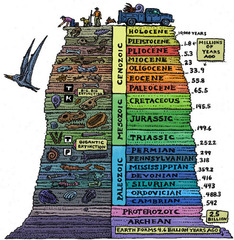
Fossil
Physical trace of an organism left from the past

Fossil Record
Total collection of fossils that have been found around the world
- Only direct evidence about what past organisms looked like/lived when they existed
- Preserves traces of organisms that lived in past
- Processed of fossilization begins when part of our organism is buried in ash, sand or mud
Main types of fossils
- Intact fossils
- Cast fossils
- Compression fossils
- Per mineralized fossils
Intact fossils
When decomposition does not occur
- Bogs
Compression fossils
When sediments accumulate on top of the material and compresses it into a thin film

Cast fossils
remains decompose after burial and dissolved minerals create a cast in the remaining hole
Permineralized fossils
Remains rot extremely slowly and dissolved minerals infiltrate the interior of the cells and harden into stone
Fossilization is rare
Fossilization only occurs under ideal conditions
- There are 10 specimens of the first bird to appear in the fossil record (archaeopteryx)
- 1 out of every 200,000,00 individuals fossilized
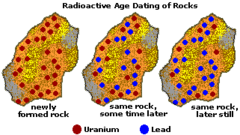
Radiometric dating
Allows researchers to assign absolute dates, expressed as years before the present to events in the fossil record
- Used for minerals and rocks
- unstable "parent" isotopes decay into stable "daughter" isotopes, scientists can determine the age of a sample by comparing the amounts of parent and daughter isotopes present
Changes in oceans and continents
Earths curst is broken into enormous plates that are in constant motion
- Movement of plates shifted extent and positions of continents overtime
- Major changes to climate
Mass Extinction
Rapid extinction of a large number of lineages scattered throughout the tree of life
- At least 60% of species present are wiped out within 1 million years
- Catastrophic events
- The Big Five
- Random with respect to fitness
- Function like genetic drift
- Sudden and temporary changes
Background Extinction
gradual process of a species becoming extinct
- normal loss of some species
- occurs when normal environment changes, emerging disease, competition reduced certain populations to zero
- Results from natural selection
Evidence for End-Cretaceous Mass Extinction Event
- Iridium present in high concentration in rocks formed 65 million years ago
- Shocked quartz
- Asteroid left a crater (Mexicos Yucatan peninsula)
Impact hypothesis for extinction of dinosaurs
- An asteroid struck earth 65 mya, resulting in the extinction of 60-80% of multicellular species alive
Adaptive Radiation
Rapid diversification of a single lineage into a variety of species
- each adapted to a different ecological niche
- driven by competition for resources or the opening of new habitats
Diversification after Cretaceous
Terrestrial ecosystems around the world were simplified diversity remained low for 4-8 million years
- Mammals diversified to fill niches left empty by extinction
- Within 10-15 million years all major mammalian orders living today had appeared
Cambrian Explosion
Bulk of new animal classes arose in about 24 million years
- O2 concentration
- Hox genes allowed for large phenotypic changes with few genetic changes

What caused Cambrian Adaptive Radiation
1) Higher oxygen levels
2) Rise of algae
3) Evolution of new body plans that allowed improved movement and sensory perception
4) Evolution of defensive structures and behaviors
5) New ecological niches
New body plans
- Chordata
- Bilateral body plan
- Cephalization and evolution of light sensing organisms
Evolution of defensive structures and behaviors
- Exoskeletons evolved and diversified into complex armature
- Priapulid worms evolved structural and behavioral adaptations allowing them to burrow into the sea
- Ex: Bite marks take out of trilobites
Modes of adaptive radiation
- Species interactions
- Colonization of a new space
- Open ecological niches (extinction leads to open ecological niches)
Hallmarks of adaptive radiation
- Monophyletic group
- Speciated rapidly
- Diversified ecologically into many niches
Open ecological niches
Cenozoic radiation of mammals (explosion of mammals after extinction of dinosaurs)
- Innovation = extinction of large reptiles
- Opportunity = available resources & niche space
Colonization of a new space
Devonian radiation of plants
- Innovation = seeds and vascular tissue
- Opportunity = colonization of terrestrial environment
Devonian radiation of insects
- Innovation = wings
- Opportunity = colonization of the air
Radiation of silverswords, fruit flies & honeycreepers
- Innovation = colonization of Hawaiian archipelago
- Opportunity = available resources and niche space
Species interactions
Cretaceous radiation of angiosperms
- Innovation = flowers
- Opportunity = mutualistic co-evolution with insects