Protein Sorting and Transport
 Call Kai
 Learn
Learn Practice Test
 Spaced Repetition
 Match
Match Flashcards
 Knowt Play
1/29

There's no tags or description
Looks like no tags are added yet.
Name | Mastery | Learn | Test | Matching | Spaced | Call with Kai | Chat |
|---|
No analytics yet
Send a link to your students to track their progress
30 Terms
Gene Expression
DNA→RNA→Protein
Transcription in nucleus
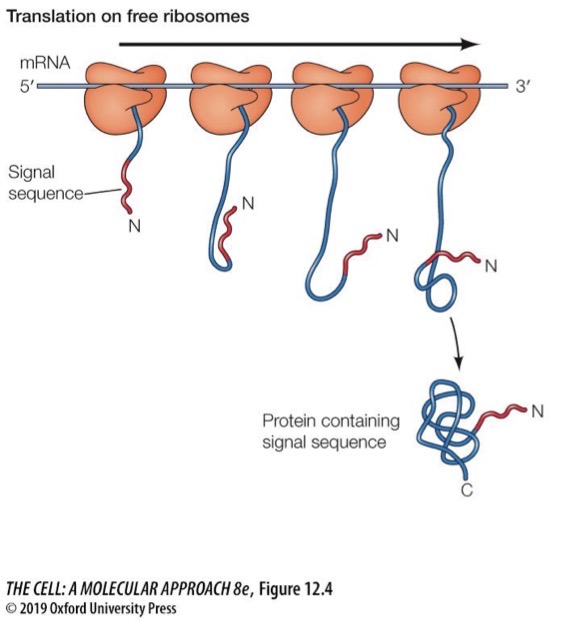
Translation on cytosolic ribosomes
ER receives translated proteins → folded/processed → transported to Golgi in vesicles → shipped to destination
Endoplasmic Reticulum
Rough ER- covered by ribosomes on cystosolic face for protein processing
Smooth ER- no ribosomes, functions in lipid metabolism
Cytosolic ribosomes
Binds to mRNA to form poly ribosome
Goes to nucleus, mitochondria, chloroplasts, peroxide meds, cytosol, peroxisomes
ER Ribosomes
Binds to mRNA to form poly ribosomes
Ribosomes dock to ER Membrane and incorporates into ER Vesicle → transports to Golgi, plasma membrane, nuclear membrane, peroxisome membrane, lysosomes, secretory vesicles

Secretory Proteins
Ribosomes targeted to go to rER - ERLS (on N terminus) attaches to Signal Recognition Particle (SRP) in cytosol and SRP Receptor in ER membrane —> Passes to Sec61/SecY translocon in membrane to enter ER —> bound for secretion
Chaperone Proteins (BiP)
Assists in correct folding into 3D conformation as the chain enters ER Lumen through translocon
Disulfide bonds
Proteins in rER meant for PM, lysosomes, and endosomes form disulfide bonds
Protein Disulfide Isomerase (PDI)
Oxidizing environment of rER uses this to form disulfide bonds for proteins meant for PM, lysosomes, and endosomes
Glycosylation
Most other proteins are converted to glycoproteins via glycosylating enzymes to
Protect from degradation
Keep in rER until folded
Serve as transport signal for vesicles
Serve as cell-cell recognition molecules (glycocalyx)
Oligosaccharyl transferase
Catalyzes oligosaccharide from monomers in glycosylation
Target aa (asparagine)
Dictates where oligosaccharide is added on protein
GPI Anchors
Anchors plasma membrane proteins. C Terminal sequence anchors in membrane and enzyme cleaves and attaches it to GPI anchor
ER Retention Signal
Ensures proteins meant to be in ER stay or escapees are returned
Proteosome
If folding/assembly of protein by chaperone protein fail, proteins are exported to cytosol for degradation by proteosome
Unfolded Protein Complex (UPR)
Misfolded proteins accumulate → UPR → Produces more ER/Chaperones or apoptosis
IRE1 Pathway/ ATF6 Pathway/ PERK Pathway
Sensor proteins that detect unfolded proteins to restore balance
Smooth ER
Lipids synthesizes on cytosolic membrane face of sER
Flippases catalyze transfer of lipids to other side of bilayer
Cholesterol and ceramide synthesis
Golgi Apparatus
Network of interconnected, membranous sacs
Receive/process/sort proteins
Synthesize glycolipids and sphingomyelin
N-linked Glycosylation → Glycoproteins
Modification of glycoproteins by N-linked oligosaccharide addition to N on asparagine and mannose removal in rER
Lysosomal Protein Glycosylation
Mannose proteins are phosphorylates and recognized by receptor in trans-Golgi → directs proteins to lysosomes
O-linked Glycosylation → Proteoglycans
Adding single sugars to oxygen of serine and threonine side chains to from proteoglycans → crucial to extracellular matrix
Proteoglycans → have GAG chains that are modified by sulfate groups
Lipid/Polysaccharide Metabolism
Ceramide and cholesterol made in sER are transported to Golgi to make sphingomyelin and glycolipids
Vesicular Transport
Vesicles bud off to travel to endosomes and lysosomes
Secretory granules mature to fuse with PM and release
Cytosolic Coat
Transport vesicles have coat that sheds once ready to fuse with designated organelle
Clathrin: mediates transport back and forth from trans-Golgi to destinations (endosomes,lysosomes,PM)
COPI: ER Golgi Intermediate Compartment to ER
COPII: ER → ERGIC → Golgi

Adaptins
GTPases recruit adaptins to donor membrane. Adaptor proteins trap cargo receptors and cargo molecules and assemble clathrin coat

Rab Proteins/Tethering Proteins
Transport vesicles must recognize target to unload cargo
Rab Proteins (on surface of vesicles) recognize tethering proteins (on target) → coat removed
V-SNAREs interact with t-SNAREs for membrane fusion
Lysosomes
Membrane-bound organelles that contain digestive enzymes to break down macromolecules
Mutations in enzymes can lead to lysosomal storage disease (gaucher disease)
Digestive enzymes are active at pH 5 maintained by active transport (ATP hydrolysis energy) proton pumps in lysosomal membrane
Role of Lysosomes
Digest materials ingested during endocytosis
Transport vesicles from trans-Golgi fuse with late endosomes → mature lysosomes
Ingested materials in endosomes hydrolyzed by lysosome → recycled or exocytosed
Autophagy
Gradual degradation of old cell components; stress response during starvation to rid of nonessential components
Old organelle or PM section enclosed by ER-derived membrane (autophagosome made) → lysosome fuses with autophagosome (phagolysosome made) → organelle broken down by enzymes