2B.3
 Call Kai
 Learn
 Practice Test
 Spaced Repetition
 Match
 Flashcards
 Knowt Play
1/5

There's no tags or description
Looks like no tags are added yet.
6 Terms
Describe structure of mononucleotide
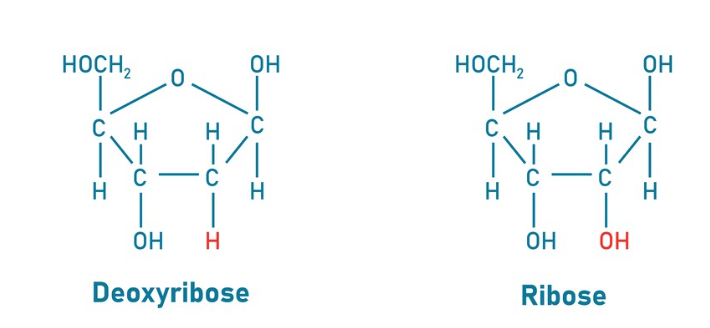
Deoxyribose or Ribose
Phosphate group attached to C5, and a nitrogenous base
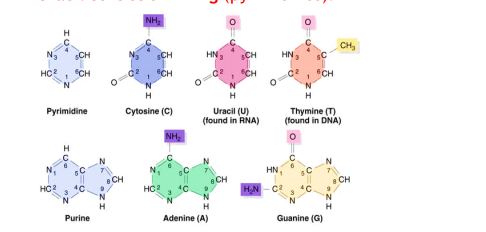
ADENINE CYSTOSINE THYMINE URACIL OR GUANINE ATTACHED TO C1.
(Thymine present in DNA uracil in RNA)

Describe the formation of polynucleotides
Many nucleotides linked together by condensation reaction to form strong covalent phosphiester bonds and sugar phosphate backbone
Draw a polunuctleotide

arrange the nitrogen bases into either pyramidine or purine
Pyramidine = 1 ring
Cytosine Thymine Uracil
Purine = 2 ring
Adenine Guanine
Describe the DNA molecule
Structure is double-helix
2 polynucleotides running anti-parallel arrangement so the complementary nitrogenous bases face each other and form hydrogen b
onds
Two strands held together by hydrogen bonds between the complementary nitrogenous base pairs
Adenine complementary to thymine A-T pair held by two hydrogen bonds
Cytosine complementary to guanine C-G pair held by 3 hydrogen bonds
Compare and contrast structure of DNA and RNA
DNA has deoxyribose sugar
RNA has Ribose sugar
DNA has thymine
RNA has Uracil
DNA double stranded
RNA single stranded
Both phosphodiester bonds and hydrogen bonds present in DNA while RNA only has phosphodiester bonds
3 Types of RNA mRNA tRNA and rRNA